You do not need to wait for a crisis, or a GP#
Many students who would benefit from therapy never ask for it. They assume it is for people with a diagnosis, that it needs a doctor's letter, or that the waiting list is years long. For the main NHS service in England, none of those assumptions is quite right.
NHS Talking Therapies, the service you may remember as IAPT (Improving Access to Psychological Therapies), treats common problems such as anxiety, low mood, depression, panic, phobias, obsessive thoughts and the effects of stress. In most areas you can refer yourself online or by phone. It is free. You do not need to explain yourself to a receptionist.
It also has a better record on waiting than its reputation suggests. According to NHS England figures, 88.7 per cent of referrals in January 2026 waited less than six weeks for a first appointment. Over 2024 to 2025, around 1.81 million people were referred, about 1.21 million started treatment, and roughly 670,000 finished a course. Just over half of those who finished, 50.5 per cent, moved to recovery, which met the national target.
There are caveats, and we will come to them. Wait times vary widely by area, and a first appointment is not the same as the start of full treatment. But the headline is useful: this is a real option, it is quicker than many people expect, and you can start it yourself.
The part that trips students up is geography. Where do you live, where is your GP, and which service should you contact? That is what most of this guide is about.
Background: what NHS Talking Therapies is, and what it is not#
What it is. A national network of local services, run by NHS trusts and sometimes partner organisations, that offers short, structured psychological treatments. The most common is cognitive behavioural therapy (CBT), which helps you spot the links between thoughts, feelings and behaviour and change patterns that are keeping you stuck. Others include counselling for depression, interpersonal therapy, guided self-help (working through a programme with a practitioner who checks in) and online courses. Many people get a mix.
Who it is for. Adults, normally 18 and over, with mild to moderate common mental health difficulties. NICE, the body that sets clinical guidelines for the NHS in England, recommends these therapies for depression and anxiety disorders, and they have a large evidence base.
What it is not. It is not an emergency service, and it is not designed for severe or complex conditions such as psychosis, severe eating disorders or active suicidal crisis. If that is your situation, your GP, NHS 111, a local crisis team or A&E are the right routes. If you are in immediate danger, call 999. Samaritans are available free on 116 123 at any hour.
It is also not the same as your university counselling service. They overlap, but they are separate, and some students use both.
Finally, the name "talking therapies" can mislead. Many people expect to lie on a sofa and discuss their childhood. In practice, NHS sessions are usually practical and goal focused. You may be asked to keep a diary, try a small experiment between sessions or practise a technique.
The big question: home address, term-time address or GP?#
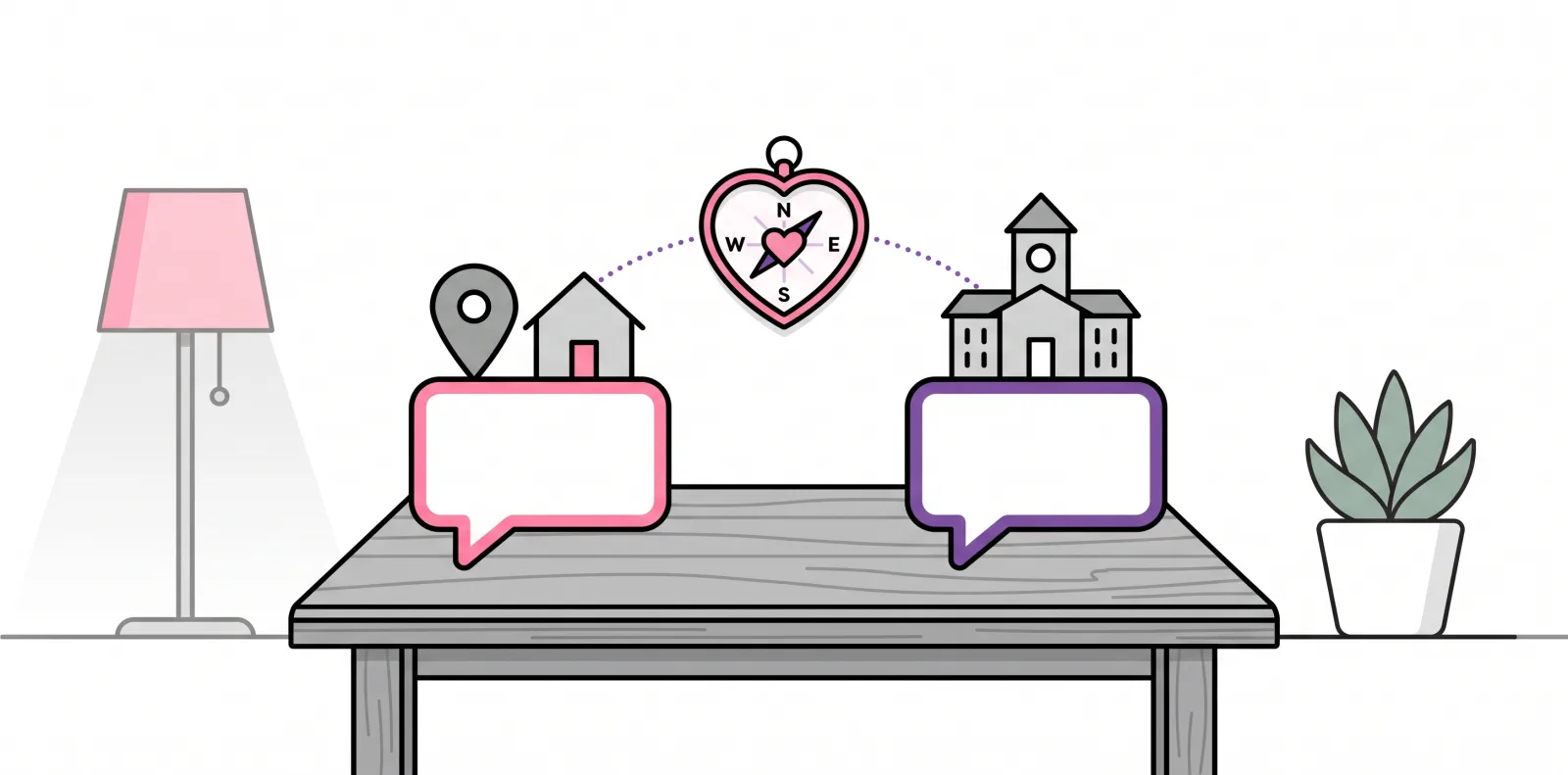
Talking Therapies services are organised by area. Each serves a local population, and the usual rule is that you can use the service covering where you live or where you are registered with a GP. The exact rule differs from one service to the next, which is why you will see conflicting advice online.
For students, this creates three plausible choices.
Option A: use your term-time address#
If you are living in halls or a shared house for most of the year, this is normally the most practical choice. You can attend appointments in person or by video, sessions fit around your timetable, and the service sits where your life actually is.
Many students register with a GP near their university for the same reason. NHS guidance generally recommends registering with a local practice when you start university, using your term-time address. Many universities have an on-campus or partner health centre for exactly this.
Option B: use your home address#
This can work if you are only away part of the year, or if you already have a therapist, a service or a GP at home. The main risk is a mismatch. If your appointments are weekly and in person, and you are 200 miles away from home from September to June, it will not work.
Video and phone sessions have changed this. Many services now offer them, so a home service might still be workable. Ask.
Option C: a mixture#
Some students are registered with a GP at home and live elsewhere. Some services will accept a self-referral based on where you live, some on where your GP is. Phone the service covering your term-time address and ask directly: "I live here during term but my GP is at home. Can I self-refer?" It takes five minutes and saves weeks.
The table sets out how the options compare.
| Situation | Likely best route | Why | What to check |
|---|---|---|---|
| Live in halls or a student house for most of the year | Term-time address service | Local, in-person or video sessions fit your timetable | Whether the service takes self-referrals without local GP registration |
| Registered with a GP at home, living away | Phone the term-time service first | Rules differ by area; many accept residents | Whether you can register as a temporary patient locally |
| Studying near home or living at home | Home service | No change of area, existing GP | Appointment times around your timetable |
| Moving between two addresses across the year | Choose where you spend most weeks | Continuity matters for a course of therapy | Whether the service offers video appointments |
| International student | Term-time service, after registering with a GP | You are entitled to NHS care if you have paid the Immigration Health Surcharge | Whether you have a GP and NHS number |
If a service says no, do not give up. Ask which service covers your area, or ask your university wellbeing team or a local GP surgery. They know the local pathways.
How to self-refer, step by step#
There is no single national form, but the process is broadly the same everywhere.
- Find your local service. On the NHS website, search for "NHS Talking Therapies" and enter your postcode. The page lists services covering that area and links to their self-referral forms or phone numbers.
- Check eligibility. Look for age (usually 18 or over), area rules and any exclusions listed on the service's page.
- Complete the form or call. Online forms usually take 10 to 20 minutes. You will be asked for your name, contact details, GP details, and some questions about how you have been feeling. You may fill in short questionnaires about low mood and anxiety. These are standard and are used to track your progress, not to judge you.
- Wait for contact. You are normally contacted within days or weeks for an assessment, which may be by phone or video.
- Attend the assessment. A practitioner asks about your difficulties, goals and any risks, and recommends a suitable treatment. This is a good time to mention what is practical for you, including your timetable and whether you want in-person or online sessions.
- Start treatment. This is typically weekly or fortnightly sessions over a few weeks, sometimes with a longer wait between assessment and the first therapy appointment.
If you do not have a GP, register with one first. Registration is free, and you can usually do it online in a few minutes using your term-time address. You do not need proof of address or immigration status to register, even though some practices ask. If someone refuses you, you can contact your local integrated care board for help.
What to expect in treatment#
Short-term, structured, practical. Here are the typical elements.
A first session that feels awkward. Almost everyone finds it awkward. The practitioner is used to it.
Homework. In CBT you might track your thoughts, plan activities or gradually face situations you have been avoiding. Treat it like practice for a sport. The sessions are the coaching, and the real change happens between them.
Measurement. You will fill in questionnaires most sessions. They show whether you are improving, and they help your therapist adjust the plan.
A defined end. Courses are usually a limited number of sessions, often six to twelve for common problems. Some people find that frustrating. The structure is a feature, because the evidence for time-limited therapy is strong.
Mixed results, honestly. About half of those who finish a course reach recovery, which is a good headline and also a reminder that the other half do not. Regional variation is large. NHS England data show recovery rates ranging from around 32 per cent to 57 per cent across local services. If the first approach does not help, tell your therapist. Switching to a different type of therapy or stepping up to more intensive care is normal.
When it does not fit, and what else is available#
Talking Therapies is not the answer for everyone. Consider other routes if:
- Your difficulties are complex or severe. Ask your GP about referral to a community mental health team.
- You need support right now. University wellbeing and counselling services often have shorter waits for a first conversation, and the NHS 111 mental health option can connect you to urgent help.
- You want a particular approach. Private therapy is expensive for most students, but some charities and training clinics offer reduced-cost counselling.
- You prefer peer support. Student Minds, Mind and Shout (text 85258) offer other kinds of support.
- Your problem is partly practical. A debt, a housing problem or an assessment deadline can cause or worsen distress. Money advice, extensions or mitigating circumstances can ease the load while therapy works on the rest.
It is also worth saying that therapy and university support can coexist. Telling your tutor that you are in treatment can help you get extensions or reasonable adjustments without disclosing details.
Common worries, answered gently#
"I am not ill enough." The service exists for common difficulties, and you do not need a crisis to qualify. Anxiety that is quietly ruining your term counts.
"I do not want it on my record." Your Talking Therapies records are part of your NHS record. They are confidential and are not shared with your university or employer without your consent, except in limited safeguarding situations. If this is a worry, ask the service how information is shared before you start.
"What if my therapist is not right for me?" You can ask for a change. Good therapists want you to say so.
"What if I move between terms?" Tell the service early. Some can continue sessions by video, and others will transfer your care.
Frequently asked questions#
Do I need a GP referral for NHS Talking Therapies? In most areas you do not. You can refer yourself online or by phone, though some services ask for your GP details. If you are not registered with a GP, register with one, as that helps with records and wider care.
Which address should I use if I live in halls but my GP is at home? Usually your term-time address, because that is where you will attend appointments. But rules vary, so phone the service covering your university area and ask. Some services accept residents regardless of their GP, and some do not.
How long will I wait for a first appointment? Nationally, 88.7 per cent of referrals in January 2026 waited under six weeks for a first appointment, but your local wait may be shorter or longer. The wait for ongoing treatment can be longer than for the initial assessment, so ask about both.
Is NHS Talking Therapies confidential? Yes, with limited exceptions where someone is at serious risk. Your information is not passed to your university or employer without your consent. If you are unsure, ask the practitioner at the start of your assessment.
What if I am under 18? Some services accept 16 and 17 year olds, but many do not. Children and young people's mental health services (CAMHS) or your GP can help. Check the service's age criteria on its website.
Can international students use NHS Talking Therapies? If you have paid the Immigration Health Surcharge and are registered with a GP, you are generally entitled to NHS care. Practice and service rules vary, so check with the service, and speak to the university's international student team if you hit a barrier.
What if therapy does not work for me? Tell your therapist. Treatment can be adjusted, changed to a different approach or stepped up to more intensive care. Not responding to one therapy is not a personal failure, and other options exist through your GP and the wider NHS.