
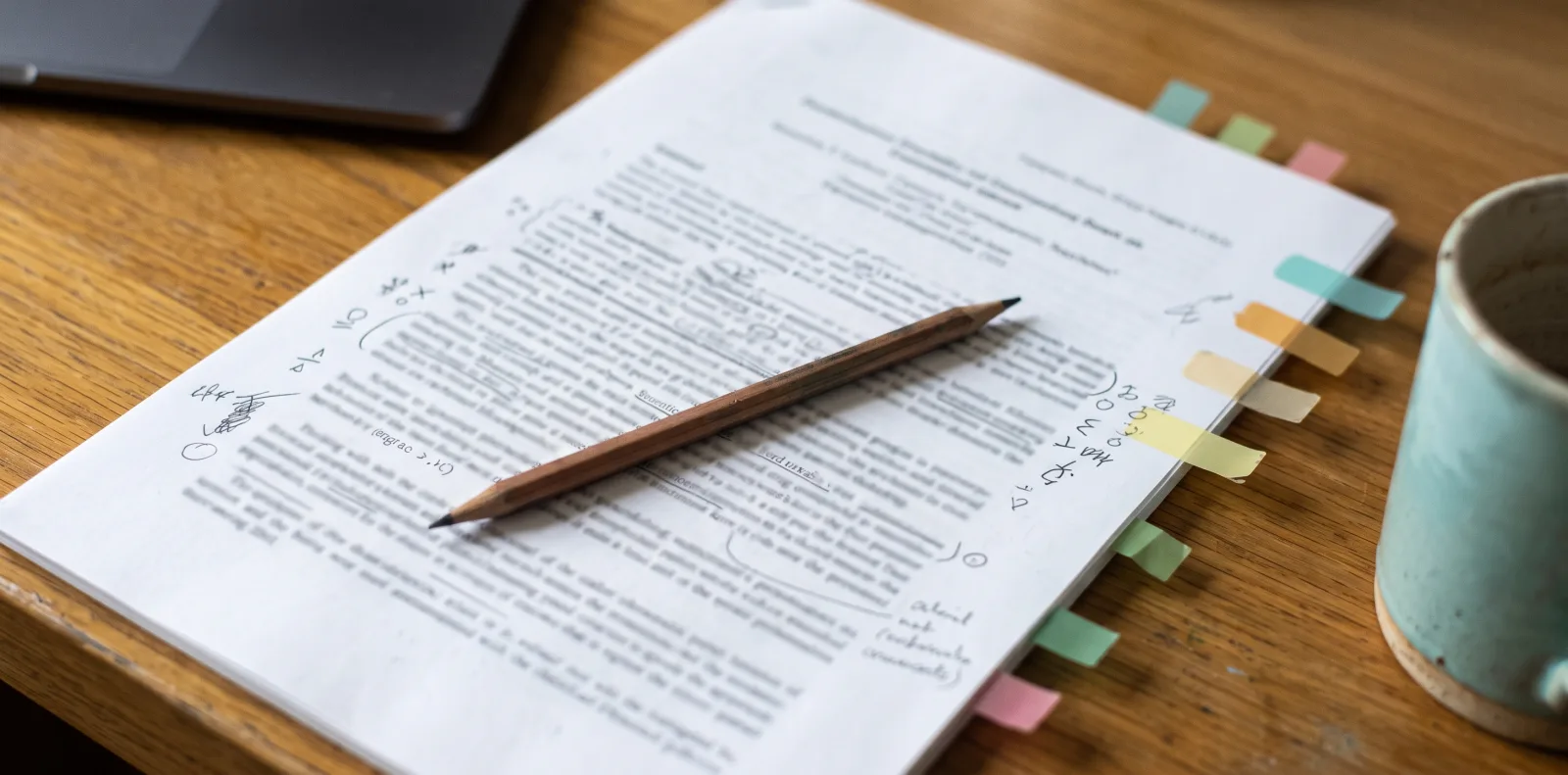
Nobody reads papers front to back, including the people who wrote them#
The first time you are told to read a journal article, you do what you have always done with text. Start at the top, read every word, slow down when it gets hard, and arrive at the methods section thoroughly defeated.
Academics do not read this way, and nobody tells undergraduates that. A working researcher with forty papers to get through this week reads most of them in five minutes, a handful in an hour, and perhaps two properly. The skill being taught is triage, not comprehension.
Once you know that, papers stop being an endurance test.
What a paper is made of, and what each part is for#
Most empirical papers follow a structure called IMRaD: Introduction, Methods, Results and Discussion, usually with an abstract at the front and references at the back.
The abstract is a compressed summary of the whole paper, typically 150 to 300 words. It is written to be findable and persuasive, which means it is the least reliable part of the document.
The introduction explains why the question matters and what is already known. It ends with the specific claim or hypothesis being tested.
The methods section says exactly what the researchers did: who they studied, how many, what they measured, how they analysed it. This is the part students skip and the part that decides whether the paper is worth anything.
The results report what was found, usually with tables and figures, without interpretation. In a well-written paper the results make no claims.
The discussion interprets the results, compares them with other work, and states limitations. It is where authors are most likely to overreach, because this is where they argue for significance.
A few terms that block people early. A preprint is a paper posted publicly before peer review, so it has not been checked by independent reviewers. Peer review means other researchers in the field assessed it before publication, which filters out some bad work and misses plenty. A p-value is the probability of seeing a result at least this extreme if there were genuinely no effect; by convention, below 0.05 is called statistically significant, a threshold that is arbitrary and widely criticised. A confidence interval gives a range of plausible values for the effect and is far more informative than a p-value. Effect size says how big the difference is, as opposed to how confident we are that there is one at all.
The three-pass method#
The most useful published approach comes from the computer scientist S. Keshav, who set out a three-pass method that has since spread well beyond computing.
The first pass takes five to ten minutes. Read the title, abstract, introduction, section headings and conclusion, and glance at the figures. Ignore everything else, including all the mathematics. At the end you should be able to say what the paper claims, what category of work it is, and whether you need to read it at all. Most papers stop here, and that is the point.
The second pass takes up to an hour. Read the whole paper but skip proofs and fine technical detail. Look hard at the figures and tables, because the real findings live there. Mark references you have not read. At the end you should be able to summarise the paper's argument, with evidence, to someone else.
The third pass is the slow one. Keshav's estimate is four to five hours for a beginner and around an hour for an experienced reader, and the aim is to reconstruct the work: to follow the reasoning as if you were the author, challenging each assumption. You do this only for papers central to your own work.
Read the methods before you read the results#
This is the single change that makes the biggest difference, and it is almost the opposite of what feels natural.
If you read the results first, you learn what the authors found, and everything after that is read through the lens of a finding you now half believe. If you read the methods first, you form your own view of what this study could possibly show, and then you check whether the results are consistent with that.
Four questions cover most of it.
Who was studied, and how many? A striking finding from 24 undergraduates is a hypothesis, not a fact.
What was actually measured? Papers routinely claim something about wellbeing and measure a four-item self-report questionnaire. That is not dishonest, but the gap between the concept and the measure is where a lot of overclaiming happens.
Was there a comparison group, and how were people assigned to it? Randomised assignment supports causal claims. Observational data supports association. A paper that collected observational data and writes its discussion in causal language is telling you something about the authors.
Was the analysis planned in advance? Pre-registration means the hypothesis and analysis were published before data collection, which makes the result much harder to massage.
How to read against a paper#
Reading critically does not mean disliking things. It means having specific questions rather than a general suspicion.
Check whether the conclusion in the abstract matches the finding in the results. Abstracts often round a modest effect up into a claim.
Look at the effect size, not just the p-value. With a large enough sample, trivial differences become statistically significant. A result can be real and too small to matter.
Read the limitations section properly. Authors know their own weak points better than you do, and they are required to name some. Then ask which limitation they did not mention.
Look at who funded the work and what the conflict of interest statement says. This is not a reason to dismiss a paper. It is a reason to read the methods more carefully.
Check whether the paper has been cited by anyone who disagrees. One contradicting paper often teaches you more about a field than three supporting ones.
Making it survivable when you have forty to get through#
For a literature review, read in layers rather than in order. Do the first pass on everything before doing the second pass on anything. You will discover that half your list is irrelevant, and you will discover it in an afternoon rather than a fortnight.
Take notes in your own words at the point of reading. A highlighted PDF is not a note, it is a promise to read it again later. One sentence per paper, in plain language, saying what it found and why you care, is worth more than a marked-up file.
Read the figures first on the second pass. In most quantitative papers, the figures carry the argument and the prose describes them.
And accept that some papers are badly written rather than too hard. Students routinely blame themselves for a paper that three reviewers should have sent back. If you have read the abstract three times and still cannot say what the claim is, that is often the paper's fault.
Reviews, meta-analyses and primary papers are different animals#
Knowing which kind of paper you are holding changes how you should read it.
A primary research paper reports a study the authors ran themselves. It is the raw material, and its conclusions apply to the specific sample, setting and measures described in the methods.
A review article summarises a field in narrative form. It is the fastest way into an unfamiliar topic, and it reflects the authors' view of what matters, which is simultaneously its value and its bias.
A systematic review follows a pre-specified search strategy, so which studies were included is reproducible rather than chosen. A meta-analysis goes further and combines results statistically into a pooled estimate.
For an essay or a dissertation introduction, start with a recent systematic review or meta-analysis, because it hands you the state of the evidence and a curated reading list at once. Then read the primary papers carrying the specific argument you want to make, since citing a review for a specific finding is a habit markers notice.
Frequently asked questions#
How long should reading one paper take? Five to ten minutes for most of them. The three-pass method is designed so that you only spend an hour on papers that survived the first pass, and four to five hours on the few you genuinely need to reconstruct.
Should I print papers or read on screen? Whichever you will annotate. Annotation is the active step, and it matters more than the medium. Reading a PDF without marking it up usually means reading it again.
What if I do not understand the statistics? Read the figures and the sample size, and treat the statistical detail as a black box on your first two passes. You can assess most of a paper's quality from its design without following the maths, and the maths becomes easier once you know what question it answers.
Is it acceptable to read only the abstract? For deciding whether to read further, yes. For citing the paper, no. Abstracts routinely overstate, and citing something you have not read is how errors propagate through a literature for decades.
Can I use AI to summarise papers? As a first-pass triage aid it can help, and as a way of asking what a term means it is genuinely useful. Two cautions: summaries flatten exactly the methodological detail that decides quality, and they are confidently wrong often enough that you should never cite from one without opening the paper.
What is the difference between a preprint and a published paper? A preprint has been posted publicly but not peer reviewed. It may be excellent or unpublishable. Peer review is a weak filter rather than a guarantee, so the difference matters less than people think, but it is worth stating when you cite one.
How do I find the important papers in a field? Start with a recent review article or meta-analysis, which summarises the field and hands you a reading list. Then look at what those papers cite repeatedly. Papers that keep reappearing across independent reference lists are usually the load-bearing ones.