Forty papers, two evenings, one seminar on Monday#
The reading list lands on Friday afternoon. Forty items, most of them PDFs with titles longer than this paragraph, due for discussion in Monday's seminar. You do the maths. Even at a generous ten minutes per paper, that is close to seven hours of continuous reading, and ten minutes barely covers the abstract of anything with a methods section.
This is the moment most students conclude they are bad at reading. They are not. They are trying to do something nobody actually does: read forty papers the way you would read a novel, start to finish, every sentence weighted equally. Working researchers do not read like that either. They triage.
Skimming, done properly, is not the lazy cousin of proper reading. It is a taught skill with a published literature behind it, and it is the only realistic way through a heavy reading list without burning out or faking it in seminar.
What a paper actually looks like once you know its shape#
Most empirical papers follow a structure called IMRaD: Introduction, Methods, Results, and Discussion, usually preceded by an abstract, a short standalone summary written last but printed first. Know this shape and you know where every kind of information lives, instead of hunting for it.
The introduction states the problem and what is already known. The methods section explains exactly how the study was done, in enough detail that someone else could repeat it. The results report what was found, mostly through tables and figures. The discussion interprets those results and admits their limits.
This structure exists because science writing is meant to be navigable, not suspenseful. Computer scientist Srinivasan Keshav made this explicit in a short 2007 paper, "How to Read a Paper," which proposed three passes of increasing depth rather than one exhaustive read. Science Careers writer Elisabeth Pain made a similar case a decade later, describing experienced researchers reading the abstract, jumping to the figures, and only then deciding whether the introduction and methods are worth their time. Skimming is not skipping. It is reading in the order that gets you the answer fastest.
A reading order that isn't start to finish#
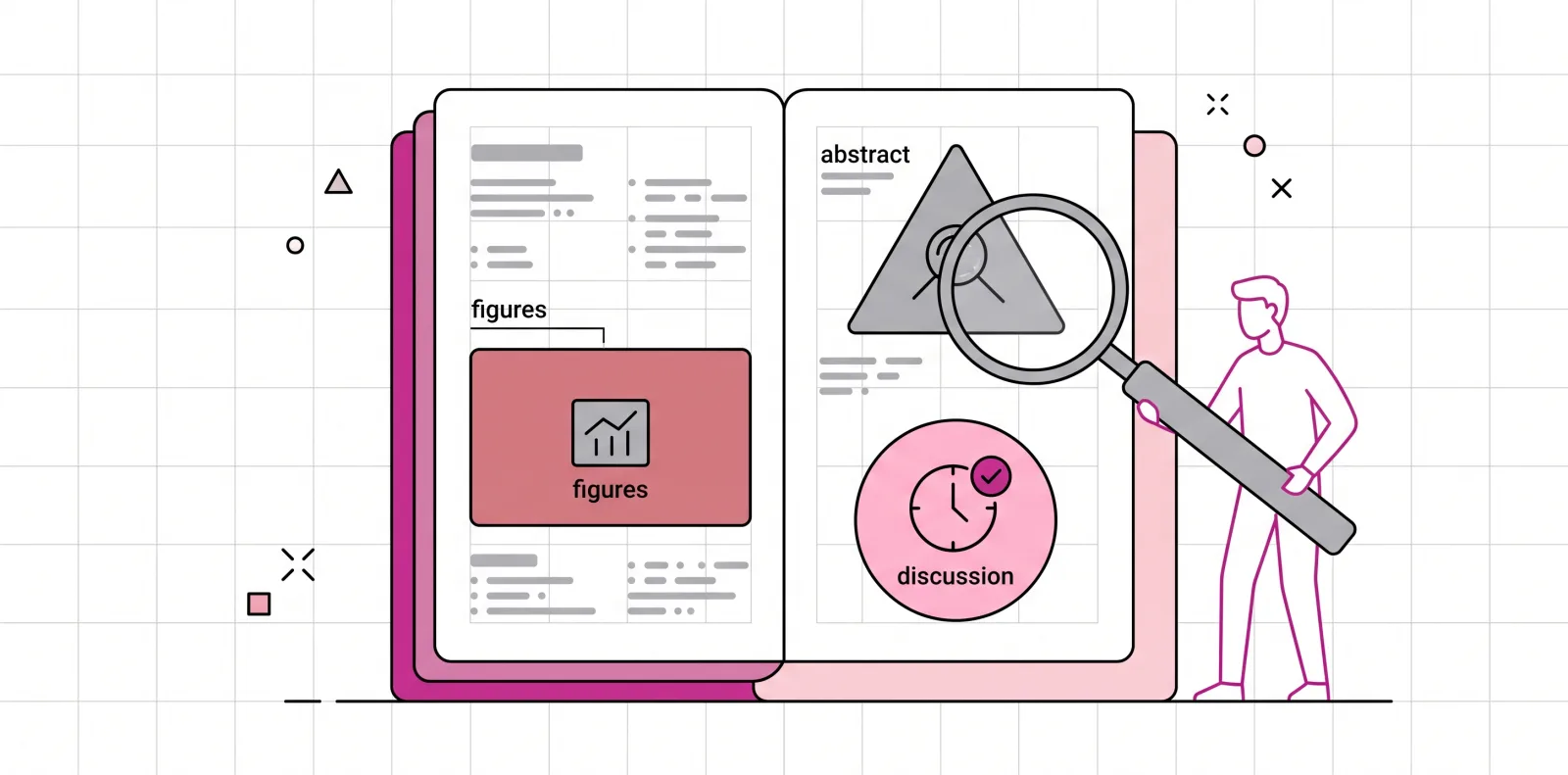
Reading a paper in the order it was printed suits the author, not you. The order that suits a reader with forty papers and two evenings looks more like this: title and abstract first, then figures and tables, then the discussion, and only then the introduction and methods, usually only for papers that survive that first pass.
| Section | What to look for | Question to ask | Rough time |
|---|---|---|---|
| Title and abstract | Claim, sample, method in one sentence each | Is this relevant to what I'm writing? | 1-2 min |
| Figures and tables | The actual result, before it is interpreted for you | What pattern is being shown here? | 2-3 min |
| Discussion/conclusion | The author's own interpretation and limits | Does their reading of the data match mine? | 2-3 min |
| Introduction | Prior work, gap being filled | What is this paper responding to? | 3-5 min |
| Methods | Design, sample size, how variables were measured | Can I trust this result, and can I reuse this method? | 5-10 min (only if needed) |
This is not a trick for cutting corners. It mirrors Keshav's first pass: five to ten minutes to decide whether a paper is relevant and worth a second look. Most of your forty papers will not survive past the figures stage, and that is triage working, not a failure of attention.
What an abstract tells you, and what it deliberately leaves out#
An abstract is a compressed argument, one paragraph doing the work of six. Read it for four things: the question asked, the method in broad strokes, the headline result, and the authors' own claim about what it means. Most abstracts follow roughly that order, so you can extract all four in under ninety seconds.
What an abstract cannot tell you is whether the method was sound. It summarises the sample, not its adequacy; the result, not its statistical robustness; the conclusion, not its competing interpretations. A paper can have a decisive-sounding abstract and a methods section riddled with caveats buried lower down. Treat the abstract as a filter for relevance, never a substitute for judgement on quality. If a paper is going into your dissertation's argument, it earns a second look, not a citation.
Let the figures do the talking before the prose does#
Figures and tables are where a paper's actual evidence lives, unmediated by the author's framing. A bar chart, a scatterplot, a regression table: these show the pattern the authors then spend several paragraphs interpreting for you. Read the figure first and you form your own read on the data before absorbing theirs.
This matters more than it sounds. Accounts of how experienced scientists read describe them moving straight to the visual evidence, then checking whether the text's interpretation matches what they saw. Look at the axis labels, work out what is being compared to what, and only then read the caption. If the figure and the prose tell noticeably different stories, that gap is often the most useful thing you take from the paper, and it is invisible if you read the words first.
Two habits make this pass sharper. First, check the sample size or n reported near the figure before you trust the pattern in it; a striking difference between two bars means very little if one of them rests on a handful of participants. Second, look for error bars, confidence intervals, or a p-value in the caption, and note whether the authors' language in the discussion matches how uncertain that number actually is. A caption that says "no significant difference" next to a chart with wide, overlapping error bars is telling you something the prose in the discussion will not spell out as plainly.
Deciding which papers earn a full close read#
Skimming has a genuine limit, and pretending otherwise is how weak arguments end up in dissertations. A close read, working through the full introduction, methods, and results in sequence, is still necessary when a paper sits at the centre of your own argument, when you intend to reuse or critique its method, or when a claim in it is doing heavy lifting for something you are about to write.
A useful rule: skim everything once. Close-read only the papers that are foundational, methodologically unusual, or directly contradicted by something else you have read. Everything else stays at skim depth permanently, cited for its headline finding and no more. This reflects how selective reading already works in expert practice: nobody with a functioning research career close-reads every paper they cite, and university library guidance on critical reading treats close reading as a targeted resource, not a default.
Notes that stop you rereading the same paper twice#
The biggest time sink in a heavy reading week is not reading a paper. It is reading it again three weeks later because your first pass left no usable trace. A one-line note taken while you skim beats a detailed note reconstructed from memory later.
A workable minimum, per paper: the claim in one sentence, the method in a phrase, one reservation, and one line on how it connects to something else on your list. Keep this in a single running document or a reference manager with notes fields, searchable by keyword, rather than scattered across margins and separate files. The format matters less than the consistency. A skimmed paper with four honest lines of notes beats a closely read paper you half-remember.
Common questions about skimming academic papers#
Is skimming actually a legitimate academic skill, or is it cutting corners?#
It is a documented, taught approach. Keshav's three-pass method and similar guidance from university academic skills services exist precisely because exhaustive reading of every source does not scale, even for people paid to do research full time.
How do I know when to stop skimming and read a paper properly?#
When it is central to your argument, when you plan to use or critique its method, or when it contradicts something else you have read. Anything narrower than that can usually stay at abstract-and-figures depth.
What if I skim a paper and completely misread its conclusion?#
This is the real risk of skimming, and it is why the figures-then-discussion order matters: checking the authors' own interpretation against the data catches most misreadings before they end up in your writing.
Should I read the methods section if I am not doing quantitative research myself?#
Skim it for the sample and general approach even so. It tells you how much weight the result can bear, which affects how confidently you can cite it, regardless of your own methodology.
Is it fine to rely on an abstract alone for a literature review?#
Only for context-setting citations that are not doing argumentative work. Anything you are using to support a specific claim needs at least the figures and discussion checked against the abstract's summary.
How many of the 40 papers should actually get a full close read?#
There is no fixed ratio, but in practice it is usually a small minority, often the handful that are genuinely foundational or that your own argument leans on directly.
Does skimming work for humanities texts as well as scientific papers?#
Less cleanly. Humanities arguments often build cumulatively across a whole text rather than isolating a result in a figure, so the abstract-and-figures shortcut is weaker; a structured close read of the introduction and conclusion, with the middle sampled, tends to work better there.
Will using AI summarisers instead of skimming get me the same result?#
A summary tool can compress a paper's stated claims, but it cannot flag the gap between a figure and its interpretation, and it will confidently repeat a weak paper's conclusions with the same tone as a strong one. Treat it as a supplement to your own figures-first pass, not a replacement.
How is skimming a systematic review or meta-analysis different from skimming a single study?#
Go straight to the flow diagram showing how many studies were screened and included, and the forest plot if there is one. Those two elements tell you the scope of the evidence and the overall direction of effect faster than the abstract does. The discussion of heterogeneity between studies matters more here than in a single-study paper, since it tells you how much the included studies actually agreed.