
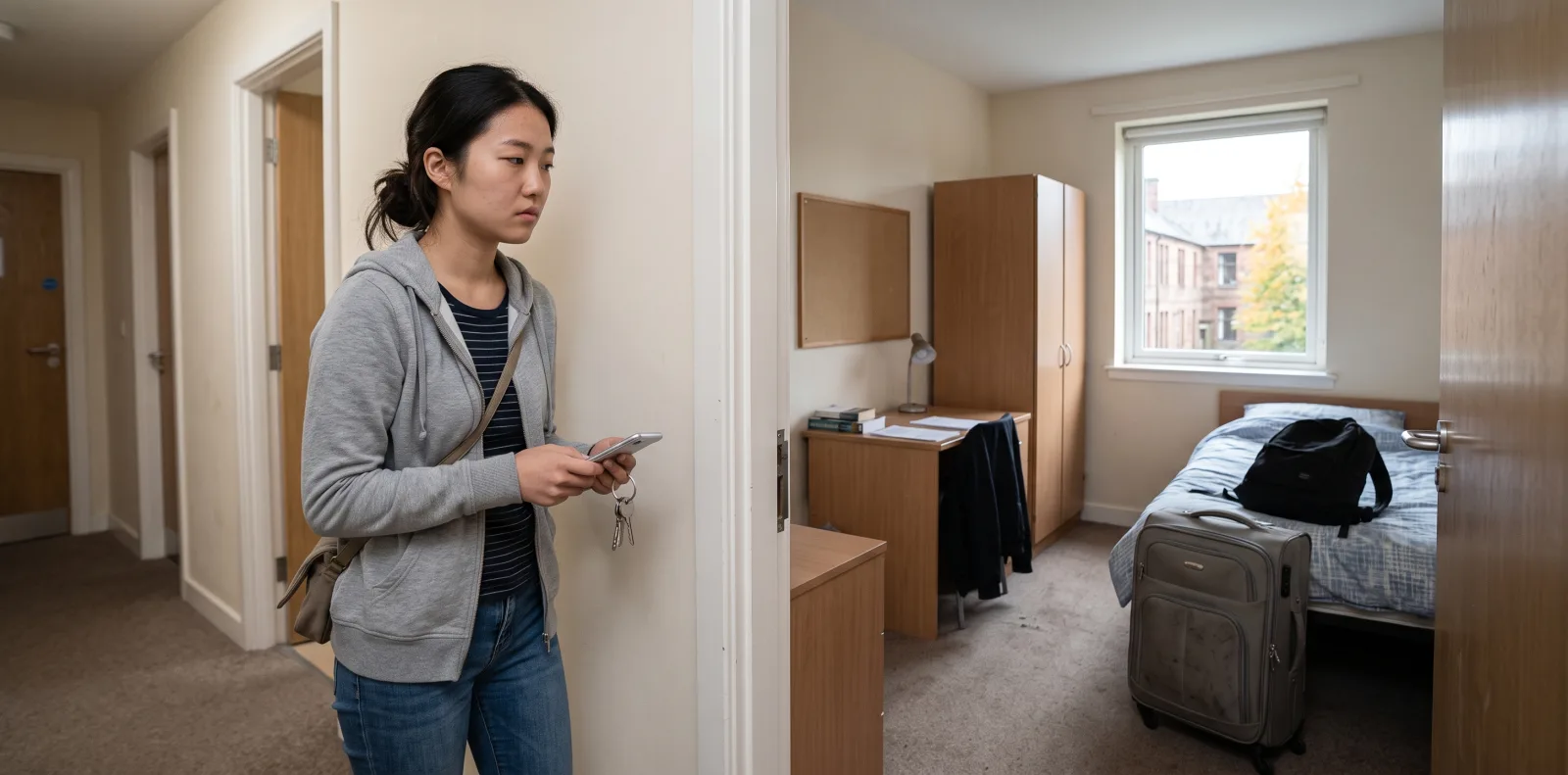
Nobody warns you that the first month is a queueing problem#
You land, you find the halls, you sleep badly, and then a month disappears into small pieces of administration that nobody mentioned in the offer letter.
The tasks themselves are not hard. What makes them hard is that they are chained. You cannot open most bank accounts without proof of address. You cannot get proof of address from your university until you have enrolled. You cannot enrol without your documents in the right format. Do these in the wrong order and a two-day job becomes a three-week one, usually in the same weeks your reading list starts.
So this is the sequence, and the reasoning behind it.
What the first 30 days actually contains#
The month splits into three kinds of task, and knowing which is which tells you what can wait.
Compliance tasks are conditions of your visa. Enrolling with your university is the main one, because your university is your visa sponsor and has a legal duty to confirm you turned up. Miss the enrolment window without telling anyone and your sponsorship can be withdrawn, which ends your permission to be in the country. This is not administrative fussiness. It is the one deadline in the month that carries real consequences.
Unlocking tasks are the ones other things depend on. A UK phone number, a document showing your address, and a working UKVI account with a share code all sit here. A share code is a temporary code you generate from your online immigration account to prove your status to a university, employer or landlord without handing over your login. Generate one before you fly, because airlines sometimes ask for it at check-in.
Quality of life tasks improve your month but block nothing. Registering with a GP, sorting a railcard, finding the good supermarket.
The mistake is treating all three as equally urgent on day one, which is how people end up queueing for a bank at 9am on the morning their enrolment slot was booked.
Days one and two: the two unglamorous things that unblock everything#
Get a UK mobile number before anything else. Almost every service you are about to use sends a verification code by SMS, and international roaming charges make that expensive and unreliable. Pay-as-you-go SIMs are available at the airport and in any supermarket, and you can move to a monthly plan later once you have a bank account. A UK number costs a few pounds and saves a fortnight of friction.
Then find out what counts as your proof of address. If you are in university halls, your accommodation contract or welcome letter usually does. If you are in a private flat, your tenancy agreement does. If you have neither yet, your university can issue a student status letter once you enrol, which most banks accept.
Sleep at reasonable hours from the first night. Jet lag that turns into a nocturnal fortnight is the single most common reason students miss enrolment slots and induction sessions.
Enrolment is a visa condition, not just paperwork#
Enrolment, sometimes called registration or matriculation, is the process of formally becoming a student. Most universities run it online first and then in person, with a document check where staff see your passport and confirm your immigration status.
Bring your passport, your CAS reference, your offer letter, and either a printed share code or the ability to generate one on the spot. Share codes expire, typically after 90 days, so generate a fresh one rather than relying on the one you made in July.
Do not miss the window. Your university reports enrolment to the Home Office as part of its sponsor duties. If you are going to arrive late because of a delayed visa or a flight problem, email the international office before the deadline, not after. Universities deal with this constantly and can usually authorise a late start. Silence is what causes problems.
Once enrolled, request two documents immediately: a student status letter, and a council tax exemption certificate. Both are free, both are usually available from the student portal, and both are needed later.
The bank account problem, and three ways round it#
UK banks want proof of identity and proof of address. New arrivals have the first and not the second, which is the deadlock.
The straightforward route is to enrol, get the student status letter with your UK address on it, then book an in-branch appointment. Bring your passport, your eVisa share code, the letter, and your university acceptance. Branch appointments in university cities fill up fast in late September, so book on the day you enrol.
The faster route is a digital bank. Several app-based UK banks open accounts from a phone with a passport scan and a selfie, sometimes within a day, and give you a working account number and sortcode. That is enough to receive wages, pay rent, and set up direct debits. Some traditional banks also run international student accounts designed exactly for this situation.
The safety net is having enough money accessible without a UK account for the first fortnight. A multi-currency travel card or an international transfer service will cover rent and food while the paperwork settles. Carrying large amounts of cash is not a plan.
One warning worth repeating. Your account will be targeted by money mule recruitment, usually presented as easy money for letting someone transfer funds through your account. Doing it is a criminal offence, it gets you frozen out of UK banking for years, and it can end your visa. If an offer involves receiving money and passing it on, it is that.
Register with a GP before you actually need one#
A GP is a general practitioner, the community doctor who is the entry point to almost all NHS care. You do not pay per appointment. Because you paid the Immigration Health Surcharge with your visa, you access the NHS on broadly the same terms as a UK resident.
Register in your first fortnight, while you are well. Registration is usually an online form on the surgery's website, and you will need your passport, your student ID or proof of enrolment, and your address. Some practices ask for a share code.
The reason to do it early is simple: when you are ill with a fever at 11pm in week seven, you want to already be on a patient list rather than filling in forms. Universities often have a practice on campus or a designated local surgery, and the student services page will name it.
Bring a copy of any regular prescription and its generic drug name, because brand names differ between countries. If you take medication regularly, book a GP appointment as soon as you are registered rather than waiting until you run out.
Money admin: National Insurance, council tax, and the 20-hour ceiling#
A National Insurance number is the reference used for tax and social security. You apply online through GOV.UK, and some applicants are asked to verify their identity. It can take several weeks.
You do not need the number before you start working. You can begin a job without it as long as you can prove your right to work with a share code, and your employer will use an emergency tax code until the number arrives. Apply once you have a UK address and a bank account, so around week two or three.
Council tax is a local charge on households. Full-time students are exempt, but the exemption is not automatic. You have to send your council tax exemption certificate to the local authority, and in shared housing every occupant's status matters. If you live in halls, this is usually handled for you. If you live in a private house with other students, one person sending everyone's certificates in during week one prevents a bill arriving in November.
Finally, the work limit. During term time, degree-level Student visa holders can work 20 hours a week. The Home Office counts each Monday to Sunday week separately and does not allow averaging, so a 26-hour week followed by a 14-hour week is a breach even though the average is fine. Keep your own record of hours. Employers make mistakes, and the consequence lands on your visa, not theirs.
Frequently asked questions#
What documents should I carry in my hand luggage? Passport with your entry vignette, CAS reference, offer or acceptance letter, accommodation confirmation, proof of funds, and any medical documents or prescriptions. Never put these in checked baggage.
Do I need to register with the police? No. Police registration was abolished in 2022 and no longer applies to any Student visa holder.
How do I prove my immigration status without a BRP card? Through your UKVI account, which holds your eVisa. You generate a share code in the view and prove section, and give that code to whoever needs it. Codes expire, so generate a new one for each request.
Can I open a bank account before I arrive? Some international banks let you start the process from your home country, and a few app-based UK banks open accounts shortly after arrival. Most high street banks require a UK address, which means enrolling first.
How long does a National Insurance number take? Applications are online and can take several weeks, sometimes longer at the start of the academic year. You can legally work while waiting.
Is healthcare really free? GP appointments, hospital treatment and emergency care are covered by the surcharge you already paid. Dentistry, optical care and prescriptions in England carry charges, though students on low incomes can apply for help with those costs.
What if my accommodation falls through when I arrive? Contact your university accommodation office the same day. Most have emergency short-term provision during arrival weeks, and the students' union usually keeps a list of vetted local options. Do not sign a private tenancy under time pressure without reading it.
Why does week four feel worse than week one? Because the novelty has worn off and the term has started properly. The dip around the fourth week is well documented and close to universal among students who have moved country. It is not a sign you chose wrong. University counselling services and international student advisers expect it and exist for exactly this.