The system you argue about online is not the variable that matters#
There is a genre of internet content in which someone explains that their note-taking system changed everything. The system is always different and the claim is always identical, which should make you suspicious.
The research on note-taking is less exciting and more useful. What consistently predicts whether notes help is not their format but whether you go back and do something effortful with them. Notes you reread are close to worthless. Notes you use to test yourself are among the most valuable study material you own.
That does not mean all systems are equal for all tasks. It means you should pick by task rather than by ideology, which is what this piece is for.
What the three systems actually are#
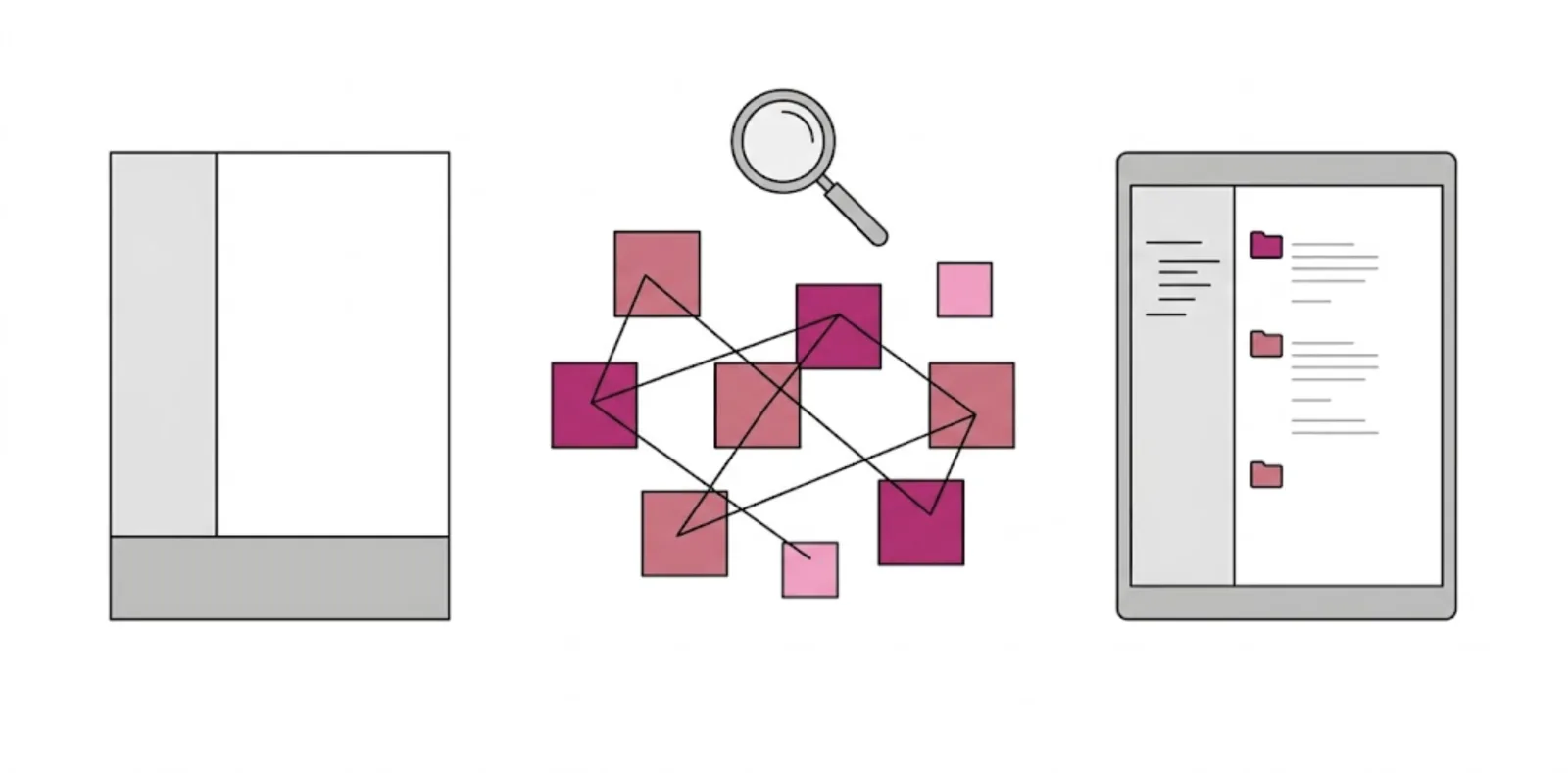
Cornell notes were developed at Cornell University in the 1950s. You divide the page into three zones: a wide right-hand column for notes taken during the lecture, a narrow left-hand column for questions and cues added afterwards, and a strip along the bottom for a summary written from memory. The format is not the point. The point is the review step, which forces you to convert what you heard into questions you must answer.
Zettelkasten, German for slip box, is the method associated with the sociologist Niklas Luhmann, who produced an enormous body of work using a physical card index. Each idea gets its own card in your own words, each card gets an identifier, and cards link to other cards. There is no folder hierarchy. Meaning comes from the connections between notes rather than from where they sit.
Digital notes covers everything from a Google Doc to Obsidian, Notion, Logseq or Apple Notes. Some of these apps implement Zettelkasten-style linking. Most people use them as searchable buckets, which is a legitimate use even if it annoys the enthusiasts.
Nothing about the three is mutually exclusive. Plenty of people take Cornell-style notes in lectures and keep a linked digital system for their dissertation reading.
The laptop versus longhand question, and what the replication found#
You have almost certainly heard the claim that handwriting notes beats typing them. It comes from a 2014 study by Pam Mueller and Daniel Oppenheimer, which found that students typing notes tended to transcribe verbatim while handwriters had to summarise, and that the summarising produced better conceptual understanding.
It became one of the most cited findings in education, and it did not hold up cleanly. In 2019, Morehead, Dunlosky and Rawson ran a direct replication using the same materials and methods, and extended it with eWriter and no-notes groups. Performance did not consistently differ between conditions, and a meta-analysis of the results showed small effects favouring longhand that were not statistically significant. Differences shrank further once students studied their notes.
The honest summary is that the medium is a weak variable and the processing is a strong one. If typing makes you transcribe mindlessly, typing hurts. If you can type while paraphrasing, typing is fine and much faster. If handwriting slows you into thinking, handwriting helps, and if it just makes you fall behind, it does not.
This is worth stating plainly because the longhand claim is still repeated confidently in study advice, usually without the replication attached.
Cornell is a review system disguised as a page layout#
Most people who say they use Cornell notes have only adopted the columns. They rule the page, take notes in the big column, and never fill in the cue column or the summary. That is not Cornell. That is a narrower page.
The cue column exists so that you can cover the notes and answer your own questions, which is practice testing in physical form. The summary exists to force one act of retrieval and compression while the lecture is still fresh.
Used properly, Cornell is one of the cheapest ways to build retrieval into a note-taking habit, because the testing infrastructure is already sitting on the page. It works best for lecture-heavy, content-dense modules where the material arrives faster than you can think about it.
It works badly for reading-heavy humanities work, where ideas cut across sources and the linear page fights you.
Zettelkasten is for building arguments, not for passing exams#
Zettelkasten is designed for a specific problem: you read widely over years and need to find non-obvious connections between things you read at different times.
That is a dissertation problem, a thesis problem or a writing problem. It is not a second-year exam problem.
The core discipline, writing each idea in your own words as a standalone note, is genuinely valuable because it forces the kind of elaboration the research rates as moderately useful. The linking is what makes it distinctive: you discover that a point from a methods paper connects to something you read about policy eighteen months ago.
The failure mode is well documented by its own practitioners. People spend more time maintaining the slip box than writing anything from it, and the collection becomes a hobby. If you are an undergraduate with modular exams, the overhead is very unlikely to pay back before you graduate. If you are writing a dissertation or a PhD, it might be the best time investment you make.
Digital notes: the honest case for and against#
Search is the real argument for digital. Finding a half-remembered point from October in a paper notebook means flicking through a notebook. Finding it in a digital system takes three seconds. For any project spanning more than one term, this matters enormously.
Digital also wins on backup, on sharing, on having your notes with you, and on handling images, code and links.
The costs are also real. Typing invites transcription, which is the mechanism behind the original longhand claim even if the effect is smaller than advertised. A laptop in a lecture is a portal to everything else. And app-switching is a genuine time sink: people who move between note apps every few months usually have less usable material than people who stuck with a worse app for three years.
Two practical rules. Pick a tool that exports plain text or markdown, so that your notes survive the app. And separate capture from organisation: get things down fast during the lecture, tidy later, rather than trying to build a perfect structure in real time.
How to pick, in one paragraph#
For lectures in content-heavy modules, use Cornell, on paper or in any app, and actually fill in the cue column. For reading across many sources towards a dissertation, use linked notes in your own words, whether or not you call it Zettelkasten. For everything else, use whatever you will keep using, and spend the energy you saved on testing yourself instead. The system is a delivery mechanism for retrieval practice. If retrieval is not happening, the system is decorative.
A workflow that uses all three without the overhead#
The systems are not rivals, and the most workable setup borrows from each at the point where it actually earns its keep.
During the lecture, capture fast in whatever is quickest for you, without trying to organise anything. The aim is to get the content down and to mark the places you did not follow.
Within a day, do the Cornell step. Add questions in the margin, write a three-line summary from memory, and flag the gaps. Ten minutes per lecture, and it holds almost all the value, because it is the only point at which you retrieve rather than record.
Weekly, move anything that connects across modules or sources into a linked note in your own words, which is the Zettelkasten habit without the ceremony. For most undergraduates that means a handful of notes a term rather than a hundred.
Before exams, work from the questions you wrote, not from the notes themselves. Any margin question you cannot answer without looking is your revision list.
The whole routine costs about fifteen minutes per lecture beyond attending it, and it replaces the far larger block of time most students spend rereading in May.
Frequently asked questions#
Is handwriting really better than typing? The evidence is much weaker than the popular claim suggests. The original 2014 finding did not replicate cleanly in 2019, and differences were small and inconsistent. What matters is whether you paraphrase rather than transcribe.
Do I need to learn Zettelkasten properly? Only if you are doing extended research writing. For modular undergraduate exams, the maintenance cost is unlikely to repay itself. The habit worth stealing regardless is writing each idea in your own words.
Which app should I use? The one you will still be using in a year. Prefer tools that export markdown or plain text so your notes are not hostage to a subscription. Switching apps repeatedly costs more than any feature gains.
Should I take notes in lectures at all if slides are posted? Yes, but change what you write. If the content is already on the slide, spend your attention on questions, objections and connections instead of copying. Those are the things the slides will never contain.
Are AI summaries of lectures useful? As a safety net for a lecture you missed, yes. As a substitute for your own notes, no. The summarising is where the learning happens, so outsourcing it removes the benefit and leaves you with a document you have never thought about.
How often should I review my notes? Spaced rather than massed. A short review the same day, another within the week, then at widening intervals. Distributed practice is one of only two techniques rated high utility in the Dunlosky review, and it costs very little.
My notes are a mess and it is already week six. Start again? No. Starting again is the most common form of productive procrastination in this area. Add a cue column and a weekly self-test to what you already have, and leave the archaeology until the holidays.