

The loan arrives in one lump, and it is smaller than you think#
Undergraduate finance in the UK is generous by international standards and almost entirely automatic. You apply, the tuition goes straight to the university, and a maintenance loan lands in your account three times a year.
Postgraduate finance is not that. There is one loan, it is not split between fees and living, nobody pays the university for you, and household income makes no difference at all. You get a single sum, you decide what to do with it, and if it does not stretch, that is your problem to solve.
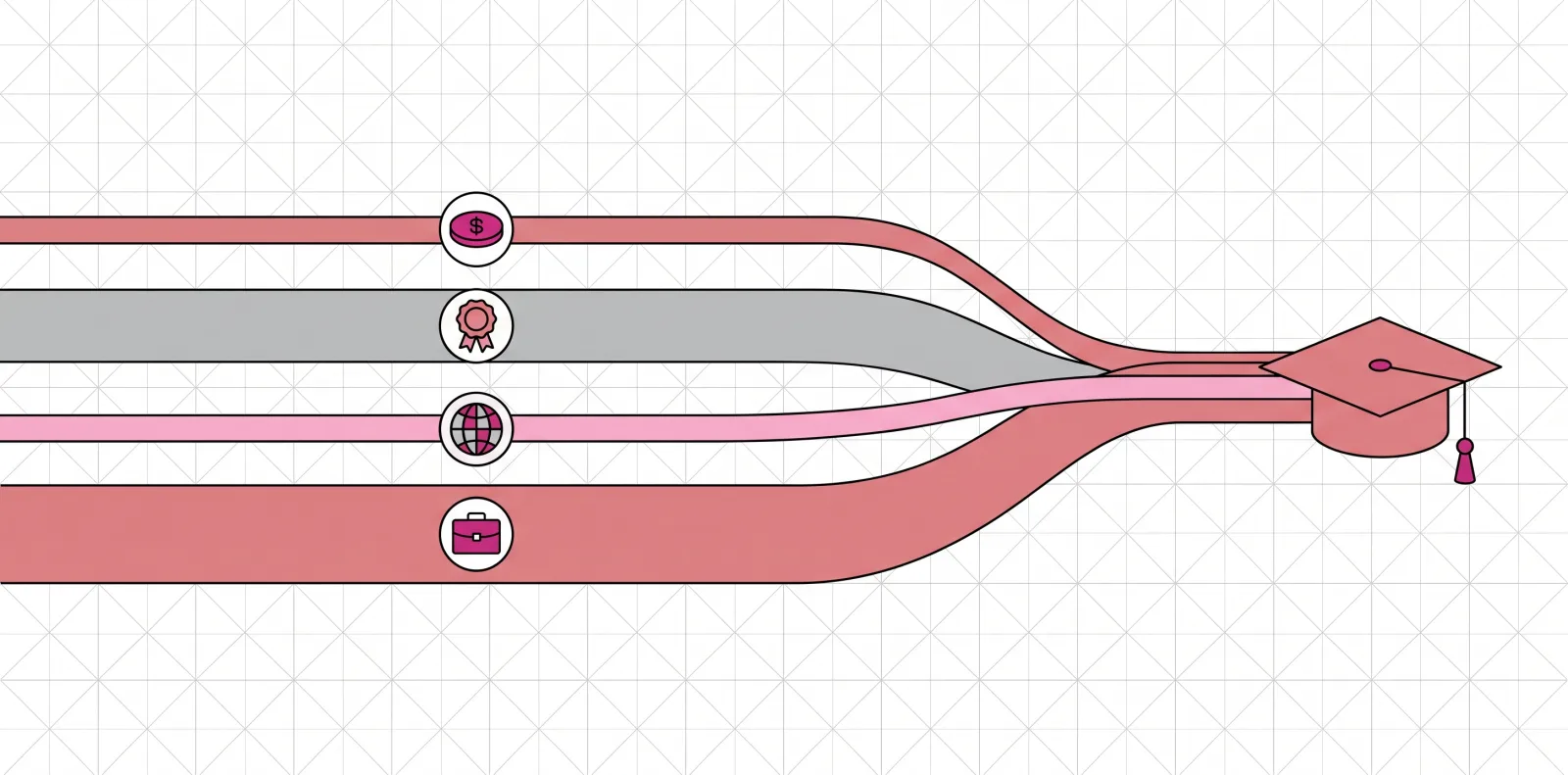
Once you see the arithmetic, the rest of the funding landscape makes sense. A master's in the UK is normally funded from three or four sources stacked together, not one.
What a master's costs, and what the loan covers#
A taught master's in the UK usually runs twelve months full time, which is short by international standards and means the money has to cover a year of living without a long summer to work through.
Average home tuition for a full-time taught master's sits at roughly £8,740, based on surveys published in early 2026. International fees average about £17,109, with medicine, dentistry and MBAs running far higher, sometimes past £60,000.
For 2026/27, Student Finance England offers a Postgraduate Master's Loan of up to £13,206 for courses starting between 1 August 2026 and 31 July 2027. For a course that started in the 2025/26 year, the figure was £12,858.
Subtract average home fees from the loan and about £4,500 remains for twelve months of rent, food and transport. In London that is roughly six weeks of rent. This is the gap everything else on this page exists to fill.
| Route | Who can use it | Roughly how much | When to apply | The catch |
|---|---|---|---|---|
| Postgraduate Master's Loan (England) | Under 60, home fee status, first master's | Up to £13,206 for 2026/27 | Opens each spring | One stream covers fees and living. Not income assessed, so no top-up |
| Master's finance (Wales) | Welsh domiciled students | Up to £19,635, grant and loan combined | Student Finance Wales, from spring | Grant share is income assessed |
| Postgraduate loans (Scotland) | Scottish domiciled students | Fee loan up to £7,000 plus living loan up to £6,900 | SAAS, from spring | Two products; the fee loan goes to the university |
| Postgraduate loan (Northern Ireland) | NI domiciled students | Fee loan paid to the university; confirm the cap with Student Finance NI | Student Finance NI | Tuition only, so living costs are not covered |
| University scholarships and bursaries | Varies by subject, background or grade | £1,000 to full fees | Usually January to May | Separate application and deadline, easy to miss |
| Alumni discount | Graduates of the same university | Typically 10% to 15% of tuition | At offer stage | Only useful if you were staying anyway |
| National schemes: Chevening, Commonwealth, GREAT | International students, varying by country | £10,000 to fully funded | Often closes a year ahead, around November | Extremely competitive, long applications |
| Employer sponsorship | Anyone employed, especially part-time students | Part or all of tuition | Your employer's budget cycle | Usually carries a repayment clause if you leave |
The postgraduate loan: what it is and what it is not#
The English loan is deliberately simple. You apply through Student Finance England, you are assessed on residency and age rather than income, and if approved the money is paid to you in three instalments of 33%, 33% and 34% at the start of each term.
Nothing is paid to your university. You are responsible for paying tuition yourself, usually in instalments the university sets, and it is entirely possible to spend the fee money and then discover the bill is due.
Eligibility has a few hard edges. You need to be under 60 on the first day of your course. You need home fee status. And it is generally a first master's only, so if you already hold a qualification at the same level you are unlikely to be funded for another.
Repayment starts in the April after your course finishes, at 6% of income above £21,000 a year. If you also have an undergraduate loan, the two run alongside each other, so a graduate on Plan 2 or Plan 5 pays 9% above their undergraduate threshold plus 6% above £21,000. On a salary of £32,000 that is a real deduction worth modelling before you commit, because it lands on top of tax and National Insurance.
The postgraduate loan is written off 30 years after repayments become due.
Where you live changes the number more than what you study#
This is the part that surprises people who move between UK nations.
Wales is the most generous headline figure, with support up to £19,635 as a combination of grant and loan, and the grant portion assessed on income. Scotland splits its support into a tuition fee loan of up to £7,000 paid to the institution and a separate living cost loan of up to £6,900, giving a combined maximum of about £13,900. Northern Ireland provides a tuition fee loan paid directly to the university with no living cost element, and the published cap has changed, so check the current figure with Student Finance NI rather than trusting an older article.
Your funding follows where you normally live, not where you study. A student from Cardiff studying in Manchester applies to Student Finance Wales. A student from Newcastle studying in Glasgow applies to Student Finance England.
University scholarships: the money most people never apply for#
Almost every UK university runs its own postgraduate funding, and awards routinely go undersubscribed because applicants assume they will not qualify.
The categories repeat across institutions. Academic scholarships, usually for a first-class undergraduate degree or equivalent. Widening participation awards, for students from low-income households, care experience, or areas with low progression to higher education. Subject-specific funding attached to a department or a research centre. Sports and music awards. And alumni discounts of typically 10% to 15% for students continuing at the same university.
Three practical points. Deadlines usually fall between January and May, months before the course starts and often before you have firmly decided to go. Many require a separate form, so holding an offer is not the same as being considered. And the funding page is often buried under the department rather than the central fees section, so search the university site for your subject plus funding.
If you hold offers from two universities, it is entirely normal to tell each one that funding will decide it. Departments sometimes have discretionary money.
Chevening, Commonwealth, GREAT: worth the effort, if you start early#
For international students, a handful of national schemes cover far more than a university award.
Chevening, funded by the UK government, covers tuition, living costs and travel for a one-year master's. It expects demonstrable leadership and at least two years of work experience, and the application is long. Applications typically open in August and close in November for entry the following September.
Commonwealth Master's Scholarships, run by the Commonwealth Scholarship Commission, cover full fees through an agreement between the Commission and the university, so scholars pay no part of tuition. They target students from eligible Commonwealth countries who could not otherwise afford to study in the UK.
GREAT Scholarships provide £10,000 towards tuition for students from a set list of countries, delivered through partner universities.
The common failure is timing. These schemes close roughly a year before the course begins, which means the application happens before most people have started thinking about a master's at all. If you are considering postgraduate study for the year after next, the deadline is probably this autumn.
Employer sponsorship: how to ask without it sounding like a favour#
Employers fund qualifications more often than employees ask. The request works when it reads as a business case rather than a personal ambition.
Frame it around a capability gap the organisation already has. Name the modules that address it. Say what you will be able to do afterwards that the team currently outsources or does badly. Attach numbers if you can, even rough ones.
Offer a shape that costs them less than full sponsorship. Part-time study over two or three years spreads the cost across budget years, which is often the deciding factor. Study leave instead of cash is cheaper for them and worth a lot to you. Partial funding, where they cover half, is a common landing point.
Ask at the right moment in their calendar. Training budgets are usually set annually, and a request made a month after the budget closed gets a no that has nothing to do with you.
Then read the agreement carefully. Most sponsorship comes with a clawback clause requiring you to repay some or all of the fees if you leave within a set period, commonly two years, often on a sliding scale. That is reasonable in principle. What matters is the detail: whether the clock runs from the start or end of the course, whether redundancy triggers it, and whether the amount repayable is the gross fee or the net cost after any tax relief. Ask HR for the clause in writing before you sign.
Frequently asked questions#
How much is the postgraduate loan for 2026/27? Up to £13,206 for students funded by Student Finance England on a course starting between 1 August 2026 and 31 July 2027. Wales, Scotland and Northern Ireland run separate schemes with different amounts and structures.
Is the loan means tested? No. The English postgraduate loan does not consider household income, so everyone eligible is offered the same maximum regardless of family circumstances.
Can I get a postgraduate loan if I already have a master's? Generally no. The loan is intended for a first qualification at that level. There are narrow exceptions, so check the current rules if you are moving into a professional field.
Do I have to take the whole loan? No. You choose how much to borrow up to the maximum, and you can reduce the amount during the year. Borrowing less means less to repay at 6% later.
Can I combine a loan with a scholarship? Usually yes, and most funded students do exactly that. A few scholarships restrict it, so read the terms, but stacking a loan, a university award and part-time work is the normal pattern.
When do repayments start? The April after your course ends, at 6% of income above £21,000. It runs alongside any undergraduate loan repayment rather than replacing it.
What if my employer will only fund part of it? Partial funding is common and still worth having. You can use the postgraduate loan alongside employer money, as long as the total you receive does not breach any condition in your sponsorship agreement.