

The average return is roughly zero, which is the most useful thing to know#
Ask whether a master's pays and you get two confident answers. One says postgraduate qualifications are the new baseline and you will be left behind. The other says they are an expensive year of deferring the job market.
The best UK evidence says both are wrong, because the average is nearly nothing and the variation is enormous. Research carried out by the Institute for Fiscal Studies for the Department for Education, published in 2020, found that by age 35, women with a master's earn about 2% more than otherwise similar people who stopped at undergraduate level. Men earn about 2% less.
Two percent, in either direction, is a rounding error against a year of fees and a year out of work. So the useful question is not whether a master's pays. It is which ones do, for whom, and instead of what.
How these numbers are built, and why raw salary comparisons mislead#
You will see league tables claiming master's graduates out-earn bachelor's graduates by some large margin. Those comparisons are close to meaningless, because the people who do master's degrees are different from the people who do not, before they enrol.
They tend to have better undergraduate results, to have come from higher-income households, and to have studied at more selective universities. All three predict higher earnings on their own. If you compare the two groups directly, you measure who goes to postgraduate study, not what postgraduate study does.
The IFS work uses the Longitudinal Education Outcomes dataset, known as LEO, which links individual education records to tax and benefits data held by HMRC. That lets researchers compare people with similar backgrounds, similar prior attainment and similar undergraduate subjects, where one group continued and one did not. What comes out is much closer to the effect of the degree itself.
Two caveats worth holding onto. The analysis covers British and Northern Irish students studying in Britain, so it says little about international students, for whom the calculation includes visa and migration factors entirely absent here. And the data are now several years old. The graduate labour market has moved since, particularly in technology and public sector pay, so treat the subject pattern as a strong signal rather than a current price list.
The spread is the story#
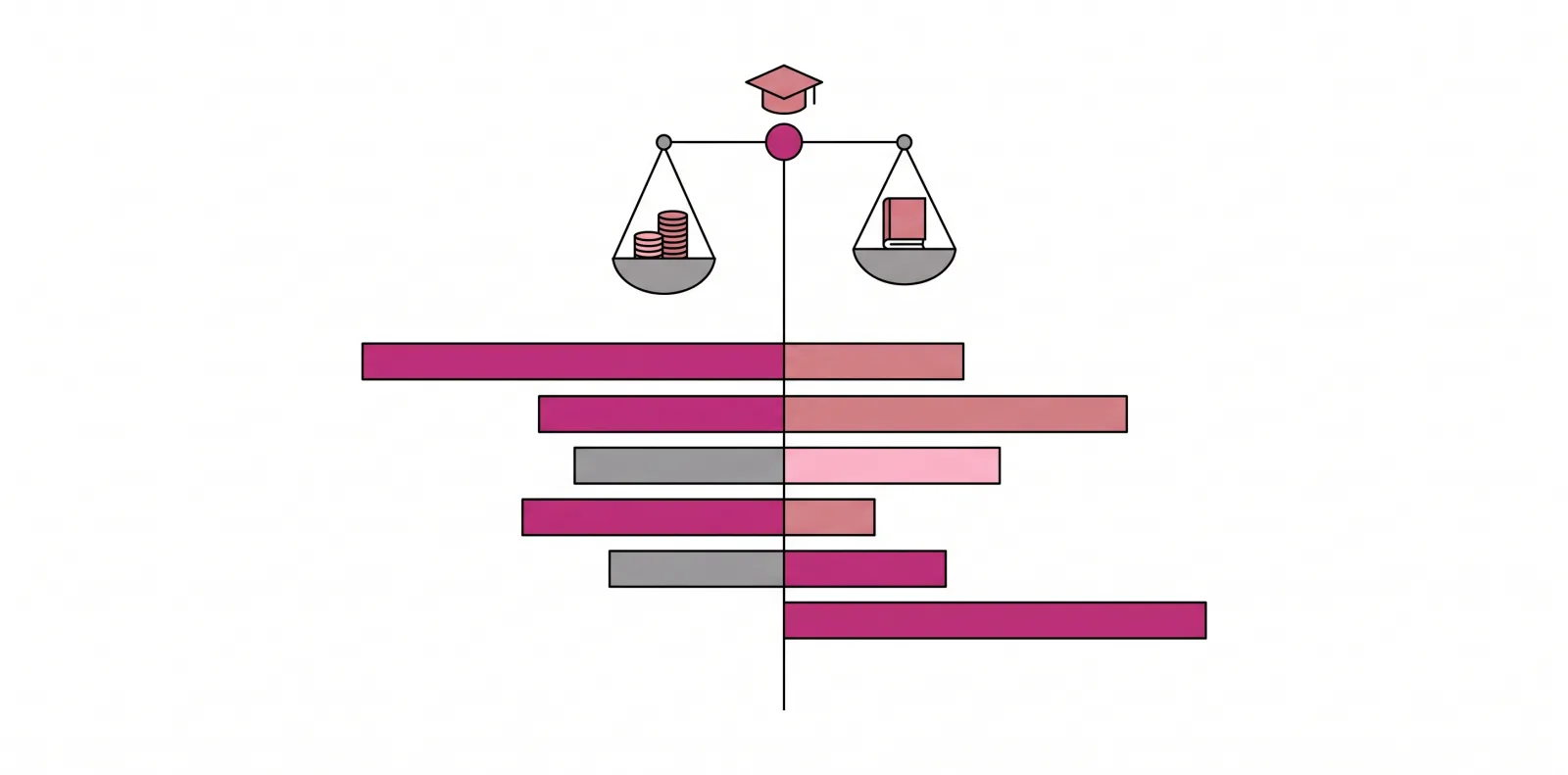
Law and business sit above 15%. Master's degrees in business, economics and law all return upwards of 10% for both men and women. These are the courses the confident version of the postgraduate pitch is built on, and for these subjects it holds.
At the other end, graduates of creative arts, English and philosophy master's courses earn more than 10% less than similar people who did not take one. For a few arts and humanities courses, men earn more than 20% less.
That negative number deserves care rather than mockery. It does not mean the degrees teach nothing. Some of it reflects the sectors those graduates enter, which pay badly regardless of qualification level. Some of it reflects the year spent out of the labour market at the point when peers were being promoted. And earnings are one axis of value among several, which is why this article is titled the way it is rather than claiming to answer whether a master's is worth it in general.
What the spread does mean is that "should I do a master's" is not a question with a single answer, and anyone who gives you one is not looking at the data.
Why women do better than men on the same degrees#
The gap runs consistently through the findings: postgraduate qualifications deliver better labour market returns for women than for men across most subjects.
The most plausible explanation is about the comparison group rather than the degree. Men without postgraduate qualifications have access to a wider range of well-paid routes that do not require formal credentials, particularly in sales, construction management, trades and parts of finance. Women's higher-paying routes more often run through credentialled professions, where a master's is either required or strongly rewarded.
So the master's is not doing more for women. The alternative is doing less. That is the same reasoning you should apply to your own decision: the return depends entirely on what you would otherwise have done with the year.
Switching subject usually beats doubling down#
This is the most actionable finding in the whole dataset, and almost nobody knows it.
For graduates of relatively low-returning undergraduate subjects, taking a master's in the same subject often produces negative returns. Taking a master's in a different field produces overwhelmingly positive returns, for both men and women. Having done an arts degree, going further into the same field is associated with large negative returns.
The reverse holds at the other end. Graduates of high-paying undergraduate subjects such as economics, law, business and some STEM fields tend to do best by staying in their subject, and switching can be particularly costly for them.
The pattern makes sense as an economic story. A master's that adds a scarce capability to an existing degree is buying you something the market pays for. A master's that deepens an already deep specialism in a crowded field is buying you more of what you already had.
The costs side, which nobody models properly#
Returns are only half of it. The other half is what the year actually costs you, and the tuition fee is the smallest part.
Average home tuition for a taught master's runs to roughly £8,740, with international fees averaging about £17,109. Against that, the English postgraduate loan offers up to £13,206 for 2026/27 as a single sum covering both fees and living.
Then add the year you did not work. A graduate earning £28,000 gives up something in the region of £22,000 after tax and National Insurance by not being in that job. That forgone income is a genuine cost and it dwarfs the fee.
Then add repayments. The postgraduate loan is repaid at 6% of income above £21,000, running alongside any undergraduate loan rather than replacing it. Someone on Plan 2 or Plan 5 with both loans pays 9% above one threshold and 6% above another, on top of income tax and National Insurance.
Put together, a full-time one-year master's in England commonly represents a £30,000 to £35,000 decision for a home student. Against a 2% earnings effect, that takes a very long time to recover. Against a 15% effect on a professional salary, it recovers quickly. The arithmetic only works out if you know which one you are buying.
Part-time study changes the sum entirely, because you keep earning. So does employer sponsorship. Both routes are underrated precisely because they remove the largest cost from the equation.
Sometimes the master's is a gate, not an investment#
A substantial share of master's degrees are not optional purchases at all, and the earnings comparison misses this completely.
If you want to practise as a clinical psychologist, a speech and language therapist, an architect, a social worker, a librarian or an academic, a postgraduate qualification is a licence requirement or a de facto entry condition. The question is not whether the return beats the alternative. There is no alternative.
The same applies to conversion courses. A law conversion for a humanities graduate, or a computing conversion for an arts graduate, buys entry to a field that was otherwise closed. The IFS finding about switching subjects points in exactly this direction.
For international students there is another factor absent from the data entirely: a UK master's is a route to the Graduate Route, which permits unsponsored work after graduation. Applications made on or before 31 December 2026 receive two years, or three for PhD graduates, and non-PhD applications from 1 January 2027 receive eighteen months. For many international students, that access is a large part of what the fee buys, and no UK earnings model captures it.
Frequently asked questions#
So is a master's worth it or not? It depends almost entirely on the subject, on what you would have done instead, and on whether you are buying a credential you actually need. The average financial return in the UK is close to zero, which means the average tells you nothing about your case.
Which master's subjects pay best? Business, economics and law return upwards of 10% at age 35 on the IFS estimates, with law and business clearing 15%. High-paying STEM specialisms also tend to hold up well, especially for graduates continuing in the same field.
Which pay worst? Creative arts, English and philosophy master's degrees are associated with earnings more than 10% below comparable graduates, and for a few arts and humanities courses the figure for men falls below minus 20%.
Should I do a master's in a different subject from my degree? If your undergraduate subject sits in the lower-returning group, the evidence favours switching. If it sits in the higher-returning group, the evidence favours staying. Switching out of a high-paying subject is the combination the data treats least kindly.
Does a master's help with getting a graduate job? For roles where it is a stated requirement, obviously. For general graduate schemes, employers are usually more interested in relevant experience, and a year of work often competes well with a year of study. Some schemes recruit master's and bachelor's graduates onto the same starting salary.
Is a part-time master's a better financial decision? Usually, yes. You keep earning, which removes the largest single cost, and employer sponsorship becomes realistic. The trade-off is three years of doing both, which is genuinely demanding.
How old is this data, and does it still apply? The IFS analysis was published in 2020 using tax records linked to education data. It remains the most rigorous UK study of its kind. The broad subject pattern has been stable across studies, but specific figures should be read as a signal rather than a current quotation, particularly in fast-moving fields.