
The question is not about you#
Every interview opens with a version of it. Tell me about yourself. Talk me through your CV. So, a bit about your background.
Candidates hear an invitation to explain who they are, and produce three minutes that start with A-levels. Interviewers are not asking that. They are doing two things at once: settling the room, and deciding what the rest of the interview will be about.
That second part is the whole game. Whatever you emphasise in the first thirty seconds is what the next ten minutes of questions will be built on. Mention a group project and you will be asked about teamwork. Mention a data pipeline you built and you will be asked technical questions. The answer is a menu you hand to the interviewer, and most candidates hand over a menu they did not intend to write.
What is being assessed#
Four things, none of which is your life story.
Can you be concise? An unstructured three-minute ramble is the first evidence that you cannot summarise, which matters in almost every job.
Do you know what this job is? A generic answer signals that you would give the same one at four other companies, which you probably would.
What do you choose to lead with? Given free rein, candidates reveal their own view of what matters. Leading with a hobby, a hardship or a childhood ambition tells the interviewer something whether you intended it or not.
Can you handle a question with no right answer? The question is deliberately open. Composure under ambiguity is part of the read.
None of this requires a performance. It requires a decision made in advance about which two things you want the conversation to cover.
The three-beat structure#
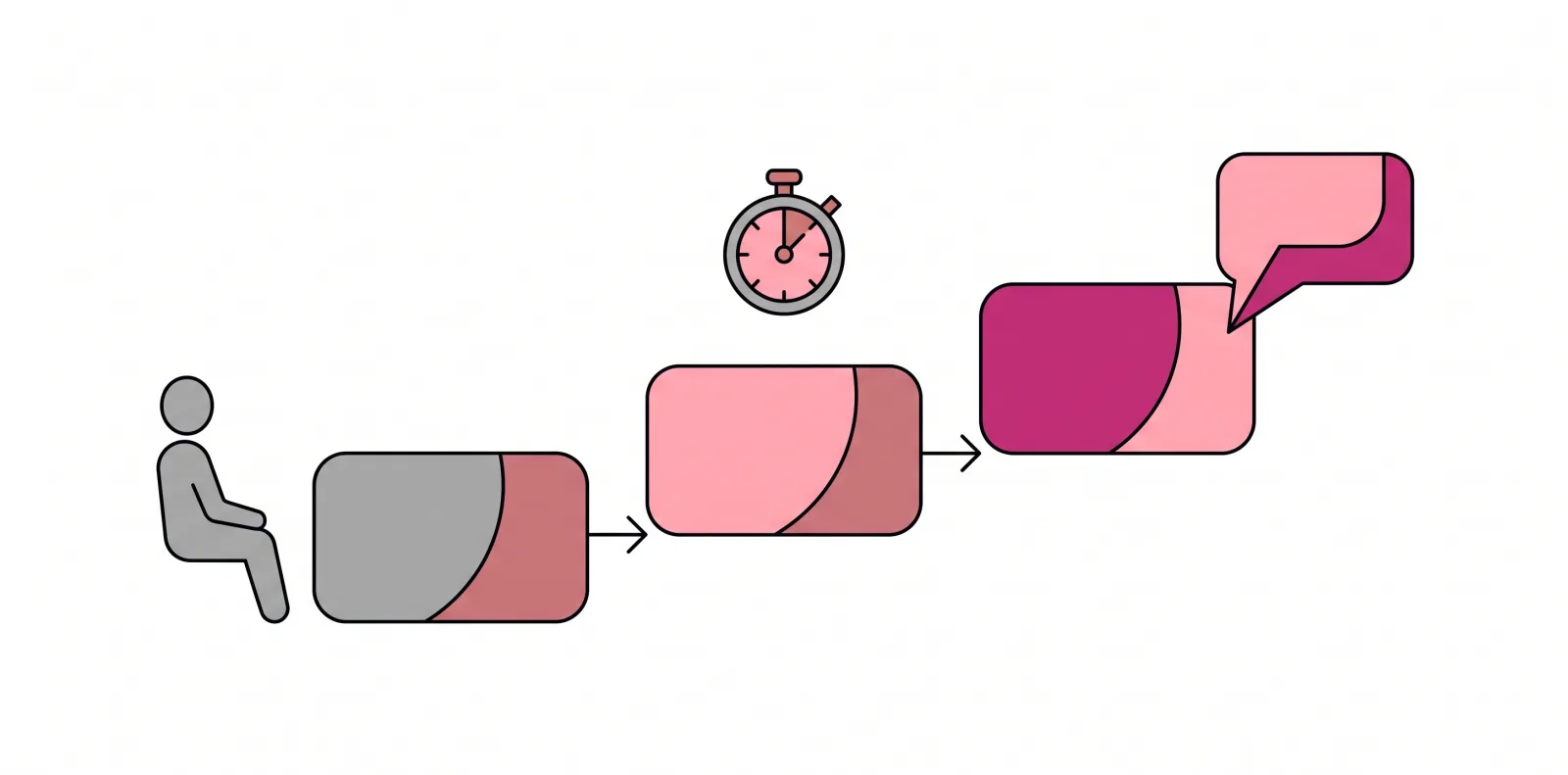
The version that works is short, chronological only in the loosest sense, and ends by handing control back.
| Beat | What it does | Roughly |
|---|---|---|
| Now | Who you are today, in one line: your course, year, and the direction you are pointed in | 8 seconds |
| Proof | The single most relevant thing you have done, with something concrete in it. A number, an output, a result | 15 seconds |
| Why here | Why this role at this organisation, specifically enough that it could not be pasted into another interview | 8 seconds |
Thirty seconds is roughly 75 to 90 spoken words. That is short. It is meant to be, because the interviewer wants to start asking questions rather than listen to a monologue, and a tight answer signals that you understand the format.
The most common error is spending the whole budget on beat one. Candidates give a careful account of their education and arrive at the interesting part with nothing left.
Four worked versions#
Final-year student with directly relevant experience
"I am a final-year Economics student at Manchester, and I have spent the last two years moving towards data analysis. Last summer I interned at a retail group where I rebuilt their weekly sales reporting in SQL, which took the turnaround from two days down to about four hours and is still running. I am applying here because your team sits inside the business rather than in a central data function, which is the setup I want to learn in."
Thirty seconds. One concrete achievement with a number. A reason for this employer that required actual research.
Student with no relevant experience
"I am in my final year of History at Sheffield, and what I have enjoyed most is the research side, taking a large amount of messy source material and working out what is actually true. I have been the treasurer of a 200-member society for two years, which meant running a real budget and chasing people for money, which is less glamorous than it sounds. I am applying to this scheme because it is one of the few that takes people from any discipline and trains them properly, and the research-heavy first year is what appeals."
No pretending. It names transferable capability, gives an unglamorous specific, and offers an honest reason.
Career changer or mature student
"I worked in hospitality management for six years, latterly running a site with fourteen staff, and went back to do a Computer Science conversion because the part of the job I liked most was fixing the systems rather than the operations. I finished in June with a distinction and a final project building a rota tool, which the old site is actually using. I am applying here because the work is internal tooling for non-technical users, which is exactly the gap I spent six years standing in."
The change is explained in one clause, not defended. The previous career becomes an asset rather than something to apologise for.
Master's student applying for a technical role
"I am finishing an MSc in Computational Biology at Edinburgh. My dissertation is on variant calling pipelines, which in practice has meant a lot of time making other people's software run reproducibly, and I ended up writing a workflow that cut our group's processing time by about a third. I am interested in this role because the team publishes its tooling openly, and I would rather build things other people use than things that live in a thesis."
Preparing it without sounding rehearsed#
Write it out, then stop writing it out. A memorised paragraph is audible, and the moment you lose a word you lose the whole structure.
Instead, memorise three anchors: one phrase for now, one for the proof, one for why here. Say it aloud six or seven times, differently each time. The variation is what keeps it sounding like speech.
Time yourself once. Almost everyone is over, usually by a factor of three, and almost everyone is surprised.
Then build two or three variants, because the proof beat should change depending on the role. The same person applying to a consultancy and to a research team should be leading with different evidence.
Rehearse the handover. Ending on "and that is why I am here" is a clean stop. Trailing off with "so, yeah" undoes a good answer, and it is the most common ending among nervous candidates.
Variants of the same question, and one trap#
"Walk me through your CV" is asking for slightly more chronology. Give the same structure with one extra sentence of sequence, not a paragraph per year.
"Tell me about yourself" in a video interview with a recording limit is the same answer, delivered to a camera. Practise once with the recording on, because the absence of a listener changes your pacing more than you expect.
"So what is your story?" from a senior person over coffee is a genuinely informal version. It permits warmth and one personal detail, but it is still being assessed.
The trap is the one that sounds friendliest: "tell me a bit about yourself, outside of work." That is an invitation to be a person, and the correct response is one genuine interest briefly described. It is not an invitation to discuss health, relationships, politics or money, and the friendliness of the framing is exactly why people occasionally say more than they meant to.
If your mind goes blank#
It happens, and recovering is easier than the fear suggests.
Buy two seconds openly rather than filling them with noise. "Let me start with where I am now" is a complete sentence, costs nothing, and delivers you into the first beat.
If you lose the thread mid-answer, stop and say so plainly. "Sorry, I have gone slightly sideways. The short version is this" reads as composure rather than failure. Interviewers are far more forgiving of a visible recovery than of a candidate visibly panicking while continuing to talk.
And if you blank on the proof beat entirely, fall back on the most recent thing you worked on. It does not have to be the most impressive item on your CV. It has to be something you can describe accurately, because the follow-up questions are where the actual assessment happens.
Frequently asked questions#
How long should the answer actually be? Thirty to sixty seconds for most interviews, which is roughly 75 to 150 words. Under thirty seconds can feel abrupt. Over ninety seconds and the interviewer is waiting for you to finish rather than listening.
Should I mention hobbies? Only if they are genuinely relevant or genuinely interesting, and only briefly. A hobby that demonstrates a skill relevant to the role earns its place. A list of pastimes does not.
Is it fine to say I am not sure what I want to do yet? Better to name a direction than a title. "I am interested in the analytical side of this sector and want to see more of it before specialising" is honest and forward-looking. "I have no idea" invites the interviewer to make the decision for you.
What if my background is unrelated to the job? Say so in one clause and move immediately to what transfers. Career changers who explain the change briefly and confidently do well. The ones who over-apologise turn a neutral fact into a problem.
Should I mention my grades? Only if they are strong and relevant, and even then briefly. If the employer has a grade requirement, they already checked before inviting you.
How do I handle it when the interviewer clearly has not read my CV? It happens, and it is not a slight. Give the same answer, with one extra line of context about your course and stage, and avoid any visible irritation. Treat it as a chance to steer harder than usual.
Is it worth writing this out in full? Write it once to find the words, then work from three anchor phrases rather than the script. Fully memorised answers are detectable and they collapse under a single interruption.