

The reason exams surprise people who revised properly#
Here is a situation most students recognise. You revise a topic thoroughly. You could describe it, you have the definitions, you followed every worked example. Then the exam asks a question you have not seen before, built on the same concept, and nothing comes.
This is not bad luck and it is rarely a memory failure. It is the difference between two states that feel identical from the inside.
Recognising something means you can confirm it when presented. Understanding it means you can generate it, apply it somewhere new, and explain why it is true rather than that it is true. Almost every study method that feels comfortable builds the first and not the second.
Why you cannot tell the difference from the inside#
Psychologists have a name for this. In 2002, Leonid Rozenblit and Frank Keil described the illusion of explanatory depth: people believe they understand how ordinary things work in far more detail than they actually do, and the illusion collapses the moment they try to produce a step-by-step explanation.
Ask someone to rate how well they understand a bicycle, then ask them to draw one that would work. The rating drops afterwards. Nothing was learned in between. The attempt simply exposed what was already missing.
The same mechanism runs through revision. Reading a clear explanation produces a feeling of understanding, because the explanation is doing the work and you are experiencing its fluency as your own competence. The moment you have to produce it yourself, the borrowed structure disappears.
This is why confidence is such a poor guide to preparedness, and why the study methods that feel best are frequently the least effective. Robert Bjork's research programme on desirable difficulties makes the point directly: conditions that slow learning down and feel harder often produce better long-term retention and transfer than conditions that feel smooth.
Six tests that tell you which one you have#
None of these take long. All of them are unpleasant, which is the point.
| Test | What you do | What failing it means |
|---|---|---|
| Blank page | Close everything, write what you know about the topic from memory | You have recognition, not recall. The gaps are your revision list |
| Explain to a novice | Explain it aloud to someone with no background, without jargon | You are relying on terminology as a substitute for the mechanism |
| Why, three times | Ask why your explanation is true, then why that is true, then again | Your understanding stops at the level you were taught, with nothing underneath |
| Change one thing | Alter a condition in the problem and predict what happens | You learned a procedure, not a model. This is the transfer failure exams exploit |
| Worked example, covered | Cover a solution and reproduce it, then compare | You can follow reasoning but not generate it |
| Wrong on purpose | Give a deliberately incorrect version and say precisely why it is wrong | You know the right answer without knowing the boundary of the concept |
The blank page test is the cheapest diagnostic in education and almost nobody runs it, because it produces an unpleasant result in about ninety seconds.
Self-explanation: the technique that does most of the work#
Of the methods rated in the research literature, self-explanation sits in the moderate-utility band alongside elaborative interrogation, and it is the one most worth building into how you study.
It means narrating your reasoning as you work, aloud or in writing, in your own words. Not what the step is, but why this step and not another one. Why does that assumption hold here? What would break if it did not?
The version most people have heard of is the Feynman technique, named after the physicist Richard Feynman. Pick a concept, write an explanation as though for someone who knows nothing about the field, and every time you reach for jargon or notice a gap, go back to the source, fix it, and rewrite.
What makes it work is not the writing. It is that jargon hides gaps beautifully. Saying that entropy increases explains nothing, but it sounds like an explanation, and the sound is enough to fool you. Removing the technical vocabulary strips out that cover and exposes the places where you have a label instead of a mechanism.
The practical version takes ten minutes per concept, and it is the difference between revision that produces confidence and revision that produces capability.
Build the concept from the concrete, then abstract it#
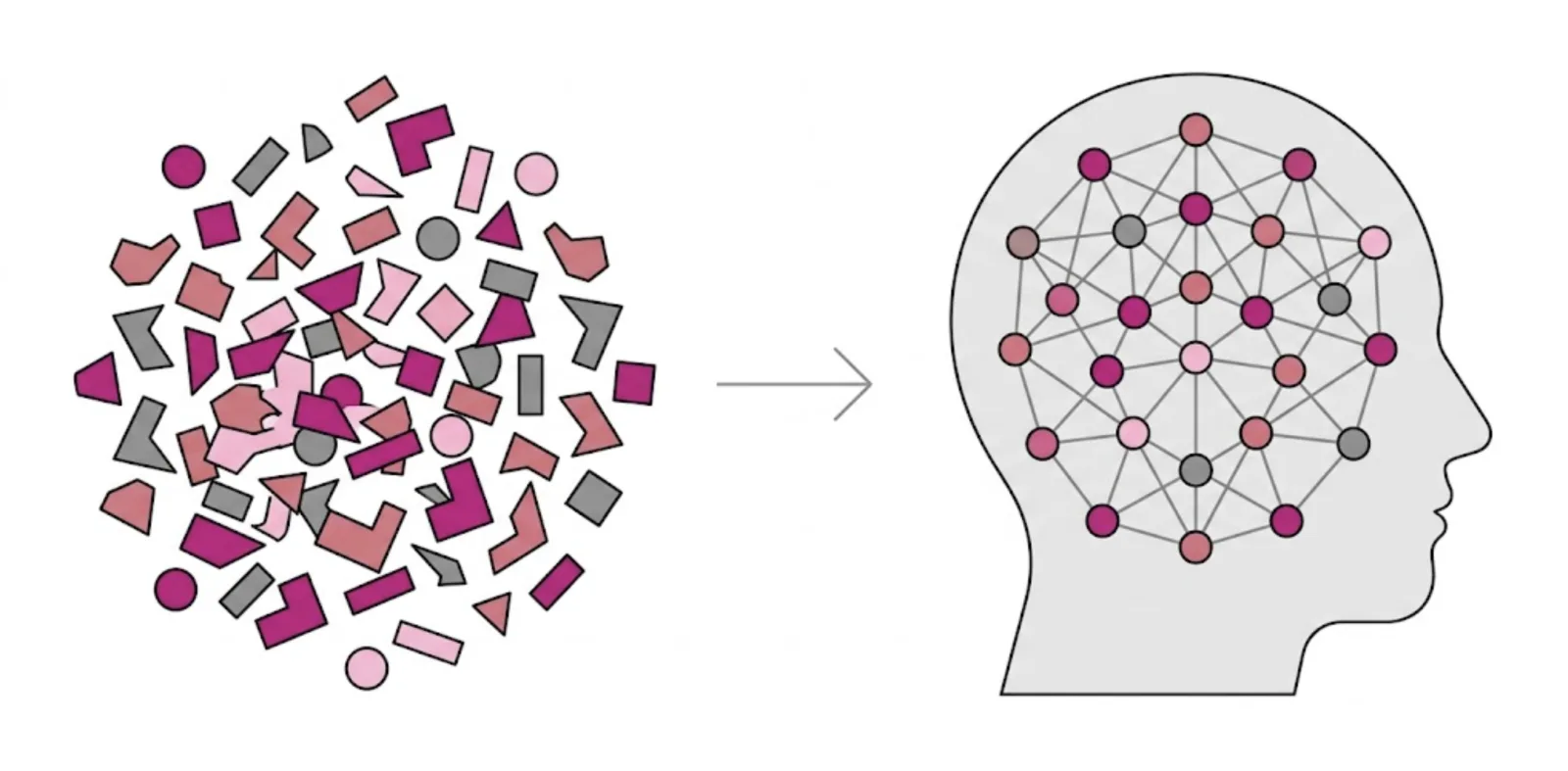
Hard subjects are usually taught in the wrong direction for human learning. The abstract statement comes first, then the examples. That is efficient for someone who already understands, and difficult for everyone else.
Reverse it when you revise. Start with a concrete case you can hold in your head, work out what is happening, then ask what stays true when you change the specifics.
For a statistical concept, work through it with eight made-up numbers you can compute by hand before touching the general formula. For an economic model, work a single market with actual figures. For an algorithm, trace it by hand on a list of six elements. For a legal principle, work the facts of one case before the rule.
The general version means something once you have watched the specific version behave. Presented first, it is a string of symbols you can memorise and not use.
This is also why you should resist the urge to skip the examples in a textbook chapter. They are not illustrations of the theory. For most learners they are where the theory becomes usable.
Interleave, and accept that it feels worse#
Studying one topic until it is solid, then moving to the next, feels organised and produces a strong sense of mastery.
Mixing topics so that each problem requires you to identify what kind of problem it is produces lower accuracy during practice, a weaker sense of progress, and better performance on tests.
The reason is that blocked practice removes the hardest step. If you have just done twenty questions on the same method, you never practise recognising when that method applies. In the exam, nothing is labelled. The recognition step is the assessment.
This is the most reliable example of the pattern running through everything here: the version that feels productive and the version that produces results are frequently different versions, and your sense of how well things are going is measuring fluency rather than learning.
What to do when you genuinely cannot get it#
Sometimes a concept refuses to land, and the honest answer is that the problem is usually upstream.
Almost every hard topic depends on something earlier that you half-learned. Second-year statistics collapses because first-year probability was memorised. Organic chemistry mechanisms collapse because electron behaviour was never really understood. Trying to attack the hard topic directly fails because the missing piece is two chapters back.
So when you are stuck, work backwards rather than harder. Ask what this topic assumes you already know, and test that with the blank page. The gap is nearly always there.
Two further things worth trying. Find a different source, because explanations vary enormously in quality and a textbook that has defeated you is not a measure of your ability. And ask a specific question rather than a general one. Lecturers and demonstrators respond very differently to "I don't understand chapter four" and "I can follow the derivation up to the third line and I can't see why that substitution is allowed." The second question is answerable, and asking it well is itself a sign that you have done the work.
Frequently asked questions#
Is memorisation ever the right approach? Yes, for genuinely arbitrary things: vocabulary, anatomical names, standard formulas, syntax, dates. The error is memorising things that have an underlying logic, because arbitrary facts have to be held individually while understood facts can be regenerated.
How is self-explanation different from just taking notes? Notes usually record what was said. Self-explanation records why it is true and what would break if it were not. One is transcription, the other is reasoning, and only the second exposes gaps.
Does the Feynman technique actually work or is it internet folklore? The specific packaging is popular rather than studied, but its core mechanism, explaining in your own words without jargon, maps closely onto self-explanation, which is supported by the research literature. The branding is folklore. The underlying method is not.
Why does my revision feel like it is going well and then fail in the exam? Because fluency and learning feel the same and are not the same. Rereading and following worked solutions build recognition, and exams test generation. The tests in this article exist to break that illusion before the exam does.
How long should understanding one hard concept take? Longer than reading about it and shorter than most people fear. Ten to thirty minutes of active work per concept is typical, most of it spent uncomfortable. If it has taken three hours, the missing piece is probably earlier material rather than this one.
Is it worth explaining things to other students? Yes, and the person explaining usually gains more than the person listening. The demand to produce a coherent explanation on the spot is self-explanation with an audience that will notice when you bluff.
What if the lecturer is genuinely bad? It happens, and it is not a character test. Find a different source, ideally a textbook or a lecture series from another university, and use contact hours for specific questions rather than for the first exposure. Lecture quality varies far more than students are led to expect.