
The September After the Graduation Photos Come Down#
By September, the group chat has gone quiet. The graduation photos are posted, liked, and archived. Everyone you know seems to have slotted into something: a grad scheme, a master's, a flight somewhere with better weather. You have a degree, a folder of half-finished job applications from June, and the feeling that everyone else got a memo you never received.
This is far more common than it looks from the outside. Around four in ten young people in England go on to higher education each year, according to the Department for Education's Higher Education Initial Participation Rate, and a large share finish their course with no fixed idea of what comes next. Not having a plan for what to do after graduation isn't a personal failing. It's closer to the default setting.
What "No Plan" Actually Looks Like in the Graduate Data#
The main UK dataset here is the Graduate Outcomes survey, run by the Higher Education Statistics Agency (HESA). Unlike its predecessor, which checked in after six months, Graduate Outcomes waits fifteen. That gap is itself an admission: working out your direction takes the best part of a year and a half, not a summer.
Prospects, the graduate careers service behind the annual "What Do Graduates Do?" report, sorts destinations into a handful of categories: graduate-level employment, non-graduate employment, further study, unemployment, and a catch-all "other." That category is the polite term for graduate underemployment: working in a role that doesn't require a degree, such as retail supervision or bar management, while you work out what you actually want. Prospects treats it as a normal stage, not a warning sign.
Not Knowing Is a Stage, Not a Character Flaw#
Career psychologists have spent decades studying why some people leave education with a five-year plan and others feel a low-grade panic instead. Itamar Gati and colleagues built an influential taxonomy of career decision-making difficulties in 1996, sorting them into three groups: not being ready to decide, lacking information about yourself or your options, and holding inconsistent information, where your own preferences conflict or other people's opinions contradict each other. Most graduate indecision is a mix of all three, not one clean problem with one clean fix.
A more useful reframe comes from John Krumboltz, a Stanford psychologist whose "planned happenstance theory," published with Kathleen Mitchell and Al Levin in 1999, argued that most careers are shaped substantially by unplanned events. The useful skill, in this view, isn't forecasting your future accurately, it's staying curious and open to opportunities you didn't plan for. Graduating without a five-year plan isn't a design flaw; rigid plans made at twenty-one are usually the ones that age badly.
The feeling even has a name. Alexandra Robbins and Abby Wilner popularised "quarterlife crisis" in their 2001 book of the same title, describing the disorientation of early adulthood: too many options, too little structure, and a culture that expects a confident answer to "so what's next?" before most people have lived enough to have one.
The Five Paths After Graduation, Weighed Side by Side#
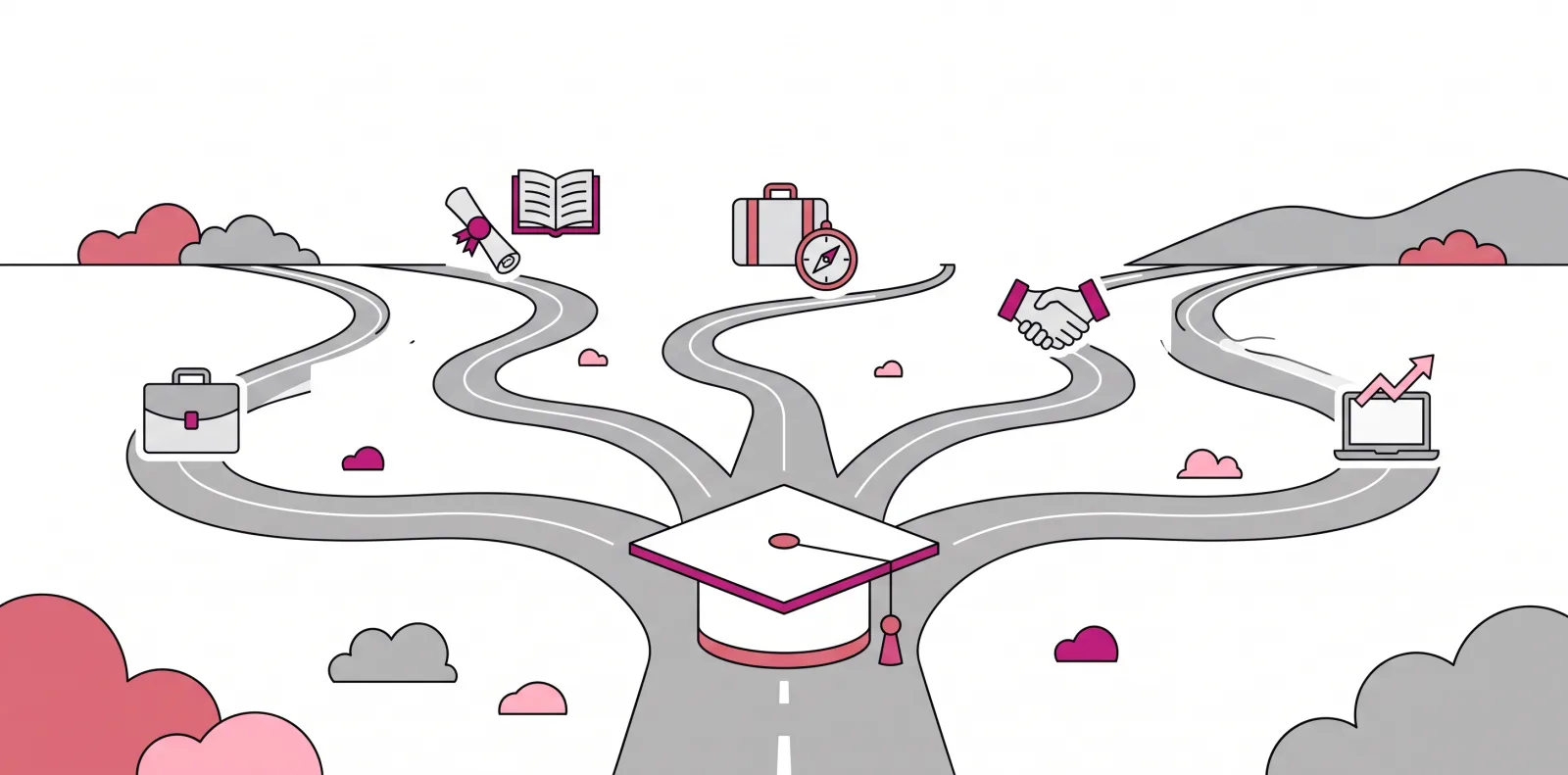
Cut through the noise and most graduates are choosing between five broad routes: a graduate job, further study, a structured gap year or period of travel, an internship or placement, and self-employment or freelance work. None is objectively correct. Each trades off cost, risk and speed differently.
| Option | Typical cost | Risk level | Typical outcome |
|---|---|---|---|
| Graduate job or scheme | Low; paid from day one | Low to moderate; often competitive to secure | Structured training, though it can lock you into a sector by default |
| Further study (master's, PGCE, etc.) | High; postgraduate loans in England rarely cover full costs | Moderate; strong where it's a genuine entry requirement, weak as a stalling tactic | Higher pay in some fields, little wage premium in others |
| Gap year or travel | Moderate to high, usually self-funded | Low to your career, higher to your savings | Widely reported personal growth, limited evidence of career advantage |
| Internship or placement | Low cost, often unpaid or low-paid | Moderate; unpaid roles raise access and legal concerns | Strong route into graduate-level work when paid and structured |
| Freelance or self-employment | Low start-up cost, unpredictable income | High; no safety net, inconsistent work | Builds a portfolio and independence, with volatile income early on |
Further study is the option graduates most often reach for as a placeholder rather than a plan, and the evidence should give pause. Prospects and HESA figures show a master's pays off clearly where it's a genuine requirement, such as clinical or research-heavy careers, but produces a murkier salary return where employers value experience over an extra qualification. The Institute for Fiscal Studies has separately found that postgraduate returns vary hugely by subject and institution rather than offering a flat boost across the board. If the honest reason for applying is "I don't know what else to do," that's worth naming before signing up for another year of study debt.
How to Explore Options Without Waiting to Feel Ready#
The instinct when you feel lost is to sit somewhere quiet and think hard until an answer appears. Herminia Ibarra, a London Business School professor, argues in her book Working Identity (2003) that this gets the process backwards. Her research into career changers found that clarity usually follows action, not the other way round: people worked out what they wanted by trying things, not by reasoning in advance. She calls it acting your way into a new way of thinking.
In practice, that means treating exploration as a set of small, cheap experiments rather than one enormous decision. Book a few informational interviews with people doing jobs that sound interesting, even loosely. Take a short course or a volunteering stint in a field you're curious about before committing years to it. Apply for roles you're only 60% sure about; a job offer, even one you turn down, tells you more than another week of internal debate does. University careers services usually stay free for a set period after you leave, and most graduates simply forget to use them once the student email account shuts down.
Using a Bridge Job Without Getting Stuck in It#
A bridge job, any paid work taken to cover rent while you figure out the real plan, isn't a failure. It's one of the most common graduate outcomes, and stays survivable as long as it's temporary by design, not by accident. The risk is drift: bridge jobs are comfortable enough to become permanent by default, and the longer someone stays, the harder the switch feels, because the CV starts telling a story nobody chose.
The fix is structural rather than motivational. Set a review date, three or six months out, and treat it as non-negotiable. Use the job's actual downtime, not imagined future time, to apply elsewhere and build the skills your target role needs. Be honest about the bridge job in interviews, too. Hiring managers generally read a short unrelated stint more sympathetically than graduates assume, provided you can explain what you were doing with the rest of your time.
Why More Choices Make This Harder, Not Easier#
There's a specific trap that catches capable, thoughtful graduates hardest: researching every option so thoroughly that none of them ever feels good enough to commit to. Psychologist Barry Schwartz described this in The Paradox of Choice (2004), building on economist Herbert Simon's distinction between "maximisers," who try to find the objectively best option among every possible one, and "satisficers," who choose the first option that meets their standards and move on. Schwartz's research found maximisers report less satisfaction with their decisions, not more, because an ever-expanding menu of alternatives guarantees regret about the roads not taken.
Applied to graduate life, this shows up as job applications left in draft, browser tabs open for six master's courses, and a running mental tally of what everyone else has already decided. A workable fix is a soft deadline: pick a date, apply a "good enough for now" standard rather than a "correct forever" one, and remember that almost no first job is a permanent verdict on a career. Graduate Outcomes data shows plenty of movement between graduate-level and non-graduate roles in the years that follow. The market doesn't treat the first move as final, so there's no reason a twenty-two-year-old should either.
Questions Graduates Keep Asking#
Is it normal to graduate with absolutely no plan?#
Yes. HESA delays its main outcomes survey to fifteen months precisely because a clear direction rarely exists at six, and Prospects' own data treats a spell in non-graduate work as a routine stage rather than an exception.
How long does it actually take graduates to find graduate-level work?#
There's no single fixed figure, and it varies by subject and region, but several months of searching is typical, which is part of why the official survey window runs past a year rather than weeks.
Should I do a master's if I don't know what else to do?#
Be cautious. A postgraduate qualification pays off clearly where it's a genuine entry requirement, but Institute for Fiscal Studies research shows the wage return varies enormously by subject and provider. Buying time with a master's can mean paying for delay rather than direction.
Is a gap year a good idea if I'm undecided?#
It can reset your energy and widen your perspective, and many graduates report it positively, but the career-advancement evidence is thinner than the personal-growth evidence. Treat it as a wellbeing choice more than a strategic one.
How do I stop endlessly researching options and actually choose one?#
Set a deadline and adopt a "good enough for now" standard instead of hunting for a perfect fit. Barry Schwartz's research on maximisers versus satisficers found that constantly searching for the best option tends to produce more regret, not less.
Will taking an unrelated bridge job hurt my CV?#
Generally not, provided it stays time-limited and you can explain what you did during it. Set a review date at the outset so it doesn't quietly become the default rather than the plan.
Nobody hands out the memo everyone else seems to have received, because it doesn't exist. Most graduates are improvising, a few months behind wherever they think they should be. The way through isn't a better plan drawn up in isolation. It's smaller experiments, an honest deadline, and permission to let the first move be good enough for now rather than correct forever.