
The box on the template that says "Work Experience"#
You open a CV template, and there it is: a heading called Work Experience, sitting under your name like a dare. Under it, nothing. You have never had a job. Maybe you've done a few days of unpaid babysitting for a neighbour, or helped out at a family shop, but nothing that feels like it belongs on a document employers take seriously.
The instinct is to leave the section there and stare at it, or to delete it and hope nobody notices what's missing. Neither works, because the gap itself is not really the problem. Recruiters read hundreds of student CVs a year and most of them know that an eighteen or twenty-year-old without a job history is normal, not suspicious. What actually loses you the interview is a CV that has nothing at all where that evidence should be. The fix isn't finding a job overnight. It's putting something honest and specific in its place.
What a recruiter, or a piece of software, is actually looking for#
Before you can fill a gap, it helps to know what's being checked. Many employers, especially larger graduate schemes and retailers, run applications through an applicant tracking system (ATS) first: software that scans your CV for keywords tied to the job description and filters candidates before a person opens the file. The Institute of Student Employers, which surveys UK graduate recruiters annually, has consistently found that large employers receive well over a hundred applications per entry-level vacancy. That volume is exactly why the filtering exists.
That matters because "work experience" is a proxy, not the actual thing being assessed. A recruiter scanning a CV isn't hunting for a job title. They're hunting for evidence of specific things: can you communicate clearly, manage your time, work with people you didn't choose, follow through on a task nobody is checking up on. Prospects, the UK's official graduate careers service run by Jisc, is blunt about this in its own CV guidance: employers want proof of skills, and a part-time job is only one of several ways to supply it. Coursework, societies, volunteering and even family responsibilities can all do the same job if you describe them the same way a job description would.
Turning your degree into evidence, not just a list of modules#
Your course is the most under-used section on a student CV. Most students list module titles and nothing else, which tells a recruiter what you studied but nothing about what you can do. Instead, pick two or three pieces of coursework, a dissertation, a group project or a lab report, and describe them the way you'd describe a task at work: what you did, what tools or methods you used, and what came out of it. "Led a four-person team project analysing local transport data, presenting findings to course tutors" reads as project management and communication, not just an assignment.
This is also where independent projects earn their place. A society Instagram account you grew, a coding project on GitHub, a podcast with three listeners: none of these are jobs, but they're things you did on your own initiative that produced a result. National Careers Service, the UK government's free careers guidance service, calls this "transferable skills," and recommends this approach for anyone without paid work history rather than apologising for the jobs you haven't had.
Rewriting the personal statement so it earns its space#
The personal statement at the top of a CV is usually the first thing read and the first thing wasted. Students without work experience often use it to apologise: "Although I have no work experience, I am a hardworking and enthusiastic individual." That sentence tells a recruiter nothing they can act on, and it draws attention to the exact gap you're trying to manage.
A stronger version does two things: names two or three specific strengths, and immediately backs each one with a concrete example from study, a hobby, or volunteering. Instead of claiming to be a "team player," state where you led or contributed to a group outcome and what happened as a result. CIPD, the professional body for UK HR and recruitment, has long noted in its guidance to employers that generic self-description in applications is one of the most common reasons CVs get screened out early, because it can't be verified or compared against anything. Specificity is what survives a skim read.
Counting the work that doesn't look like work#
A lot of experience gets left off CVs because students don't think it counts. Caring for a family member, running a household budget on a tight income, organising a house move, or coaching a younger sibling's football team all involve responsibility and dealing with other people, precisely what a paid job would demonstrate. UCAS makes the same point in its careers content for students: admissions tutors and employers respond to evidence of responsibility, whether or not money changed hands.
The same applies to short-term or one-off activity: a single day volunteering, helping at an open day, marshalling at a local event. It's honest to describe these briefly rather than stretching them into something they weren't, but a handful of small, real entries under "Experience" beats an empty section every time.
Choosing a structure that doesn't spotlight the gap#
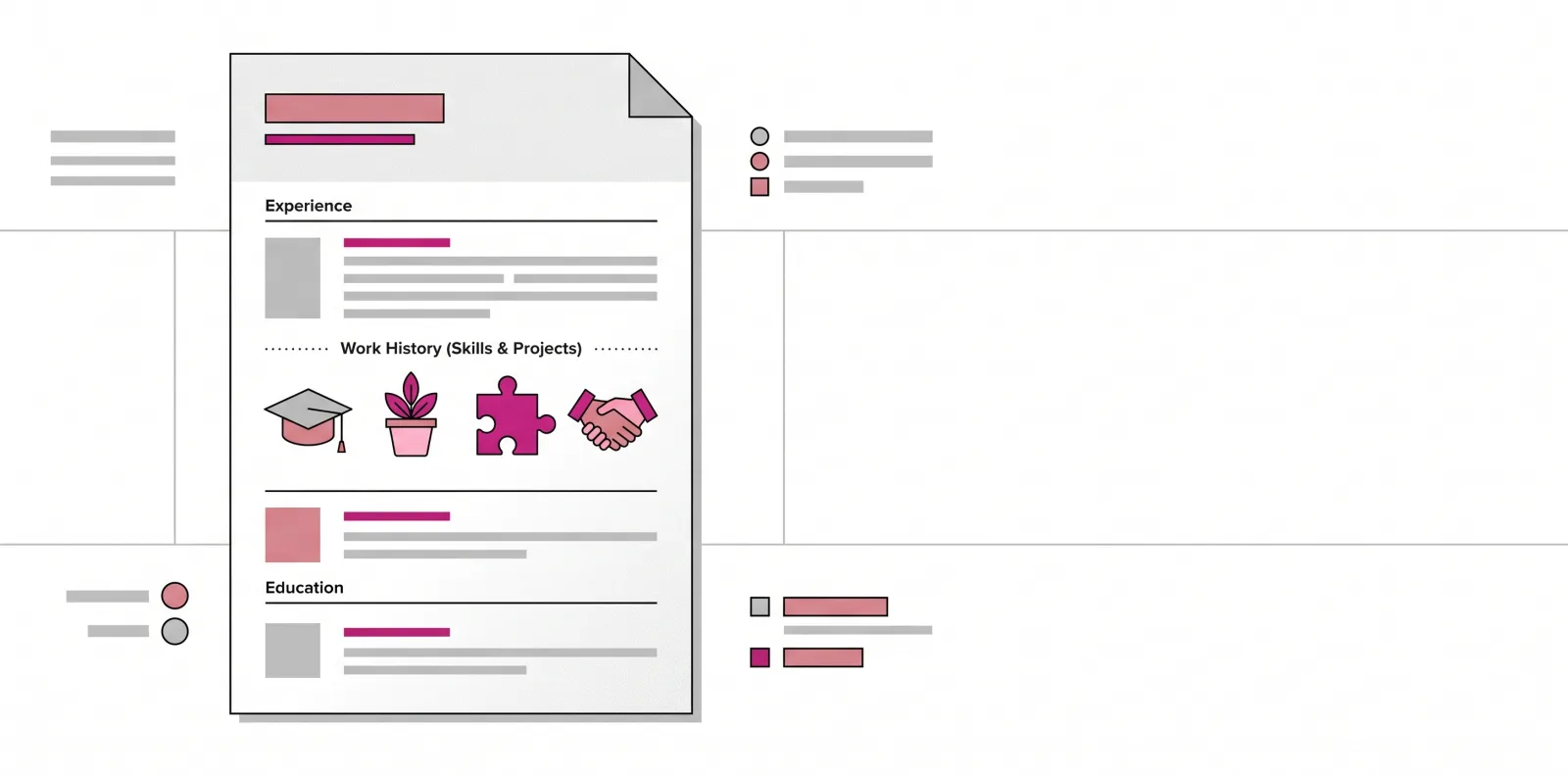
Format does some of the work that content can't. A standard chronological CV, organised by job history, puts the empty column exactly where a reader's eye lands first. A skills-based (or "functional") CV flips that: it opens with grouped evidence under skill headings like Communication, Organisation and Problem-solving, each backed by two or three short examples pulled from study, volunteering or projects, with a brief, honest activities list further down.
Skills-based formats aren't universally loved. Some recruiters, particularly in traditional sectors like law or finance, still expect a conventional chronological layout and can read a skills-based CV as evasive if overused. The sensible approach is to use the structure that fits your gap, not to treat either format as automatically superior.
| Option | What it shows a recruiter | Best used when | Strength of evidence |
|---|---|---|---|
| Skills-based CV structure | Transferable ability, front-loaded | You have activity but no job titles | Good, if backed by real examples |
| Coursework and dissertation detail | Applied academic skill, method, output | Your course is directly relevant | Strong for technical or analytical roles |
| Volunteering and informal work | Responsibility, reliability, initiative | You've done unpaid or one-off activity | Solid, especially if regular or ongoing |
| Societies and extracurricular leadership | Teamwork, organisation, follow-through | You've held a role, not just membership | Moderate to strong, role-dependent |
| Personal or freelance projects | Initiative, specific hard skills | You've built or made something independently | Strong for creative, digital and technical roles |
The mistakes that make an empty section worse#
Filling the gap badly is worse than leaving it visibly thin. The most common error is padding: turning a single afternoon of shadowing a relative into a paragraph, or listing "Microsoft Word" as a skill for a graduate scheme. Recruiters read enough CVs to spot inflation quickly, and it damages trust in every other line on the page. High Fliers Research has tracked graduate recruitment among the UK's leading employers for over two decades in its annual Graduate Market report. Its findings keep pointing the same way: many top employers already fill a substantial share of entry-level roles with people who did a placement or internship with them first. That's a real pressure, and the answer to it is building smaller, genuine evidence now, not inventing bigger claims later.
The second mistake is silence: no personal statement, no activities section, just education and a skills list of adjectives. A CV doesn't need to be long to work, but every section that exists should be doing something. If a heading has nothing real to put under it, it's better to rename or remove it than leave it visibly hollow.
Questions students ask about CVs and experience#
Should I list a work experience section if I genuinely have nothing to put in it?#
No. Rename it to something like Experience or Activities and include volunteering, projects, or responsibilities instead of leaving a labelled section empty, which draws more attention than a differently named one that's full.
Is a one-page CV still expected with no work history?#
Yes, for undergraduates and recent school leavers, one page is standard in the UK and Prospects' own templates reflect this. A short CV with strong content beats a stretched one with padding.
Do employers really care about a personal statement, or is it just filler?#
They read it, and it's often the deciding factor in whether the rest of the CV gets a proper look, according to recruiter guidance from CIPD. Vague statements get skimmed past; specific ones get read.
Will a skills-based CV look like I'm hiding something?#
It can, if it's used to avoid all detail rather than to organise real detail. Keep dates and institutions visible in an education section, and use the skills-based format to add structure, not to obscure a genuinely thin CV.
How much does unpaid volunteering actually count compared with a paid job?#
Recruiters generally care about the skills demonstrated, not whether you were paid. UCAS and the National Careers Service both treat unpaid roles as equally valid evidence, provided you describe the responsibility and outcome, not just the activity.
Is it worth mentioning hobbies that have nothing to do with the job?#
Only if you can tie them to a transferable skill. Running a five-a-side team says something about organisation and reliability; simply listing "football" as an interest says very little on its own.
Should I apply for jobs I'm underqualified for just to build experience?#
It's reasonable to aim slightly below your ideal role to get a first foothold, but don't undersell relevant academic or project experience to do it. Many part-time and entry-level employers value reliability and attitude over a perfect CV.
Start with what you've actually done#
An empty work experience section says nothing about your employability. It just means the CV is structured wrong. Recruiters and their software are hunting for evidence of specific skills, and that evidence already exists somewhere in your course, your commitments and the things you've built or organised without anyone asking you to. So skip the job hunt for tonight. Go back through the last two years, write down everything you did that involved real responsibility, and put it where the gap used to be.