A brown envelope lands, and the group chat panics#
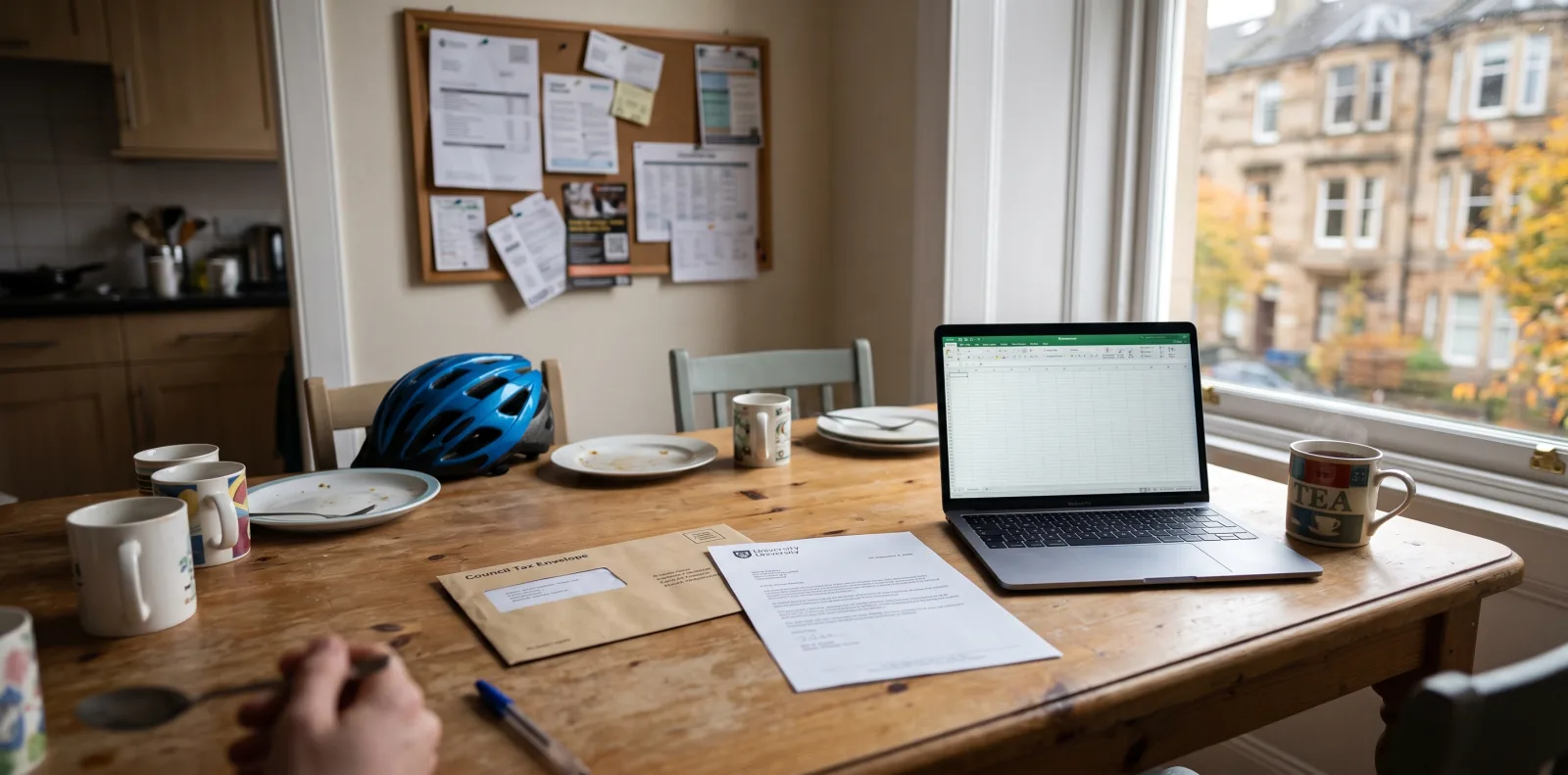
A shared house of five full-time students gets back from the first week of term to find a council tax bill on the doormat, addressed to "The Occupier," for just over two thousand pounds. Someone photographs it for the house group chat, and within minutes there's a plan forming to split it across the rent.
In most of these cases the bill is simply wrong, not because the council is trying to catch anyone out, but because it has no way of knowing who lives in a property until someone tells it. A house full of full-time students is likely entitled to pay nothing, but only once the right paperwork lands on the right desk.
This piece covers who qualifies for student council tax exemption, where the legal definition of "full-time" catches people out, what changes when a working non-student moves in, and how the claim works in practice, with regional differences across England, Scotland, Wales and Northern Ireland flagged along the way.
What council tax is, and why full-time students are treated differently#
Council tax is the local tax that funds services run by your council: bin collections, local policing, social care, libraries, road repairs. It was introduced by the Local Government Finance Act 1992, charged per property rather than per resident, and banded by the property's value from Band A up to Band H.
The standard bill assumes two or more adults live at an address. A single adult living alone gets a 25% discount. Full-time students sit outside that system entirely. Under the Council Tax (Discount Disregards) Order 1992, a dwelling occupied only by full-time students qualifies for the Class N exemption: not a discount, a full exemption, whether the house holds one student or twelve. Full-time students are "disregarded" when the council counts adults at a property, and a property with nobody left to count owes nothing.
To claim it, your council will want a Certificate of Student Status (sometimes called a council tax exemption certificate), issued by your university or college's student records office. It confirms you're enrolled on a course that meets the exemption's definition of full-time, which is narrower than you might assume.
Who actually counts as full-time for this exemption#
This is where the confusion usually starts, because "full-time" here isn't your university's own enrolment category, and has nothing to do with how packed your timetable looks.
A course qualifies as full-time if it runs for at least one academic year (or requires attendance for at least 24 weeks a year, for courses spanning more than one year) and normally requires at least 21 hours of study a week during term time, based on the course's own stated requirements rather than how many hours any individual student puts in.
That 21-hour figure is set broadly, meant to include lectures, seminars, labs and expected private study as the institution defines them, not just scheduled contact hours, which is why humanities and arts students with lighter timetables still generally qualify. It excludes anyone on a genuinely part-time programme and most further education courses under the hours threshold. Under-20s on further education courses sit under a related but separate rule with different thresholds, worth checking directly with your college.
If your course doesn't sit neatly inside "standard full-time degree," ask your student records office whether they'll issue the certificate. GOV.UK's council tax guidance and Citizens Advice both point back to the institution as the authority here.
Living with one non-student changes the maths, not the whole bill#
Student houses rarely stay uniformly student. A common set-up: four full-time students share with a fifth housemate who's finished their course and started working. That's where the full exemption stops applying.
Because full-time students are disregarded for counting purposes, a household of students plus one non-student adult is treated as having a single countable adult, triggering the 25% single-person discount rather than a full exemption. The bill is usually addressed to the non-student resident, since a disregarded student generally isn't the liable party, even though everyone on the tenancy may still be jointly responsible for the rent under a separate agreement with the landlord.
Bring in a second non-student adult and the disregard stops helping. Two countable adults means the ordinary, undiscounted bill applies, split however the household agrees.
| Household composition | Council tax outcome | Who's billed |
|---|---|---|
| All residents full-time students | Full exemption (Class N), nothing owed | Nobody, once certificates are filed |
| Full-time students plus one working non-student | 25% single-person discount only | The non-student resident |
| Full-time students plus two or more non-students | No discount; full bill applies | All non-disregarded residents |
| One student living alone after housemates graduate | Individual exemption continues | Nobody, Class N still applies to one person |
| Students in an HMO with a live-in landlord | Landlord is usually the liable person; exemption depends on the landlord's own status | Landlord, unless they're also disregarded |
| One part-time student among full-time students | Part-time student counts as a liable adult | Depends how many countable adults remain |
Getting the certificate and making the claim stick#
The process is fairly mechanical, but nobody chases it up for you, so it only happens if someone in the house starts it.
Most university portals now generate a Certificate of Student Status as an instant PDF; if yours doesn't, ask the student records office. Register or find the council tax account with the relevant local authority, usually via its website, and submit the certificate for every full-time student on the tenancy alongside the tenancy agreement or a landlord's letter confirming who lives there. If the whole household qualifies, ask specifically for the Class N exemption rather than "a discount," since some online forms default to the wrong option. Keep the confirmation reference, since a mid-year change of housemate can trigger a fresh review.
Doing this before the first bill is generated saves weeks of chasing. Backdating an exemption is usually possible, but slower than getting the paperwork in early.
Where councils get it wrong, and how to push back#
Even in a straightforward all-student household, billing errors happen often enough that Citizens Advice and Save the Student both keep standing guidance on disputing them. Councils sometimes bill automatically the moment a tenancy is registered, before any exemption paperwork arrives, simply because the system has no way yet of knowing who's moving in. When one student graduates mid-year, the council correctly ends that person's disregard but occasionally applies the change to the whole property instead of just that resident. In an HMO (a House in Multiple Occupation), the landlord rather than the tenants is often the liable person, so paperwork needs to go through the landlord's account, and students who apply individually sometimes find nothing registers against the right bill. Certificates needing annual renewal also get missed, so a household exempt one year gets billed again the next through a lapse, not a real change.
If a bill looks wrong, contact the council's council tax team, not the housing team, with the certificate references attached, and ask in writing for the account to be corrected and any disputed charge suspended while it's reviewed. A genuine dispute generally shouldn't be enforced while under review, but get that in writing too.

Part-time courses, sandwich years and other grey areas#
Not every student situation fits the standard template, and this is where people most often lose an exemption they'd assumed was automatic.
Part-time students fall outside the 21-hours-a-week and full-year thresholds by definition, so the disregard doesn't apply, whatever the course is called. A postgraduate doing a part-time master's alongside a job is billed as an ordinary resident.
Sandwich courses, where a placement year sits inside an otherwise full-time degree, are more nuanced. Guidance generally treats students as remaining full-time through a compulsory placement year provided they're still formally enrolled and the placement counts as an assessed part of the qualification, but practice varies between local authorities, and some ask the university to confirm the placement genuinely forms part of the course rather than being a paid gap year attached to it. Anyone heading into a placement year should get that confirmation in advance rather than assume continuity.
The other common trap is timing. The disregard ends when a course finishes or a student formally withdraws, not when the tenancy ends, so a June graduation followed by a lease running to September can generate a real, payable bill for that gap.
Questions students actually ask#
Do international students get the same exemption?#
Yes. The Class N exemption is based on full-time enrolment, not nationality or fee status, so international students on a qualifying course are treated the same as home students. UKCISA's guidance for international students confirms the same enrolment test applies to everyone.
Does this work the same way in Scotland, Wales and Northern Ireland?#
England, Scotland and Wales all run council tax with broadly equivalent student exemptions, though forms and processes are set by each nation's own councils, so check your specific local authority's page rather than assume an English council's process applies elsewhere. Northern Ireland doesn't use council tax at all. It runs a domestic rates system administered by Land & Property Services, with a separate full-time student rates exemption applied for through LPS rather than a local council.
I'm the only student in the house. Does anything apply to me?#
You'd be disregarded individually, but the other adults are still counted normally, so no household exemption applies unless they also qualify for a disregard of their own.
Can I get a refund if I was billed before my exemption came through?#
Generally yes. Once the certificate is submitted and confirmed, councils can backdate the correction, and Citizens Advice recommends asking explicitly, in writing, for a refund of anything already paid.
Does an unpaid or disputed council tax bill affect my credit record?#
Council tax arrears aren't reported like a loan or credit card, but unresolved non-payment can lead to a liability order through the magistrates' court, so raise a genuine dispute with the council rather than leaving a bill unpaid.
Does having a part-time job affect my exemption?#
No. The exemption depends on enrolment status, not income or employment, so working part-time alongside full-time study doesn't change your council tax position.
What if my certificate has expired but I'm still on the same course?#
Contact your student records office for a renewed certificate and resubmit it to the council. Since some councils review student households annually, a lapsed certificate is one of the more common reasons an exempt address suddenly gets billed again.