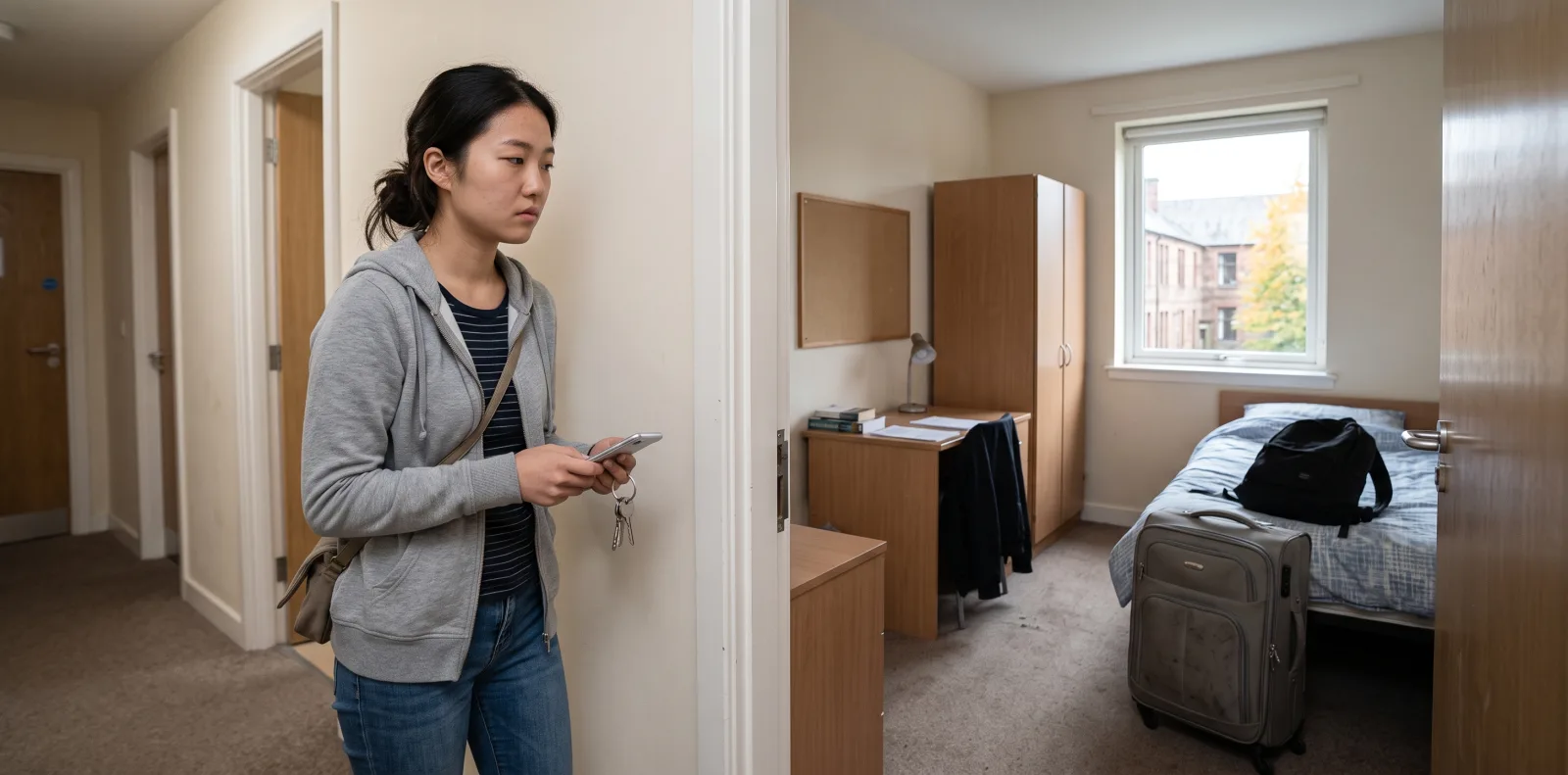
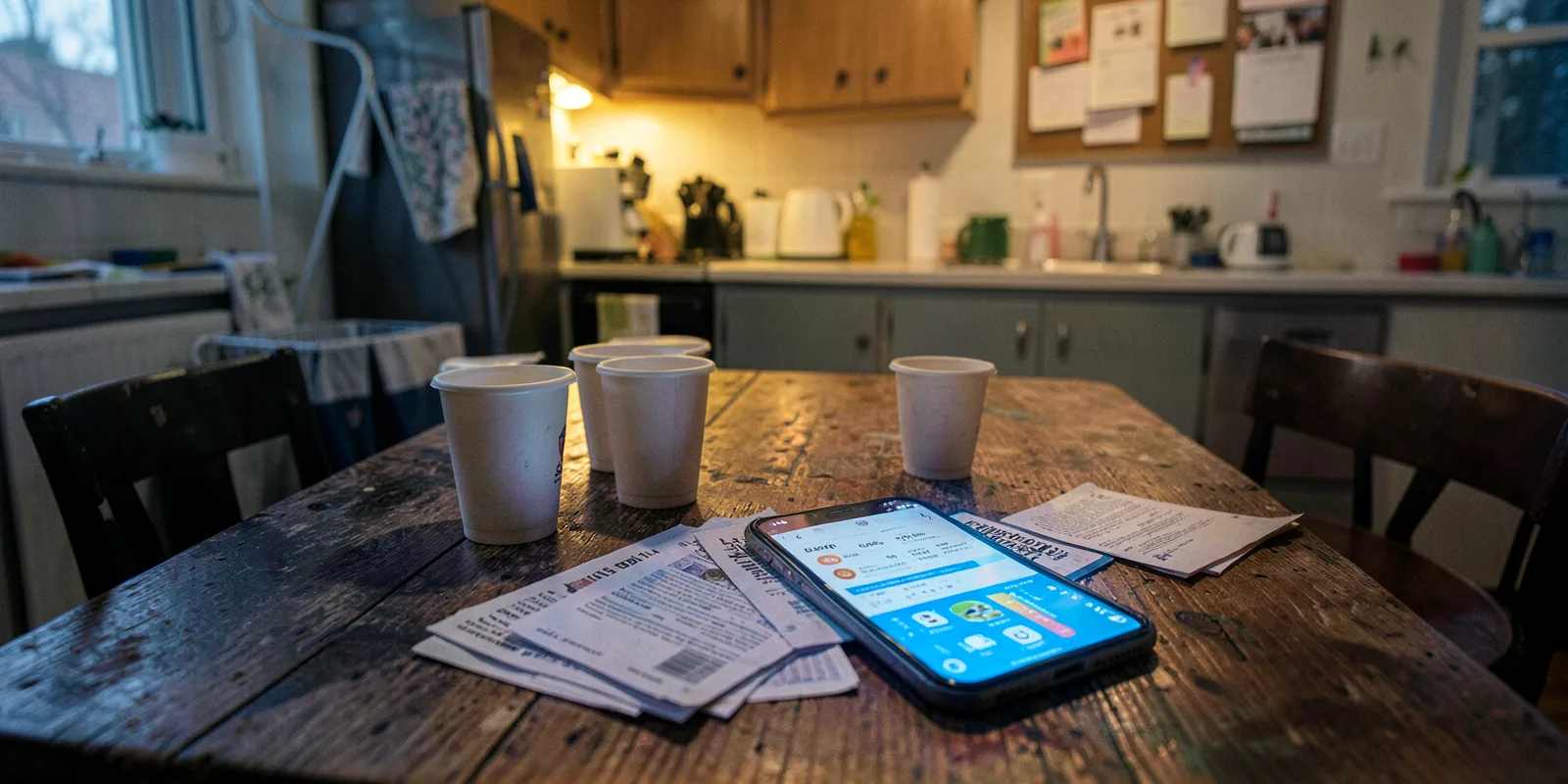
The gas bill message that sits unanswered for three days#
Someone posts the number in the group chat. Two blue ticks appear within the minute. Nobody replies. By day three, whoever paid the bill upfront is liking the original message instead of answering it, which somehow makes things worse.
Every student house has a version of this. It is rarely about the money, most shared bills come to less than a takeaway. It's about the arrangement nobody quite agreed to: who collects it, when, from whom, and what counts as fair when one person has the biggest room and another barely touches the heating. Housing charities and student unions field enough of these disputes that the advice is fairly settled; it just rarely gets discussed before the argument, only after.
What a tenancy agreement actually makes you responsible for#
Most shared student tenancies use a single agreement with everyone's name on it, and that agreement almost always includes a clause for joint and several liability.
In plain terms, the landlord can chase the whole rent, or the whole cost of a repair, from any one tenant, not just their "share". If one housemate vanishes without paying, the landlord can recover the full amount from whoever is left, leaving the group to sort out who owes whom afterwards. Citizens Advice and Shelter both set this out in their guidance on shared tenancies, worth reading before you sign anything. This is why splitting bills matters more in a shared house than between flatmates on separate contracts: an unpaid bill isn't really "their problem", it can become everyone's, including your credit file.
A joint bank account is one practical response: everyone pays a fixed amount in monthly, and bills come out of that pot. A bill-splitting app does something narrower: it logs who paid what and calculates who owes whom, usually without moving money itself. Neither changes the legal liability sitting underneath the tenancy; they just make the tracking less painful.
Equal split, usage-based, or room-weighted: there is no single correct answer#
Ask five student houses how they split bills and expect three different answers, and all three can be defensible.
Equal split divides every bill by the number of tenants. It is the default for most houses, mainly because it needs no discussion and no ongoing tracking. Save the Student's guidance on student bills confirms this is the most common approach, simple to run even when not perfectly proportionate to usage.
Usage-based splitting adjusts for how much of a service someone actually consumes: the person on video calls at home all day pays more towards broadband, the one on placement three days a week pays less towards heating. Fairer in principle, harder in practice, since usage is rarely measured cleanly enough to argue about without resentment building.
Room-weighted splitting ties each share to something fixed and visible, usually room size, an en-suite, or floor. It's common in letting guidance for shared houses, often the method landlords already use to set individual rents, which makes it a natural template for bills too.
None of these is objectively correct. A house where one person is home all day and three others are barely in might genuinely need usage-based splitting; a house with near-identical rooms and hours has little reason to complicate an equal split. The method that causes least conflict usually matches how unequal the house actually is, not how fair it sounds on paper.
Setting up a system in freshers' week that still works in May#
The houses that avoid bill arguments rarely do so through better personalities. They agree the mechanics early, while everyone is still being polite to each other.
That means settling, in week one, which method you're using, who physically holds the money (a joint account, a nominated collector, or an app), and what happens if a bill comes in higher than expected. Write it down somewhere everyone can see, because memory is unreliable and "I thought we agreed" is how most disputes start.
It also means picking a payment date that isn't the day the bill arrives: standing orders set for just after loan instalments land work better than chasing people manually. Unipol and the National Union of Students have long tracked student housing costs, and rising bills rank among the more stressful parts of student life, not because the sums are huge but because the admin never stops.
Build in a review point too. A system that works for autumn energy usage may not survive winter, once everyone runs the heating far more than in September, so revisit the split once a term to head off one person paying more than their share.
The housemate who is always a few days late#
Nearly every shared house has one person whose payment reliably lands after everyone else's. The cause is usually one of two things: a cash flow problem, where the money genuinely isn't there on the day because loan instalments and bill dates don't line up, or a habit problem, where the money is there but chasing it takes effort someone else has to spend.
For cash flow issues, moving the internal deadline a few days after loan payments land solves most of it. For habit issues, a fixed collection date with a consistent monthly nudge from the same person beats sporadic reminders sent in frustration once a bill is overdue. Some houses add a small, agreed late fee for anyone who misses the date by more than a few days: harsh-sounding, but a known consequence prevents more resentment than an unspoken one that surfaces when somebody finally snaps.
What rarely works is silence followed by an explosion. If a bill is genuinely a struggle for someone, that's worth knowing before rent is due, not after a landlord's reminder letter names everyone on the tenancy.
What happens to the bills when someone moves out mid-tenancy#
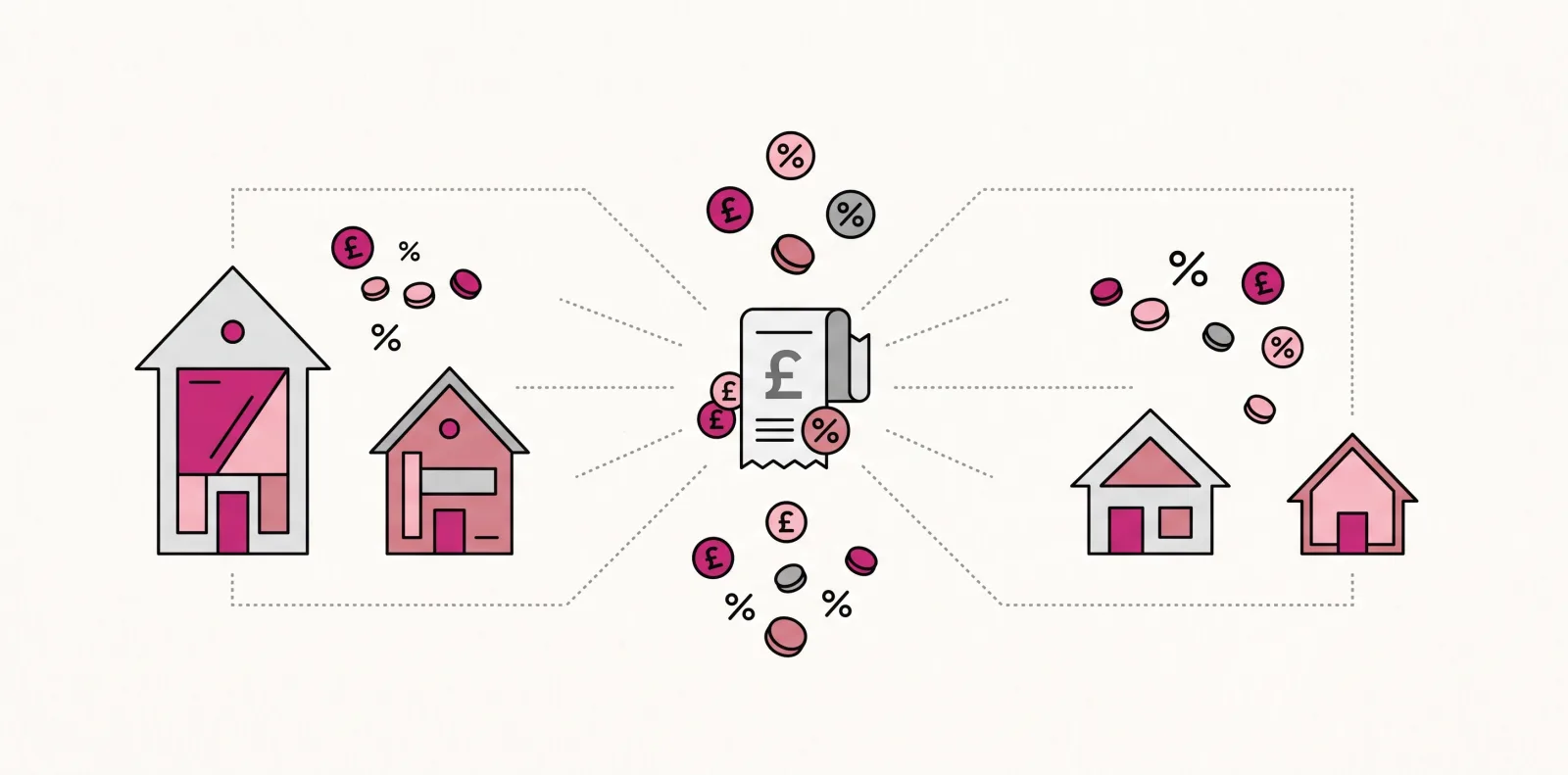
Bill splitting gets harder the moment someone leaves before the tenancy ends, whether for a placement year, a dropped course, or moving in with a partner. Joint and several liability applies to the tenancy as a whole, so remaining housemates are usually still on the hook for the departing person's share unless the agreement is formally changed, typically by adding a landlord-approved replacement tenant to the contract. Shelter's guidance on shared tenancies covers this in detail, and an informal handshake between housemates generally isn't enough as far as the landlord is concerned.
The practical fix is simpler than the legal one: recalculate the split among however many people remain, and agree upfront whether the departing housemate keeps paying until a replacement is found, or the remaining group absorbs it and gets reimbursed later. Neither option is automatically fair; it depends on why the person is leaving and how much notice they gave. What usually causes the falling out isn't the money, but a decision made unilaterally by whoever is left, without asking what the person who moved out thinks they still owe.
Apps, joint accounts, and knowing what each one cannot do for you#
Bill-splitting apps are useful for the unglamorous part of this: remembering who paid what and how much everyone else owes. Splitwise remains the most widely used option among UK students, and newer instant-split tools settle up automatically the moment someone pays, rather than leaving a balance to clear later.
A joint account solves a slightly different problem: it removes the chasing step entirely, since money is pooled upfront, at the cost of everyone trusting each other with shared access to money, not a small ask among near-strangers in week one.
Neither tool fixes a disagreement about the method itself. An app will calculate an equal split down to the penny; it won't tell you that this feels unfair to the person with the box room and worse broadband signal. That conversation still has to happen between people, ideally before the first bill lands rather than after the fifth argument about it.
Questions students actually ask about splitting bills#
Is an equal split always the fairest option?#
Not necessarily, though it's the most common because it's simplest to run and works best when rooms and usage are broadly alike. Where one room is clearly larger or one person's usage is genuinely higher, a room-weighted or usage-based split may feel fairer.
What is joint and several liability, in one sentence?#
A landlord can pursue any single tenant on a shared agreement for the full amount owed, rent or damages, not just that person's calculated share, leaving the tenants to sort out reimbursement afterwards.
Do full-time students pay council tax?#
Full-time students are generally exempt, but a household stops being exempt the moment it includes a part-time student or a non-student resident, at which point the whole property may become liable.
Should we use a joint account or a bill-splitting app?#
A joint account removes the need to chase repayments because money is pooled upfront; an app tracks who owes whom without moving money. Some houses use an app for lower-stakes costs and a joint account for larger, predictable bills like energy and broadband.
What if someone genuinely cannot afford their share?#
Address it directly and early rather than letting it surface as a missed payment. Because of joint and several liability, an unpaid bill can become the whole house's problem. University wellbeing and money advice services can help, and raising it early gives more options than a final demand letter.
Does splitting bills by room size actually work?#
Reasonably well as a starting principle, particularly when a landlord already prices rooms differently within one tenancy. It breaks down when room size doesn't track usage: a person in the smallest room running a desktop all day may still use more electricity than someone in a larger room who's rarely in.
How do we handle a bill that comes in far higher than expected?#
Agree in advance how unusually large bills get absorbed, whether that's an equal top-up regardless of the usual split, or a short conversation about the cause first. Deciding this while calm beats deciding it while annoyed.
The system matters more than the formula#
There is no single correct way to split bills in a student house, whatever a comparison chart or a confident housemate might imply. What separates the houses that get through the year without a falling out from the ones that do not is rarely the method they chose. It is whether they agreed it out loud, wrote it down, and revisited it before resentment had the chance to build. The gas bill will always arrive. Whether it starts an argument is mostly down to what was decided weeks before it did.