The link with no name on it#
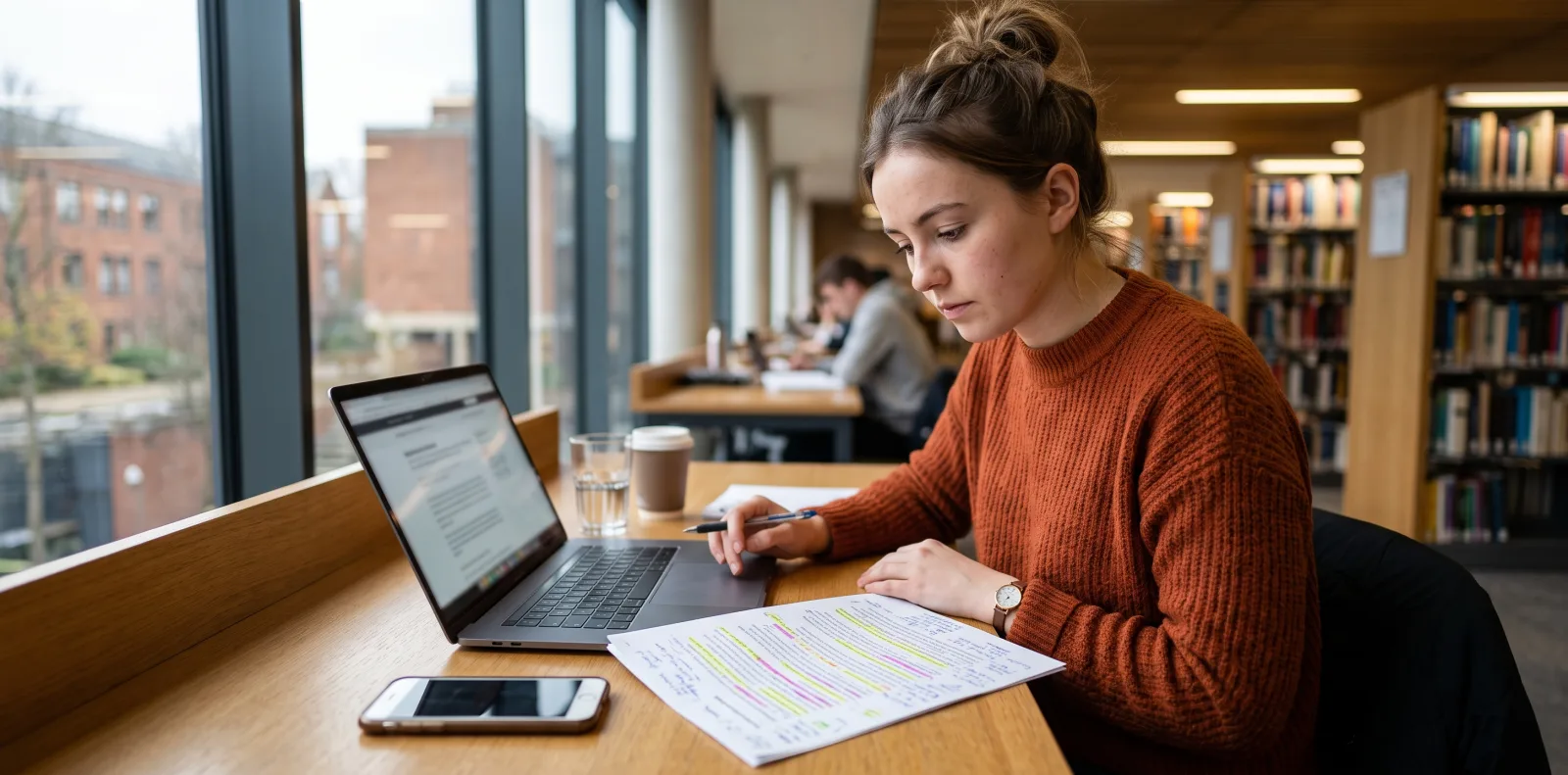
You have found the perfect source. A government report, a charity's explainer page, a diagram that finally makes the concept click. You go to reference it and discover there is no author listed anywhere, no date you can find, and the "page" is actually a PDF that opens in a new tab. Cue the small panic that has nothing to do with your argument and everything to do with formatting.
This happens constantly, and it is not a sign you picked a bad source. Books are built to be referenced: title page, publisher, year, all present and correct. Websites were not designed with your reference list in mind. Learning how to reference a website in Harvard style, including the messy cases, is less about memorising a rulebook and more about knowing what to substitute when the information you'd normally slot in simply is not there.
Why websites break the rules books follow#
Harvard referencing, used across most UK universities, follows the author-date system: an in-text citation like (Smith, 2024) points to a fuller entry in the reference list, ordered alphabetically by surname. The UK's most widely adopted guide is Cite Them Right by Pears and Shields, and most university library guides, from Leeds to Manchester to Anglia Ruskin, base their own Harvard guidance directly on it.
A book almost always gives you a named author, a clear year and a title page. A webpage might give you none of these, since websites are edited, republished under an organisation's name, or built by teams rather than individuals. Two terms come up constantly once you start referencing web content. A corporate author is an organisation, company or body credited as the author instead of a person, for example NHS or a university itself; Cite Them Right treats it exactly like a personal author. n.d. stands for "no date," used in place of a year when a source genuinely does not show when it was written or updated.
The other feature unique to web sources is the access date. Webpages can be edited or removed after you've read them, unlike a printed book, so Harvard referencing asks you to record the date you accessed the page, so anyone checking your work knows what version you saw.
Quick reference: what to substitute when something's missing#
| What's missing from the source | What to use instead |
|---|---|
| No individual author named | The organisation or body responsible for the site (corporate author) |
| No author and no organisation at all | The title of the page, moved into the author position |
| No visible publication or update date | n.d. in place of the year |
| No page numbers (most webpages) | Omit them; use paragraph numbers only if quoting directly and the source provides them |
| No fixed "publisher" | The website or platform name, if different from the author |
| Content likely to change or disappear | An Accessed date recording when you viewed it |
When there's no named author#
Scan the page footer, the "About" section and any linked policy documents before concluding a page has no author. Often what looks authorless actually has a corporate author sitting in a footer or logo. A page on managing student finance published on a university's own site, for instance, is authored by that university even without a byline.
In-text: (University of Leeds, 2025)
Reference list: University of Leeds (2025) Managing your student finance. Available at: https://www.leeds.ac.uk/student-finance (Accessed: 3 September 2026).
If you've genuinely checked and nobody at all is credited, Cite Them Right's fallback is to use the page title itself in the author position, italicised:
In-text: (Understanding contract law basics, 2024)
Reference list: Understanding contract law basics (2024) Available at: https://example.com/contract-law-basics (Accessed: 3 September 2026).
When there's no visible date#
Check the page bottom, the browser tab, and the page's source code before settling for n.d.; a right-click "View Page Source" search for "date" sometimes surfaces a publish date the visible page doesn't show. A copyright year such as "© 2023" isn't necessarily the publication date, and should only be used if there's no better clue.
In-text: (Mind, n.d.)
Reference list: Mind (n.d.) Managing anxiety and panic attacks. Available at: https://www.mind.org.uk/anxiety-panic-attacks (Accessed: 3 September 2026).
The access date still matters here, since it's the closest thing you have to a timestamp on undated content. If the page sits within a blog archive or news index, the surrounding URL structure or the archive listing it's filed under sometimes gives away a month or year even when the page itself stays silent on it. The Wayback Machine is worth a try too: searching a page's URL there often surfaces the earliest date it was captured, which gives you a reasonable sense of when the content first went live, even though you would still cite the source as n.d. unless you are confident that capture date matches the actual publication date.
When the source is a PDF report#
A PDF found online is usually a report, guidance document or dataset rather than a standard webpage, and it typically carries author and date information a webpage might lack, since organisations date their formal publications. Reference it as you would any report, adding the URL and access date because you retrieved it online.
In-text: (Office for National Statistics, 2025)
Reference list: Office for National Statistics (2025) UK graduate labour market statistics. Available at: https://www.ons.gov.uk/graduate-labour-market-2025.pdf (Accessed: 3 September 2026).
If the PDF belongs to a numbered series, add that after the title: UK graduate labour market statistics (Report No. 14).
When the source is a social media post#
Referencing a tweet feels informal, but Cite Them Right has a format for it: the account is the author, and the post's own text stands in for the title.
In-text: (UCAS, 2026)
Reference list: UCAS (2026) Clearing opens today at 8am. If your results didn't go to plan, our advisers are ready to talk you through your options [X]. 14 August. Available at: https://x.com/ucas_online/status/1234567890 (Accessed: 3 September 2026).
Use the account's display name as author, quote the post's opening words as a stand-in title (up to the first twenty, or the whole post if shorter), name the platform in square brackets, and link the specific post rather than the account homepage. The same pattern covers Instagram captions and LinkedIn posts, with the platform name adjusted.
When the source is a video or online lecture#
Video content follows the same author-date logic as any other webpage, but the "author" is usually the channel or organisation that uploaded it, not the person speaking on screen, and the reference needs to reflect that distinction clearly.
In-text: (TED, 2024)
Reference list: TED (2024) How language shapes the way we think [Online video]. Available at: https://www.youtube.com/watch?v=RKK7wGAYP6k (Accessed: 3 September 2026).
If the speaker matters to your argument, for instance because you are quoting them directly, name them in your own sentence ("As linguist Lera Boroditsky explains in a TED talk...") while still crediting the channel as the formal author in the reference list, since that is who actually published and hosts the recording. The same logic covers a university's own recorded lecture series or a conference talk uploaded by the organising body.
When the source is an image or infographic#
A diagram found through a search engine still needs its original creator credited, not the search engine or the page it happened to be embedded in. Trace it back to source where you can.
In-text: (Public Health England, 2023)
Reference list: Public Health England (2023) Five-a-day fruit and vegetable guide Infographic.
If the image has no traceable creator at all, fall back to the authorless-webpage rule: use its title, or a short descriptive title you construct, in the author position, followed by the medium in square brackets.
Common questions#
What if a webpage has no author and no organisation behind it at all?#
Rare once you've checked thoroughly, but it happens with older personal blogs and niche forums. Use the page title in the author position, as shown above, and flag the source's reliability to your tutor if that itself is in question.
Do I need to italicise the name of the website?#
Cite Them Right italicises the title of the page or document, not the hosting website's name. A specific article title is italicised; "gov.uk" or "BBC News" as the site name isn't, unless the site name is also functioning as the title.
Is a copyright footer year the same as a publication date?#
Not necessarily. A "© 2026" footer often just reflects when a site's template was last updated, not when the specific page content was written. Use it only as an estimate, when there's no better date signal available.
How do I reference a page that has since changed or vanished?#
Your access date protects you here: it shows exactly which version of the page you saw if a marker ever queries a discrepancy. Save a PDF or screenshot of pages carrying unusual weight in your argument, in case they disappear before submission.
Can I ever cite Wikipedia in Harvard style?#
Technically yes, using the authorless or corporately-authored format above. Whether you should is separate. Most UK universities treat it as a starting point for orientation rather than a citable academic source, since its content can change at any time. Follow its own references back to the original research instead.
Does every university follow identical Harvard rules?#
No, and this catches people out. Cite Them Right is the most widely used UK version, but some universities modify details, using "Cited" instead of "Accessed," or an exact time alongside the date for fast-changing sources like social media. Check your department's own guide before submission, and stay consistent throughout one piece of work.
The habit worth building#
None of these cases need a different citation system, only a willingness to look a little harder for what's missing before reaching for a shortcut. Check the footer for a corporate author before assuming there is none. Search the page source before writing n.d. Trace an image back past the page that embedded it. JISC's academic integrity guidance makes the same point in the end: accurate referencing is less about following a format perfectly and more about showing, honestly, where your evidence came from. Get that habit right, and the awkward cases stop being awkward.