
The reference list you swore you'd finish earlier#
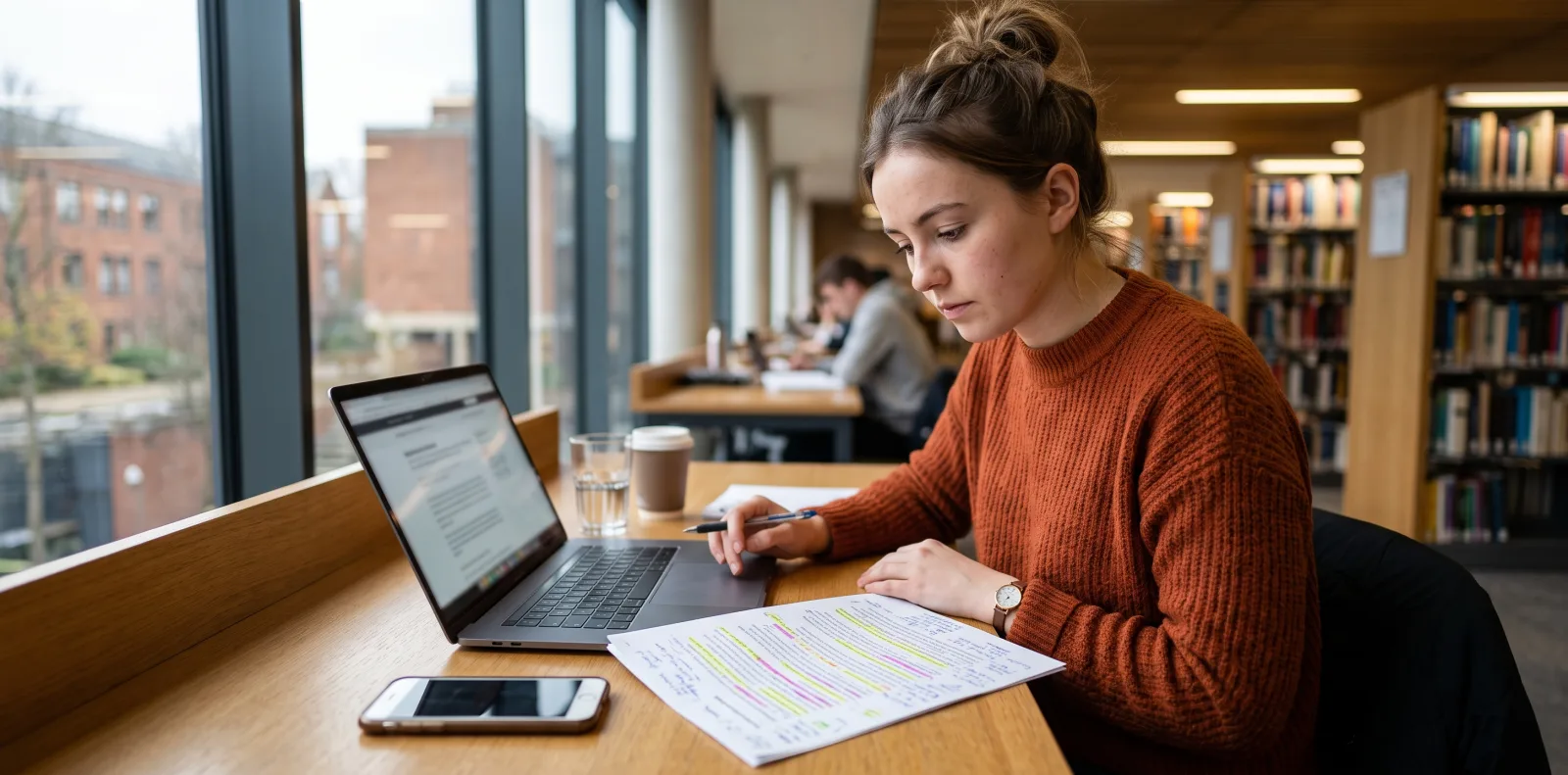
It's gone 1am, the essay has been done for hours, and you're still awake over eleven sources that all need formatting differently. One is a book. One is a journal article you only read the abstract of. One is a government website with no listed author. One is, awkwardly, a conversation you had with ChatGPT, and you have no idea if that even counts as a source.
You are not alone in this. UK search interest in "harvard referencing" roughly triples between September and November each year, peaking hard before first-term deadlines, then rising again in March as dissertations land. The panic is seasonal and predictable, which is useful: it means the fix is learnable, not a personality flaw.
What Harvard referencing actually is#
Harvard referencing is an author-date system for acknowledging other people's work. It has two linked parts. The in-text citation interrupts your sentence briefly, usually a surname and year in brackets, like (Smith, 2023). The reference list is the full alphabetical list at the end that lets a reader find what you cited. The two must match: everything bracketed in the text appears in the list, and nothing appears in the list that wasn't cited.
Here's the part nobody warns you about. "Harvard" isn't a fixed rulebook owned by Harvard University, which barely uses it. It's a loose family of author-date conventions that institutions adapt. The most widely used UK version comes from Cite Them Right by Pears and Shields, now the default guide at most UK universities and available through their library's subscription to Cite Them Right Online. But Leeds, Anglia Ruskin, Cardiff, Manchester Metropolitan and UWE Bristol all publish their own house variants, differing in small things like punctuation after the year or whether "and" or "&" joins two authors. This piece follows standard Cite Them Right conventions. Always check your department's guide before you submit, since markers grade against their institution's version, not a generic one.
Books and chapters#
For a whole book, the reference-list format is: Surname, Initial. (Year) Title of book. Edition (if not the first). Place of publication: Publisher.
Example: Bryman, A. (2016) Social research methods. 5th edn. Oxford: Oxford University Press.
In text: (Bryman, 2016) or, for a direct quote, (Bryman, 2016, p. 45).
A chapter in an edited collection is treated differently, because you're crediting the chapter's author, not the book's editor: Surname, Initial. (Year) 'Title of chapter', in Editor Surname, Initial. (ed.) Title of book. Place: Publisher, pp. xx-xx.
Example: Okafor, T. (2021) 'Migration and identity', in Hughes, R. (ed.) Contemporary sociology. London: Routledge, pp. 112-130.
E-books follow the same format, with one adjustment worth knowing. If you read a Kindle or app-based edition with no fixed page numbers, Cite Them Right allows you to replace the page number in a direct quote with a chapter or location reference instead, since that's the only stable way to point a reader back to the passage.
Example: Bryman, A. (2016) Social research methods. 5th edn. Kindle edn. Oxford: Oxford University Press.
In text: (Bryman, 2016, ch. 3) rather than a page number that only exists on your device.
Journal articles#
Journal referencing has more fields to get right: author, year, article title in quotation marks, journal title in italics, volume, issue in brackets, page range.
Format: Surname, Initial. (Year) 'Title of article', Journal Name, Volume(Issue), pp. xx-xx.
Example: Patel, R. and Owusu, K. (2022) 'Student wellbeing during assessment periods', Studies in Higher Education, 47(3), pp. 512-529.
If you accessed it online, add: Available at: https://doi.org/xxxxx (Accessed: 3 March 2026). A DOI, or digital object identifier, is a permanent link assigned to an article. Most UK library guides recommend using it instead of a database URL, since database links often expire or need a login.
Not every article has been slotted into a numbered issue yet. Journals often publish work online months ahead of print, labelled 'online first' or 'advance access'. Cite it the same way, using whatever the journal shows in place of the volume and issue.
Example: Whitfield, S. (2026) 'Remote learning and academic confidence', Studies in Higher Education, Advance online publication. Available at: https://doi.org/xxxxx (Accessed: 12 September 2026).
If the article is later assigned a proper volume and issue and you're still revising your work, go back and update the reference to match the final published version.
Websites and organisational pages#
This is where "no clear author" throws people. Use the organisation as the author if no individual is named.
Format: Author or Organisation (Year) Title of webpage. Available at: URL (Accessed: date).
Example: NHS (2025) Managing exam stress. Available at: https://www.nhs.uk/mental-health/self-help/guides/exam-stress (Accessed: 12 September 2026).
If there's genuinely no date on the page, Cite Them Right's convention is to write (no date) rather than guess. The access date matters here in a way it doesn't for a printed book: web pages change or vanish, so it records what you actually saw.
AI chatbots: ChatGPT, Claude and similar tools#
This is the newest, least settled corner of referencing, so it's worth being honest rather than pretending there's a decades-old rule. Generative AI tools don't produce a fixed, retrievable text the way a book does. Ask the same question twice and you can get two different answers, so nobody can go back and check your exact source the way they could with a journal article.
The convention Cite Them Right and most UK libraries have converged on treats the AI developer as author and the tool as something close to unpublished material.
Format: Company (Year) Name of AI tool (version, if known) [Large language model]. Available at: URL (Accessed: date).
Example: OpenAI (2026) ChatGPT [Large language model]. Available at: https://chat.openai.com (Accessed: 12 September 2026).
In text: (OpenAI, 2026).
Two things matter more than the format. Because the output can't be reproduced, many universities ask you to paste the full prompt-and-response transcript into an appendix, so your marker can see what you actually generated. More importantly, whether you're allowed to use AI at all, and how you must declare it, is set by your assignment brief and your institution's academic integrity policy, following JISC guidance on generative AI in assessment, not by a referencing style guide. Citing it correctly doesn't make a prohibited use acceptable. Check the brief before you check the format.
Lecture slides and VLE material#
Format: Lecturer Surname, Initial. (Year) 'Title of lecture or slide title' [PowerPoint presentation, module code and title]. Institution. Available at: VLE name (Accessed: date).
Example: Ahmed, F. (2026) 'Introduction to research methods' [PowerPoint presentation, PSYC1010 Research Methods]. University of Leeds. Available at: Minerva VLE (Accessed: 10 September 2026).
The more useful advice here isn't formatting, it's a habit. Lecture slides usually summarise someone else's research rather than being the research itself. Where possible, track down and cite the actual study or textbook the slide draws on. It reads as stronger academic work, and avoids the odd situation of citing a PowerPoint as a primary source.
Films and documentaries#
Format: Title of Film (Year) Directed by Director's Initial. Surname. [Format]. Place: Production company or distributor.
Example: The Social Dilemma (2020) Directed by J. Orlowski. [Netflix]. Exposure Labs.
In text, films are cited by title rather than director, since the title is what goes first in the reference list: (The Social Dilemma, 2020).
For a broadcast TV documentary rather than a streaming release, Cite Them Right's format instead names the channel and broadcast date: Blue Planet II (2017) [TV programme]. BBC One, 29 October.
That pattern is the point of this guide. Referencing panic clusters exactly when coursework and dissertations are due, so the fix is logging the boring bibliographic details while you're still reading, not reconstructing them from memory at midnight.
Frequently asked questions#
What if a source has no named author?#
Use the organisation responsible for the page in place of a personal author, for example NHS or JISC. If nothing identifies who produced it, which is rare, use the title instead and cite it by a shortened version of that title.
What if there's no publication date?#
Write (no date) both in the in-text citation and the reference list, rather than guessing a year. Don't leave the date field blank; a missing date and an unknown date are different things to a marker.
How do I cite a source I found quoted inside another source?#
This is secondary referencing, and Cite Them Right recommends avoiding it by tracking down the original wherever you can. When that's genuinely not possible, cite both: (Original Author, Original Year, cited in Author You Read, Year You Read It). Only the source you actually read goes in your reference list.
I've cited the same author twice with different years. How do I tell them apart?#
If two works by the same author share a year, add lower-case letters after the year in the order they appear in your reference list: (Smith, 2023a) and (Smith, 2023b). Keep the lettering consistent between your in-text citations and your reference list entries.
Do I need "et al." for every source with several authors?#
Cite Them Right's standard rule is to name up to three authors in full, then use "et al." (Latin for "and others") from the fourth onwards. Check your own style guide, since some UK universities set that threshold at four rather than three.
What's the difference between a reference list and a bibliography?#
A reference list contains only the sources you've actually cited. A bibliography is broader: it includes everything you consulted while researching, even background reading you never quoted or paraphrased. Most UK Harvard assignments ask for a reference list only. Check your module handbook if you're unsure, since some dissertations require a bibliography too, and submitting the wrong one can lose you easy marks for no good reason.
Is a referencing generator good enough on its own?#
Generators are a reasonable starting point but are known to mishandle edited books, multiple editions and non-standard sources like social media or AI tools. Treat their output as a first draft, then check it against Cite Them Right or your library guide before you submit.
Does referencing correctly protect me from a plagiarism accusation?#
It's the single biggest factor. Most academic misconduct panels distinguish poor academic practice, an unintentional error from misunderstanding the rules, from deliberate plagiarism, where the intent to pass off someone else's work as your own is clear. Consistent referencing is the evidence that puts you in the first category rather than the second. If you're ever unsure whether something needs a citation, your university's academic skills or library team would rather answer that now than after submission.