

The year your coursemates start earning and you don't#
Somewhere near the end of second year, a version of this conversation happens in every shared kitchen. One flatmate has accepted an industrial placement with a graduate scheme they will not officially join until after their degree. Another has just worked out that a friend from home, no degree, no placement, is already earning a full salary. The maths feels uncomfortable: a placement year usually pays somewhere between minimum wage and a modest graduate-adjacent salary, and it delays your actual degree and your actual graduate income by twelve months.
So the question students sit with is blunt. Is a placement year worth giving up a year of full salary for something universities describe in fairly vague terms as "experience"? The honest answer depends heavily on your subject, your employer, and what you were realistically going to do with that year otherwise. The evidence is useful here, just less tidy than the average prospectus suggests.
What a placement year involves, and what it costs upfront#
A placement year, often called an industrial placement or a year in industry, is a period of paid work with an employer that sits inside an undergraduate degree, usually between the second and final year. Courses built around this structure are traditionally called sandwich courses, because the work placement is layered between two blocks of academic study. A "thick sandwich" is one full year in industry; a "thin sandwich" splits shorter blocks across the degree. Most run 9 to 12 months and are paid, though pay varies enormously, from close to minimum wage in some charities and public bodies to competitive, graduate-adjacent salaries at large engineering, finance and technology employers.
Two practical things change while you are on placement. First, your tuition fee drops. The Student Loans Company caps what universities can charge for a sandwich placement year well below the standard fee, historically around £1,850 for English universities against roughly £9,250 for a normal year (Student Loans Company placement-year fee rules, updated via gov.uk). Second, your maintenance loan is recalculated at a lower, non-London undergraduate rate regardless of where you are placed, and it stays means-tested against household income, not against whatever the placement pays you. That gap, between a placement salary and a shrunken loan, is often where the real squeeze sits, not the tuition fee itself.
The money question: what you give up, and what you get back#
The headline cost is straightforward: a year not spent as a full-time graduate is a year of graduate salary not earned, plus a year of postponed pension contributions and career progression. If a graduate role pays around £28,000 to £30,000 in your sector, a placement paying £18,000 to £22,000 is a real gap, before the extra year of rent, food and loan interest.
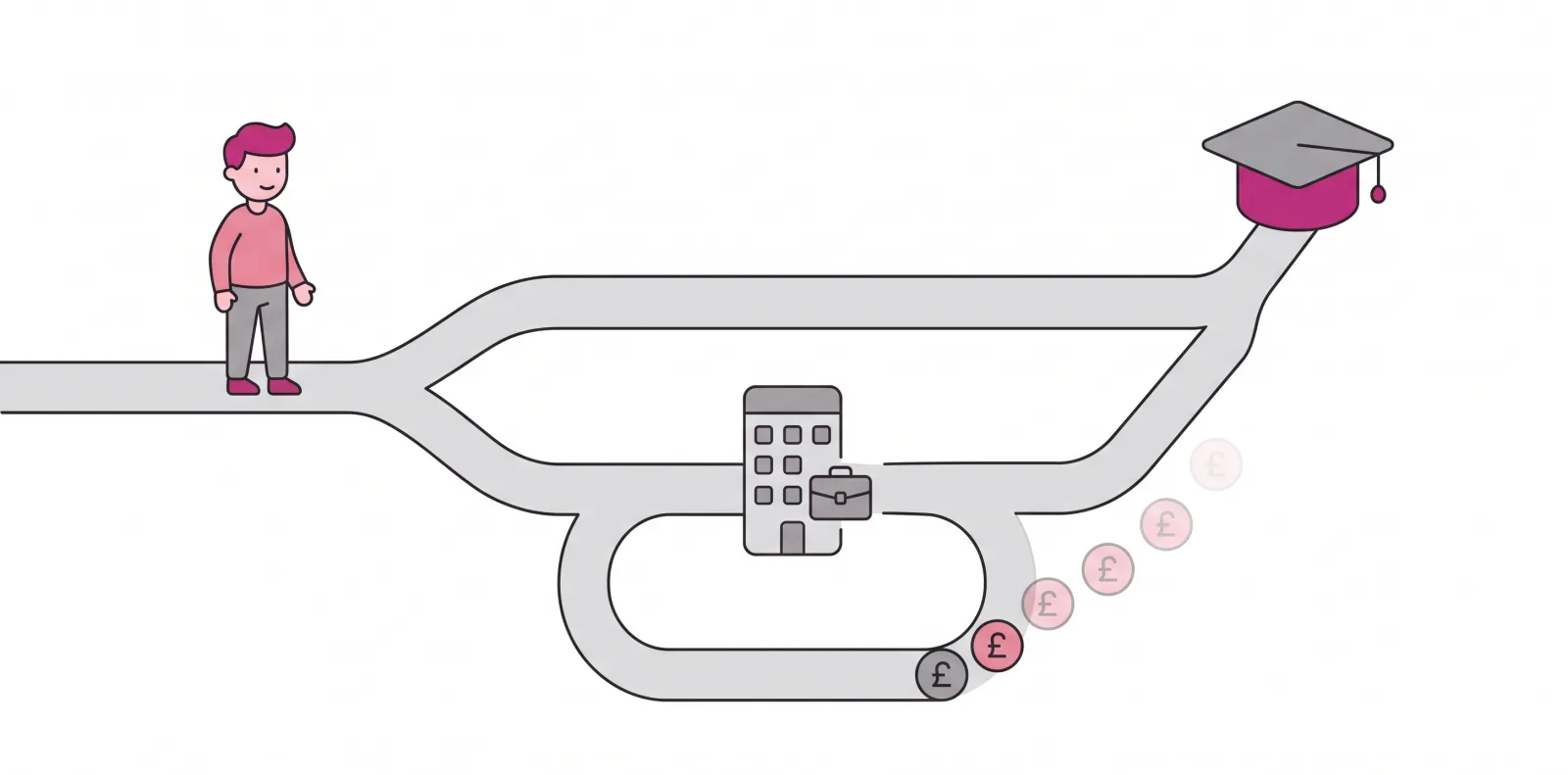
Against that, the reduced fee saves a meaningful chunk of borrowing, and a placement salary is still income, unlike a standard summer break. There's also a concrete mechanism at work here, not just a soft benefit: many large employers run their placement schemes as an extended interview. Some placement students get a conditional graduate job offer before final year even starts, turning what is usually a stressful job hunt into a formality. Whether that happens comes down to the employer and how you perform on the job, nothing more.
High Fliers Research, which surveys Britain's top graduate employers every year for its Graduate Market report, has found for several years running that close to half of entry-level vacancies at the biggest recruiters go to people who already have history with the company, usually through a placement, internship or vacation scheme. The share moves year to year, but the pattern has held for a decade. A placement is frequently a trial run for a real job, and it works out that way for a lot of students.
What the graduate outcomes data shows, and where it breaks down#
The most-cited UK source here is the HESA Graduate Outcomes survey, an official annual survey run by the Higher Education Statistics Agency that contacts graduates around 15 months after they finish. Prospects, the graduate careers service run by Jisc, regularly analyses this data and has consistently found that graduates from sandwich or placement-year courses report somewhat higher rates of "highly skilled" employment, HESA's term for graduate-level roles, than comparable graduates without one.
Here is the part left out of open day talks: this is correlation, not proof the placement caused the better outcome. Students who choose a placement year tend to be more organised and career-focused to begin with, the kind who were always likely to land a good graduate job. Researchers call this self-selection bias, and it means the gap probably mixes two things: the placement genuinely building skills, and better-prepared students choosing placements in the first place. Nobody has run a randomised trial assigning students to placement or no placement, so nobody can cleanly separate the two. Treat the outcomes gap as real but overstated if read as pure cause and effect.
Does a placement year change your final degree classification?#
Many universities advertise a "with placement" degree title and note that placement students often finish with a slightly better final classification than non-placement peers on the same course, a pattern echoed in reports from placement offices at institutions such as Kingston, Surrey and Nottingham Trent. ASET, the UK's professional body for placement and employability practitioners, has published work summarising similar findings.
The likely mechanism isn't mysterious. A year away from lectures gives students time to mature, see how their subject applies in practice, and come back to final year with clearer motivation. But the self-selection problem shows up here too, since students who opt into a placement are often stronger performers to start with. Universities also know that "placement students get better degrees" makes a good line on an open day, so treat any single institution's headline percentage as marketing until you can see the methodology behind it.
The benefits a salary comparison doesn't capture#
Some of what a placement year buys does not show up in a payslip or a HESA table. Students who take one usually leave with a working professional network, a manager willing to give a specific, detailed reference rather than a generic academic one, and a clearer sense of what a given industry is like day to day. That clarity cuts both ways. Plenty of students discover during a placement that the career they were aiming for is not what they imagined, which is a cheap way to find that out before committing to a graduate job in the same field.
Careers advisers also describe a confidence effect, harder to measure but easy to spot: students who have already worked full time and delivered on real deadlines tend to interview differently to those who haven't. It reads as fluency rather than rehearsed answers.
When a placement year is probably the wrong call#
A placement year is not automatically right for everyone, and treating it as a default rather than a choice ignores the trade-offs. It suits students less well when their subject already has a direct route to strong graduate outcomes without one, when family finances mean an extra year genuinely cannot be absorbed, or when a summer internship already gets most of the same experience for a fraction of the delay. It is also a poor fit for students certain about a research-heavy academic path, where an extra year in the lab might serve them better than a year in an unrelated industry role. International students should check visa and funding rules around a UK placement year well in advance, since they add real complexity a home student does not face.
Placement year questions students ask#
Does a placement year mean an extra year of tuition fees?#
Yes, but at a reduced rate. English universities can only charge the Student Loans Company's capped placement-year fee, historically around £1,850, not the standard £9,250. Check your own university's current figure, since it is reviewed periodically.
Will my maintenance loan drop while I'm on placement?#
Usually. You are assessed at the standard non-London undergraduate rate regardless of your placement salary or location, and it stays means-tested against household income. Many students find the placement salary needs to cover the gap left by a reduced loan.
Do employers pay placement students properly?#
It varies hugely by sector. Engineering, technology and finance employers often pay close to graduate-adjacent salaries; charities, the public sector and smaller firms pay closer to minimum wage. Check a specific employer's placement pay rather than assuming a UK-wide average applies.
Is a placement year better than a series of shorter internships?#
Neither is universally better. A placement gives depth, a longer relationship with one employer and a stronger chance of a job offer there. Shorter internships or vacation schemes let you sample multiple sectors faster, which suits students less certain what they want.
Does a placement year guarantee a better degree classification?#
No. The correlation is real in several UK universities' own data, but it is not proof of causation, since students who choose placements often perform well regardless. Treat it as a plausible benefit, not a guaranteed uplift.
What if my placement employer doesn't offer me a graduate job afterwards?#
That is common and not a signal of failure. You still finish with a full year of real, referenceable work experience and the transferable evidence needed to apply confidently elsewhere.
Can international students do a UK placement year?#
Often yes, but visa conditions and sponsorship rules vary by institution and employer, and need checking with your international office well before you apply, since the timeline runs longer than for home students.
Run the numbers for your own course, not the average one#
The honest verdict is that a placement year is a genuine financial cost with a plausible, evidence-backed but not guaranteed payoff, and the size of that payoff depends far more on your subject, your specific employer and your own performance than on the fact of doing one at all. Before committing, look at your own department's actual placement destinations and salaries rather than sector-wide averages, ask your university's careers service for their honest, unpolished numbers, and weigh the concrete year of lost salary against a benefit that is real on average but never guaranteed for you individually.