
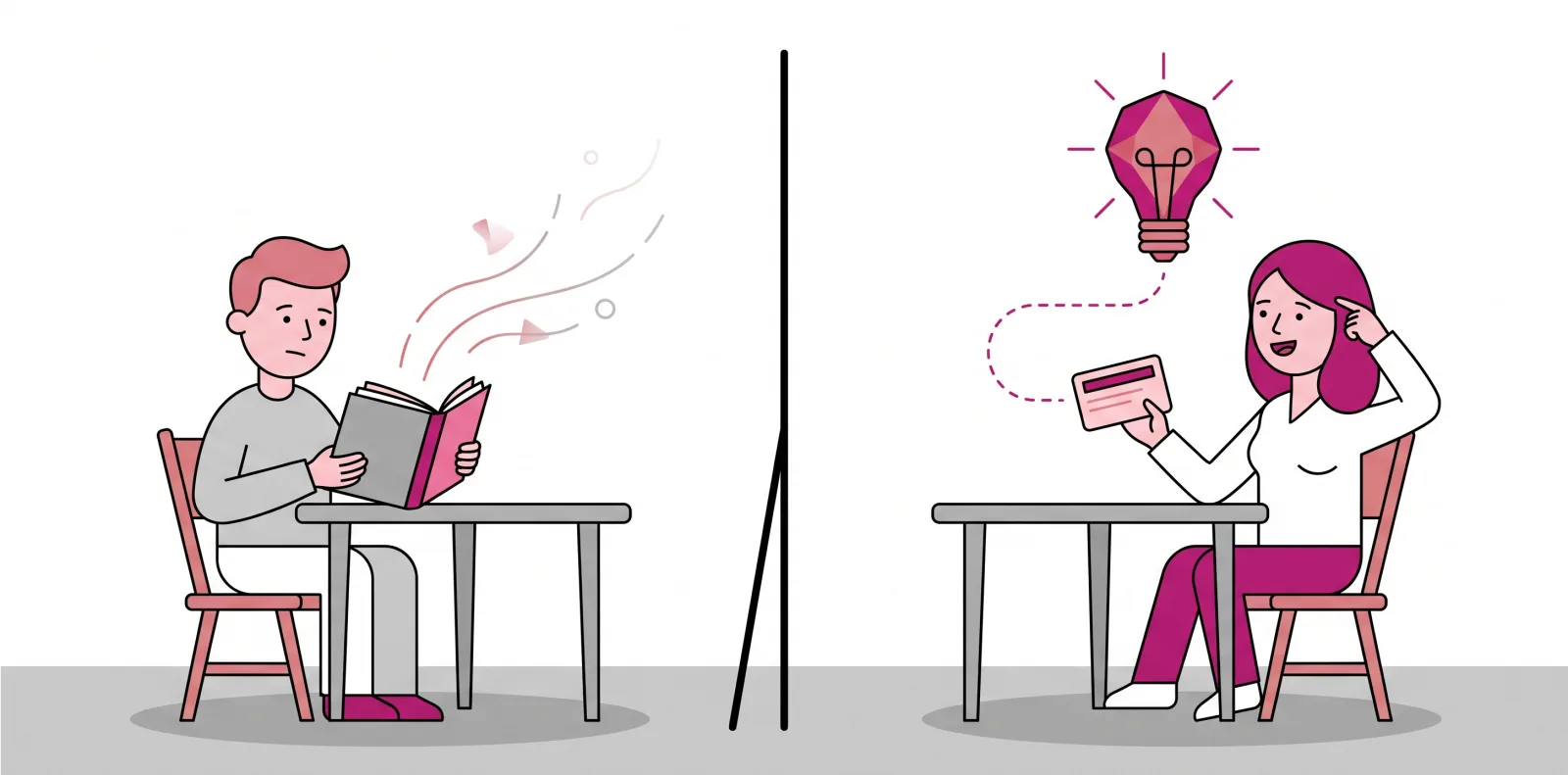
You've read that page five times. You still can't recall it.#
You close the textbook, cover the page, and try to say the definition out loud. Nothing comes. Ten minutes ago, reading that same paragraph, it all made sense. You nodded along. You even thought, "yeah, I know this."
That gap between feeling like you know something and being able to produce it from memory is one of the best-documented traps in student revision. Cognitive psychologists call it the fluency illusion, and it explains why so many students walk into exams having "revised for hours" and still blank on question one.
The fix isn't a new app or a longer timetable. It's a simple swap: testing yourself instead of reading things again. Researchers call this active recall, and the evidence behind it is unusually solid for something so cheap.
What active recall and the testing effect actually mean#
Active recall is retrieving information from memory without looking at the source, rather than re-exposing yourself to the source and hoping it sticks. Closing your notes and writing down everything you remember is active recall. Rereading the same notes with a highlighter is not, however many colours are involved.
The testing effect, also called retrieval practice, is the finding that retrieving information, even once, strengthens memory more than an equivalent amount of time spent restudying it. A test doesn't just measure what you know. It changes what you know, by making it easier to retrieve next time.
Rereading fools people because of a distinction psychologists draw between recognition and retrieval. Rereading a page makes your brain recognise the words as familiar, and that familiarity feels like understanding. But recognising a fact placed in front of you is a different mental operation from generating that fact unprompted, which is what an exam demands. Fluency of recognition is not the same as retrievability, and confusing the two is how confident students underperform.
The review that reordered how psychologists rank study techniques#
In 2013, John Dunlosky and colleagues published a review in Psychological Science in the Public Interest called "Improving Students' Learning With Effective Learning Techniques," rating ten common study strategies against the available evidence for how well each held up across learners, subjects and conditions.
Only two techniques earned a "high utility" rating: practice testing and distributed practice, meaning spacing sessions out over time instead of cramming. Moderate support went to elaborative interrogation, asking yourself why a fact is true rather than just noting that it is, and self-explanation, talking yourself through each step of a worked problem as you go. Both help, but neither matched the consistency of practice testing and spacing across the studies Dunlosky's team reviewed. Rereading, highlighting and underlining landed in the "low utility" tier, alongside summarisation and keyword mnemonics. Low utility doesn't mean zero benefit, the authors noted, but the evidence for these popular techniques was thin, set against how much revision time students pour into them.
Why testing yourself beats rereading your notes#
The clearest demonstration came from Henry Roediger and Jeffrey Karpicke's 2006 studies in Psychological Science. Students studied prose passages under different conditions: some restudied the material repeatedly, others studied it once and were tested on it repeatedly, recalling what they could without looking back.
Immediately afterwards, the repeated-restudy group did slightly better, which is exactly the trap. A week later the picture flipped. Students who had practised retrieval remembered substantially more than those who had kept rereading, roughly 61% versus roughly 40% in one key comparison. The technique that felt weaker at the time was the one that lasted.
Karpicke followed this with a widely cited 2011 study with Katherine Blunt in Science, comparing retrieval practice against concept mapping, an effortful technique often assumed superior. Retrieval practice still won on a test a week later. Students in the recall condition also rated their own learning less confidently than the concept-mapping group, despite outperforming them: the fluency illusion again, just running in reverse.
The fluency trap: why rereading feels so productive#
None of this makes rereading pointless as a first pass. You need some initial exposure before you can retrieve anything. The problem is treating rereading as revision, rather than the warm-up before the real work starts.
Rereading is comfortable. It takes little effort, produces no visible failure, and gives a steady sense of progress as pages get ticked off. Active recall is uncomfortable by design. You'll fail to remember things, and sitting there drawing a blank feels like proof you're bad at the subject, rather than proof the method is working.
That's the biggest reason students avoid a technique the evidence so strongly supports. Effortful retrieval feels worse at the time and produces better results later, and that mismatch is exactly what keeps students reaching for the highlighter instead.
Building active recall into a week that already has no spare time#
You don't need to overhaul how you study to get most of the benefit. Close the book before testing yourself: after reading a section, put it away and write or say everything you remember, then check what you missed. The checking matters as much as the attempt itself.
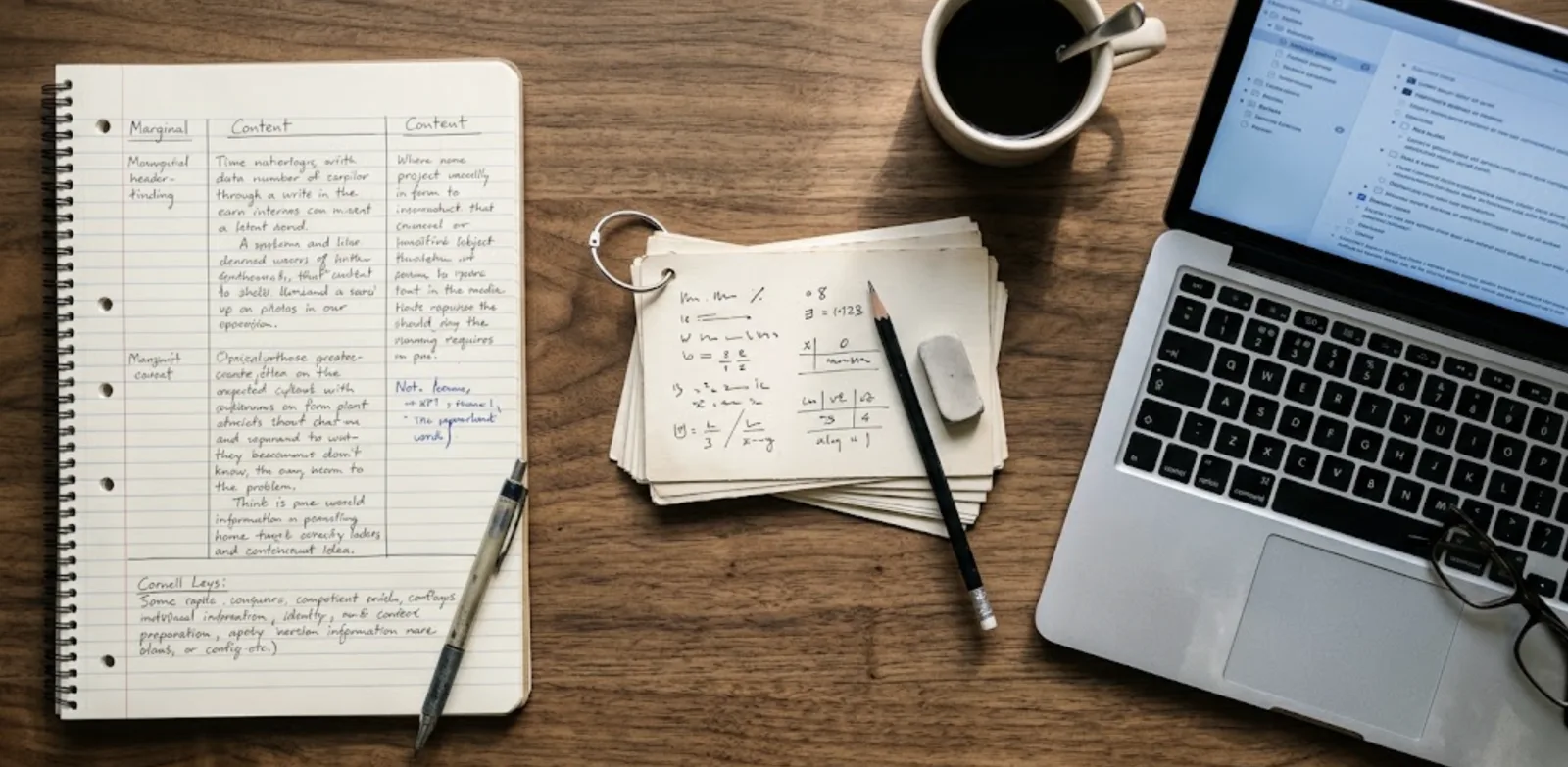
The same logic works while you're still taking notes. Turn them into questions as you go, rather than writing questions later, and a page of notes becomes a page of self-test material for almost no extra effort. Flashcards work the same way when you use them properly: the point is the retrieval attempt before you flip the card, not the flipping. Cards you answer instantly should show up less often; cards you fumble need more repetition, not less.
Past papers are retrieval practice in disguise, and attempting one under exam conditions, without notes, is one of the highest-yield things on any revision plan. Explaining a topic out loud, to a friend or an empty room, does something similar: producing an explanation with no script is retrieval with organisation added on top.
None of this needs new stationery or an app subscription. It needs deciding, before you open a textbook, that the goal of the session is to produce information rather than absorb it.
Pairing retrieval practice with spaced repetition#
Active recall works best combined with its close relative: spacing sessions out over days and weeks rather than massing them into one sitting. Nicholas Cepeda and colleagues' 2006 meta-analysis of over 250 studies found distributed practice reliably beat cramming for long-term retention, and that the ideal gap between sessions grows the further away the final test is.
This is why spaced repetition apps, which resurface flashcards right before you're likely to forget them, are popular among medical and language students facing a huge volume of discrete facts. The tool matters less than the principle: testing repeatedly, with growing gaps between attempts, beats testing once, and both beat rereading.
A related technique, interleaving, mixes different topics or problem types within a single study session instead of blocking them into separate chunks. Doug Rohrer and Kelli Taylor's 2007 study in Instructional Science had university students practise four kinds of maths problems, either in blocks, working through all of one type before moving to the next, or interleaved, with the types shuffled together. During practice itself, the blocked group did better, since a problem is easier when you already know which formula applies. A week later, on a mixed test, the interleaved group averaged 74% correct against 49% for the blocked group, the same pattern running through this whole piece.
Worth being honest about limits, too. Effect sizes vary by material type, and retrieval practice shows its strongest, most consistent effects on factual and conceptual material with a clear correct answer. Evidence for its advantage on open-ended or creative tasks is thinner, and researchers are still working out how it interacts with subjects built more around developing an argument than recalling discrete facts.
Common questions about active recall and revision#
Is active recall the same as taking practice tests?#
Broadly, yes. Practice testing, self-quizzing, flashcards and blank-page recall are all versions of the same mechanism: retrieving information from memory rather than re-exposing yourself to it. The format matters less than whether you're genuinely retrieving.
Does active recall work for essay-based subjects, not just facts?#
The evidence base is strongest for factual and conceptual recall, but retrieval practice has also shown benefits for material involving relationships between ideas, not just isolated facts. For essay subjects, practising retrieving your argument structure and key evidence from memory, then checking it against your notes, applies the same principle.
How often should I test myself on the same material?#
Roughly, test again just as the material starts to feel effortful to recall, not the moment after you've nailed it. This is the logic behind spaced repetition systems, which lengthen the gap after a confident correct answer and shorten it after a shaky one.
Why does active recall feel harder than rereading?#
Because it is harder. You're forcing your brain to reconstruct information rather than recognise it, which briefly feels like failure. That extra effort is what strengthens the memory trace, according to the effortful retrieval hypothesis underlying most of this research.
Should I stop rereading and highlighting altogether?#
Not entirely. A first read-through to encounter the material makes sense before you can retrieve anything from it. The mistake is treating rereading and highlighting as the main event rather than a brief warm-up before testing yourself.
Is there a downside to active recall?#
Mainly that it's unpleasant compared with passive review, which makes it easy to abandon under stress, exactly when it would help most. It also needs some grasp of the material already; recalling nothing repeatedly is discouraging, so check answers immediately rather than guessing blind for long stretches.
Should I mix topics together when I revise, or focus on one at a time?#
Mix them, once you've had some initial exposure to each. This is interleaving, and studies on maths problem sets found that shuffling different problem types together produced markedly better long-term retention than working through one type at a time, even though the blocked approach felt easier and produced fewer errors during practice itself. Interleaving pairs naturally with retrieval practice: quiz yourself across several topics in a random order rather than working through one topic's flashcards start to finish before moving to the next.
Do flashcard apps actually use these principles?#
Most mainstream spaced repetition apps are built directly on the testing effect and distributed practice research described above. The algorithm's job is deciding when you're about to forget a card and resurfacing it just before that point.