

The colour-coded grid that didn't survive week one#
Every September, students sit down with a ruler and four highlighters and build something genuinely impressive: nine subjects, colour-keyed, fifty-minute blocks, a five-minute toilet break pencilled in at 14:05.
By Wednesday it has slipped. A seminar overran, a flatmate had a crisis, and the 16:00 statistics block quietly became a nap. By the following Monday the timetable is still on the wall, doing a different job now: a small daily reminder of failure. Most students don't abandon revision timetables out of laziness. They abandon them because the timetable was built for an ideal week, not a real one. That's not a discipline problem. It's a design problem, and it has a name in behavioural science.
Why the plan breaks: the planning fallacy and the cramming trap#
In 1979, Daniel Kahneman and Amos Tversky described a reliable quirk in how people predict their own effort: we underestimate how long tasks will take, even when our last plan also ran late. Roger Buehler and colleagues later showed people build predictions from a "best case" mental simulation rather than their own track record. This is the planning fallacy, and a revision timetable is basically a planning-fallacy factory. It schedules a version of you that never catches a cold, never gets invited anywhere, and never just needs to stare at a wall for twenty minutes.
The second flaw sits inside the blocks themselves. A timetable that gives Monday entirely to biology and Tuesday entirely to French is using blocked practice, one topic worked in an unbroken stretch until it feels mastered. It feels efficient, because performance during the block genuinely improves. But that fluency is often temporary. A 2006 meta-analysis by Nicholas Cepeda and colleagues, covering over 300 studies, found that spreading study sessions out over time (the spacing effect) produces far better long-term retention than massing them together, even with identical total study time. Cramming and blocking both borrow performance from the future without paying it back.
The psychology of a grid that was doomed from the start#
Rigid, hour-by-hour timetables fail for a specific reason: they treat revision like a train timetable, where missing the 14:00 service to thermodynamics derails the whole day. Because every slot depends on the one before it, a single disruption cascades. Miss a block, and the guilt of "falling behind" becomes its own reason to avoid opening the timetable again, a pattern familiar from procrastination research, where aversive feelings about a task increase avoidance, which increases those feelings next time.
Fixed-time plans also assume uniform energy and difficulty across the day, which isn't how attention works across a term. Task-based plans, where the unit is "finish two practice essays" rather than "ninety minutes of biology," survive disruption better, because a delayed task is still just delayed. It isn't broken.
Building in buffer time without it becoming an excuse#
The fix implied by the planning fallacy isn't more willpower. It's more slack. A common rule of thumb among study skills tutors is to schedule roughly 60 to 70% of the time you think you have, leaving the rest genuinely unscheduled to absorb the overrunning seminar, the migraine, the group project meeting that ate your afternoon.
The trap is treating buffer time as a reward instead of a shock absorber. If it defaults to watching television whenever nothing has gone wrong that week, the plan stops accounting for the weeks when something does. A simple fix: review each evening what slipped, and feed only that into the next buffer slot rather than letting it fill on autopilot. Over a ten-week term, this habit tends to matter more than any amount of colour-coding.
Where you place the buffer matters almost as much as how much of it you schedule. A single unstructured evening at the end of the week absorbs less disruption than the same hours spread across every day, because a bad Tuesday still leaves Wednesday's plan untouched if Wednesday has its own small cushion. Students juggling part-time work or caring responsibilities, where the disruption is often a fixed weekly shift rather than a one-off crisis, tend to do better distributing buffer time this way rather than banking it all for Sunday.
Spacing and interleaving: mixing subjects instead of blocking them#
If blocked practice is the problem, the alternative is interleaving: mixing topics or problem types within one session rather than grouping them. Doug Rohrer and Kelli Taylor's studies on maths learning found interleaved practice felt harder and performed worse at the time, but produced roughly double the score on a test given a day or more later, compared with blocked practice. The discomfort is often a sign it's working. Figuring out which method a problem needs, rather than being told because you're "in the trigonometry block," is itself a form of retrieval practice.
A practical version schedules two or three subjects per day in short alternating sessions, revisiting each subject every few days rather than once a week. John Dunlosky and colleagues' 2013 review of ten study techniques, published in Psychological Science in the Public Interest, rated distributed practice and practice testing as the strongest methods, and rereading and highlighting, most students' default, among the weakest.
The weekly review habit that keeps a plan honest#
A timetable written once at the start of term and never revisited will be wrong by week three, because your grasp of each topic changes as you go. A short weekly review, ten minutes on a Sunday evening checking what got done against what was planned, catches drift before it compounds. This is data collection, not self-punishment. If statistics consistently takes twice as long as planned, that's useful information for next week, not proof you're bad at revision.
The review is also where buffer time gets reallocated and where a subject in worse shape than expected claims more of next week's slots. Treating the timetable as a living document, edited weekly rather than fixed once, removes much of the shame that makes people stop opening it.
Keep the review itself small enough to actually happen. Three questions cover most of it: what got finished, what got skipped and why, and which topic felt shakier than the timetable assumed. Writing the answers on the same page as next week's plan, rather than in a separate journal nobody reopens, means the adjustment happens in the same ten minutes rather than becoming its own task to schedule. Students who track this over a full term often find the same one or two subjects keep slipping, which is itself diagnostic: it usually means the topic needs restructuring into smaller sub-tasks, not just more hours thrown at an identically vague block.
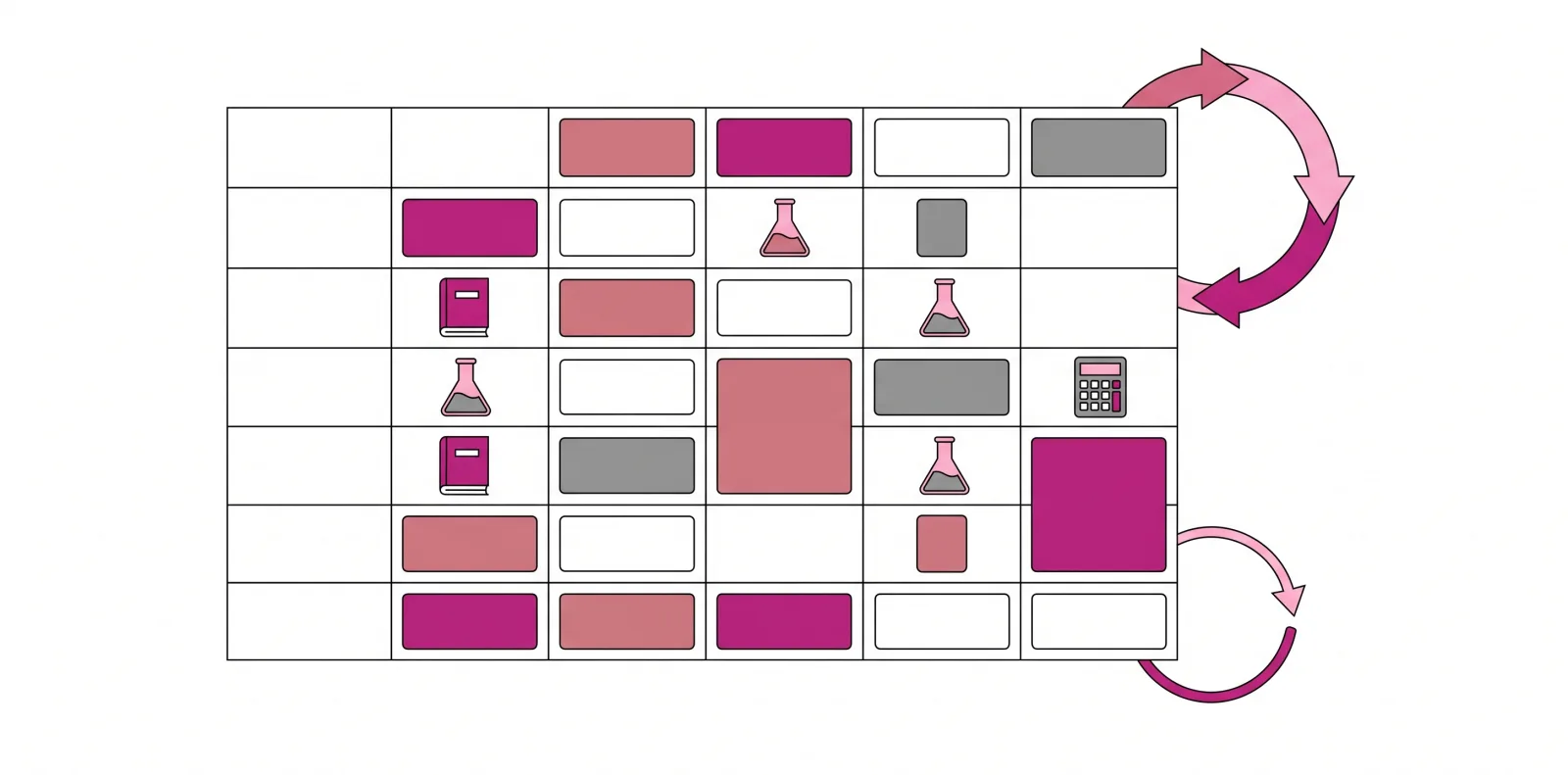
When the whole plan falls apart mid-term#
At some point, the plan doesn't just slip. It collapses: illness, a bereavement, a fortnight where everything else demanded attention. The instinct is to cram the lost time back in, which just recreates the blocked, high-pressure cramming the spacing research warns against.
The steadier response is triage. List which assessments are non-negotiable, list which topics carry the most marks or underpin the rest, and rebuild a short-term plan around those two lists only. Buehler's planning fallacy research is a useful check here too: whatever revised plan feels realistic after a setback, assume it's still slightly optimistic, and build in more slack than seems necessary. What matters most isn't which planning method you chose. It's whether you kept returning to some version of a plan at all. Adherence beats sophistication.
Comparing three planning approaches#
| Approach | How it works | Best suited to | Main weakness |
|---|---|---|---|
| Rigid hour-by-hour grid | Fixed subject and time slot for every hour of the week | Students with very predictable, unchanging schedules | One disruption cascades through the whole week |
| Flexible task-based list | Daily targets ("two past papers," "one essay plan") with no fixed clock time | Most university students with variable timetables | Requires self-honesty about what counts as "done" |
| Pomodoro-style sessions | Short fixed work sprints (often 25 minutes) with built-in breaks | Students who struggle to start or sustain focus | Can fragment deep work if breaks are too frequent |
Quick answers before you start planning#
How far in advance should I build a revision timetable?#
Four to six weeks before assessments begin gives enough runway for spaced, interleaved practice without feeling so distant it lacks urgency. Building it the week before mostly just formalises cramming.
Should I revise my worst subject first?#
Not exclusively. Interleaving research suggests rotating between weaker and stronger subjects within the same week, so retrieval demands stay on everything rather than exhausting motivation on the hardest material alone.
How much buffer time is enough?#
There's no single validated figure, but filling only 60 to 70% of available time with fixed tasks, leaving the rest unscheduled, is a sensible starting ratio to adjust after a couple of weekly reviews.
Is the Pomodoro Technique evidence-based?#
The underlying idea, that short focused sessions with breaks support sustained attention, fits broader vigilance research, though the specific 25-minute interval is a popularised convention rather than a precisely tested optimum. Treat the length as adjustable.
What if I finish everything on my timetable early?#
Use the freed time for retrieval practice on earlier material rather than rushing ahead to new content. Cepeda's spacing research suggests revisiting older topics after a gap strengthens memory more than front-loading new ones.
Does it matter if I use an app or paper?#
Format matters far less than whether the plan is task-based and reviewed weekly. Use whichever you'll actually open daily. A beautiful abandoned app is no better than an abandoned paper grid.
How do I stop feeling guilty when I fall behind?#
Treat missed sessions as data, not failure. A weekly review that simply moves an undone task into the next buffer slot, without extra sessions bolted on as punishment, keeps the plan usable instead of turning it into a source of dread.