

The first sentence a marker has read all afternoon#
By essay fourteen of twenty, a marker has read "Throughout history, communication has played a vital role in society" more times than seems statistically possible. Nobody taught students to write that sentence. It spreads because it feels safe, saying something true while committing to nothing.
That's the problem. An introduction that commits to nothing gives a marker nothing to mark. Three sentences of throat-clearing before the real essay starts isn't a stylistic quirk, it's lost marks, since most UK marking criteria reward a clear line of argument from paragraph one, not a polite run-up to one.
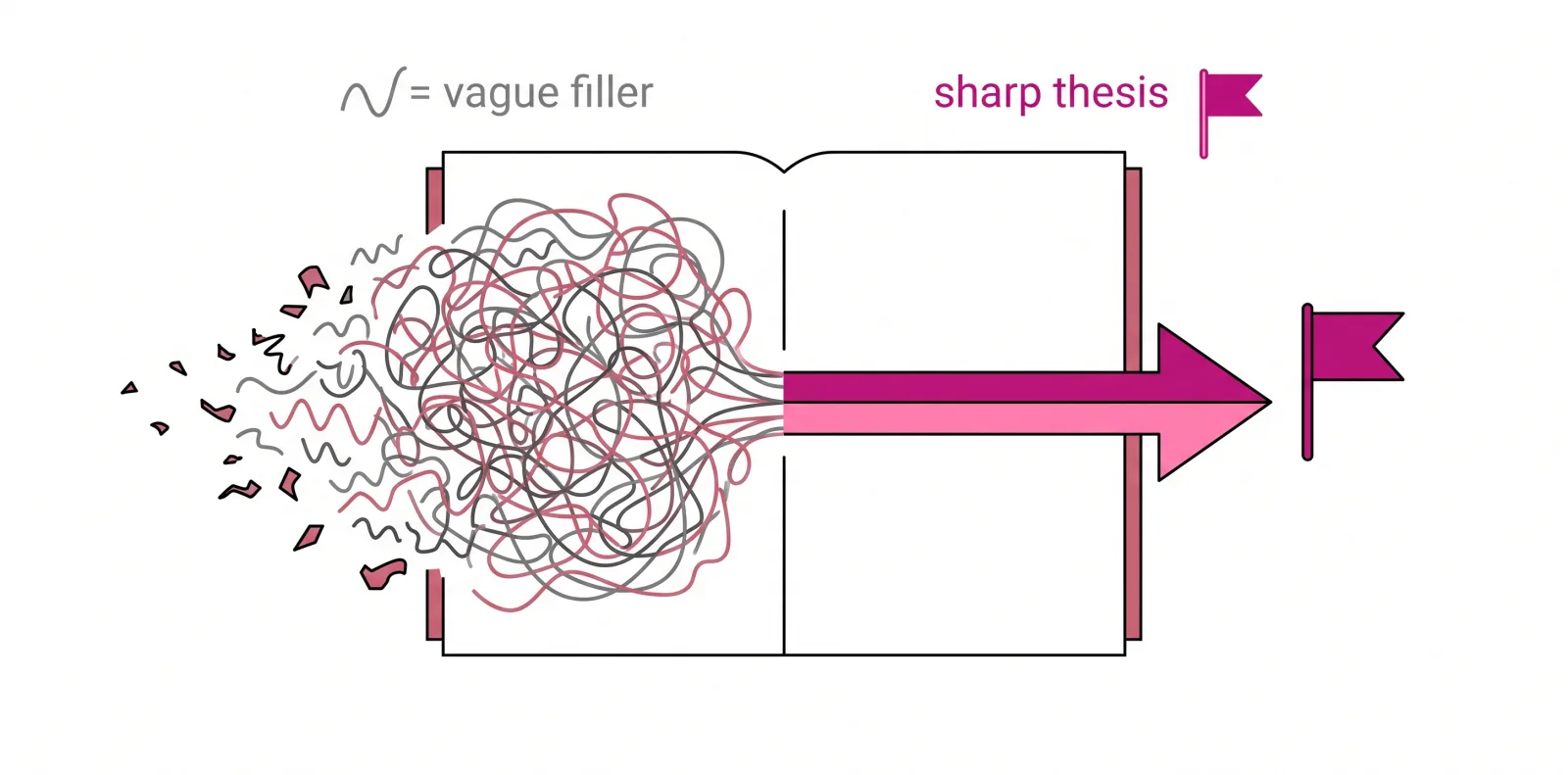
The fix isn't a cleverer hook. It's understanding what those first hundred-odd words are scored on, then writing to that instead of a vague memory of what an introduction should sound like.
What a marker is actually scoring in your opening paragraph#
University marking rubrics rarely say "write an engaging opener." They say "clear line of argument," "critical engagement," "well-structured response." An introduction is where a marker checks all three before reading a single piece of evidence.
The Royal Literary Fund's guidance for student writers, used across many UK universities, is blunt about it: readers form judgements fast, and an introduction that fails to state a position leaves them guessing at your argument for the rest of the essay. The University of Leicester's study skills resources make the same point about the "thesis statement," the sentence naming your specific argument rather than your general topic.
Three things get checked: thesis clarity, does the marker know what you're actually arguing, not just discussing; signposting, has the essay indicated the shape of what's coming; and engagement, does the opening suggest you've understood the complexity in the question, rather than restated it.
None of that requires a dramatic hook. It requires specificity, which is exactly what generic openers are built to avoid.
Why "throughout history" openers fall flat#
Generic openers exist because they're safe under deadline pressure, safe from ever saying anything wrong, which is another way of saying they say nothing at all. "Education has always been important in society" can't be marked incorrect, but it can't be marked as an argument either.
There's a newer wrinkle too. Markers have grown wary of the sweeping, ungrounded generalisation, partly because it now reads as a hallmark of AI-generated filler rather than considered analysis. Fair or not to any individual student, a vague opener no longer just reads as lazy. It can read as unconsidered, right when a marker forms their first impression of your work.
| Weak filler opener | Why it fails | Stronger, specific alternative | Why it works |
|---|---|---|---|
| "Throughout history, communication has been important." | True of almost anything; commits to no argument | "Letter-writing conventions in the 1780s reveal how closely politeness policed class boundaries." | Names a specific claim the essay will defend |
| "In today's society, technology plays a big role." | Vague time reference, vague subject, no position | "Smartphone use in lectures correlates with lower recall, but the causal direction remains disputed." | States a tension the essay will resolve |
| "This essay will discuss the causes of the war." | Announces topic, not argument | "The war's causes were structural long before they were diplomatic." | Signals a specific, arguable position |
| "Since the dawn of time, humans have told stories." | Cliché with no factual content | "Oral epics survive structurally intact because repetition served memory, not art." | Grounds the claim in a specific mechanism |
The pattern across every strong version is the same: a claim specific enough that someone could disagree with it. That is, unhelpfully, also the definition of a thesis statement.
Turning a topic into an argument#
Most weak introductions confuse announcing a topic with stating a thesis. "This essay will discuss X" tells the reader what territory you're in, not what you think about it, which is the part markers are grading.
Before: "This essay will discuss the causes of the French Revolution."
After: "The French Revolution was driven less by ideological conversion than by fiscal collapse, which left Louis XVI unable to offer concessions any absolutist monarchy could survive making."
The second version is riskier, because it can be wrong. That's the point. Manchester's Academic Phrasebank, a widely used UK resource built from published academic writing, catalogues exactly this move: hedged, precise claims instead of flat announcements, phrases like "this essay argues that" or "contrary to the received view." A thesis doesn't need to be provocative. It needs to be falsifiable, something a reader could push back on, rather than a description no one could contest.
This convention isn't universal. Some humanities disciplines, and some academic traditions students arrive having practised, favour a more exploratory opening that builds toward a position rather than stating one immediately. If your handbook rewards that, don't force a blunt thesis against your marker's grain. Absent contrary guidance, most UK undergraduate criteria reward an early, explicit argument, so treat it as the safer default.
Signposting the structure without sounding like a checklist#
Signposting means telling the reader the shape of the argument before you make it. Done badly, it turns into "Firstly, this essay will examine X. Secondly, it will examine Y. Thirdly, it will conclude," which reads like a table of contents wearing a jumper.
Before: "This essay will first look at economic factors. Secondly, it will look at social factors. Finally, it will look at political factors, before concluding."
After: "The argument unfolds in three stages: it traces the economic pressures that made reform necessary, tests whether social unrest accelerated or merely accompanied that pressure, and closes by asking why political elites resisted reform they could no longer avoid."
The information is identical. The second version folds the structure into the logic of the argument itself, so each stage builds toward something rather than sitting in a numbered list. Signposting should describe the shape of your reasoning, not just the order of your paragraphs.
Hooking a marker without resorting to gimmicks#
Rhetorical questions ("Have you ever wondered why...?") and dictionary definitions ("The Oxford English Dictionary defines success as...") are the two most reliable ways to open an essay with nothing. They feel like hooks elsewhere, but a marker isn't a stranger you're persuading to keep reading. They're already reading, professionally, and they want your position, not your throat-clearing.
Before: "Have you ever wondered what makes a good leader? This essay will explore that question."
After: "Churchill's wartime popularity and his landslide 1945 defeat are usually treated as a contradiction. They're better read as evidence that voters separate crisis leadership from peacetime governance."
The genuine hook here isn't a trick, it's specificity plus a small tension the essay promises to resolve: a fact that seems to contradict itself, a debate two credible sources disagree on, a pattern that doesn't fit the obvious explanation. That's what earns attention from a reader who already has to be there. No dictionary required.
Calibrating length to the word count you've actually got#
Introductions scale with the essay, and getting that proportion wrong causes two different problems. Too short, and there's no room to state a thesis and signpost structure before diving into evidence. Too long, and you're spending word count on throat-clearing that should have gone to analysis.
As a rough guide many UK study skills units use, aim for 8 to 10 percent of total word count: around 120 to 150 words on a 1,500-word essay, 250 to 300 on a 3,000-word one. Dissertations do more scene-setting across several pages, so don't apply this ratio there.
Here's what missing that ratio looks like on a 1,500-word essay, where the target sits around 130 words.
Before: "Throughout history, governments have had to balance individual freedom against collective safety, and this tension has grown more pronounced due to technological change, globalisation, and shifting public attitudes. This essay will explore this complex issue by examining case studies from different countries, weighing the arguments on both sides, before reaching a conclusion about which approach works best."
After: "Emergency powers granted during a crisis tend to outlast the crisis that justified them, not through deliberate planning, but because nothing forces a government to give power back once granted. The argument compares how far actual expiry dates drifted from the sunset clauses originally legislated, and asks what that drift reveals about how administrations treat emergency powers by default."
Both gesture at the same territory, but only the second one argues something, and it does so in fewer words. Padding an introduction with scope instead of vagueness is still padding: a marker skims past "case studies from different countries" as fast as they skim past "throughout history."
The real test isn't a target, though. It's whether every sentence does one of three jobs: context, argument, or signposting. If it does none, it's filler, however good it sounds.
Introduction questions students keep asking#
How long should an essay introduction actually be?#
Roughly 8 to 10 percent of the total word count for a standard undergraduate essay, though always check your specific module handbook or assignment brief, since some departments specify exact proportions.
Should I write the introduction first or last?#
Many experienced writers draft it last, since the argument often sharpens while writing the body. Write a rough placeholder thesis early to guide structure, then rewrite the introduction properly once you know what you actually argued.
What's the difference between a thesis statement and a topic sentence?#
A thesis statement states your overall argument for the whole essay, usually in the introduction. A topic sentence states the point of a single paragraph. Every topic sentence should trace back to, and support, the thesis.
Does this advice apply the same way in every subject?#
No. Some disciplines and individual markers prefer a more discursive build-up before the thesis lands, particularly in certain humanities traditions. Treat explicit-thesis-first as the safer UK undergraduate default, and adjust when specific feedback says otherwise.
Can I still use a hook, or is that just for creative writing?#
Yes, but it should be a fact, a tension, or a genuine complication relevant to your argument, not a rhetorical question. The best hooks in academic writing are just precisely chosen facts.
The one-line version of all of this#
If your introduction could be pasted onto a different essay without anyone noticing, it's a placeholder, not an introduction. State what you're arguing, signal how you'll argue it, then spend the rest of the word count proving it.