
The 2:1 essay that needed nothing new#
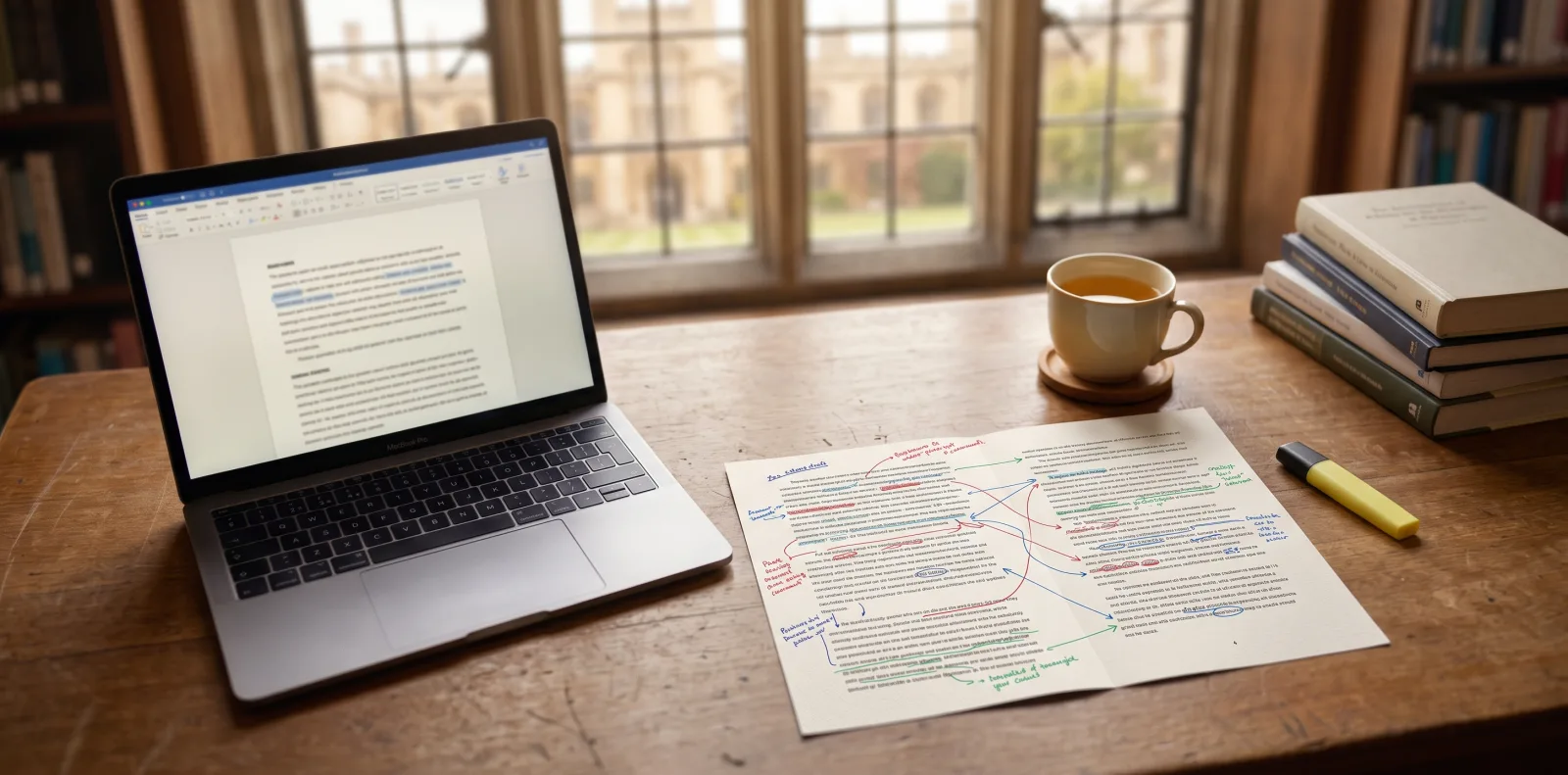
A student brings the same essay back to a study skills tutor twice. First draft: solid reading, accurate quotations, a mark in the low 60s. Second draft: not one new source. The tutor had moved three paragraphs, cut two topic sentences to their actual claim, and added a paragraph addressing the obvious objection. The mark moved into the 70s.
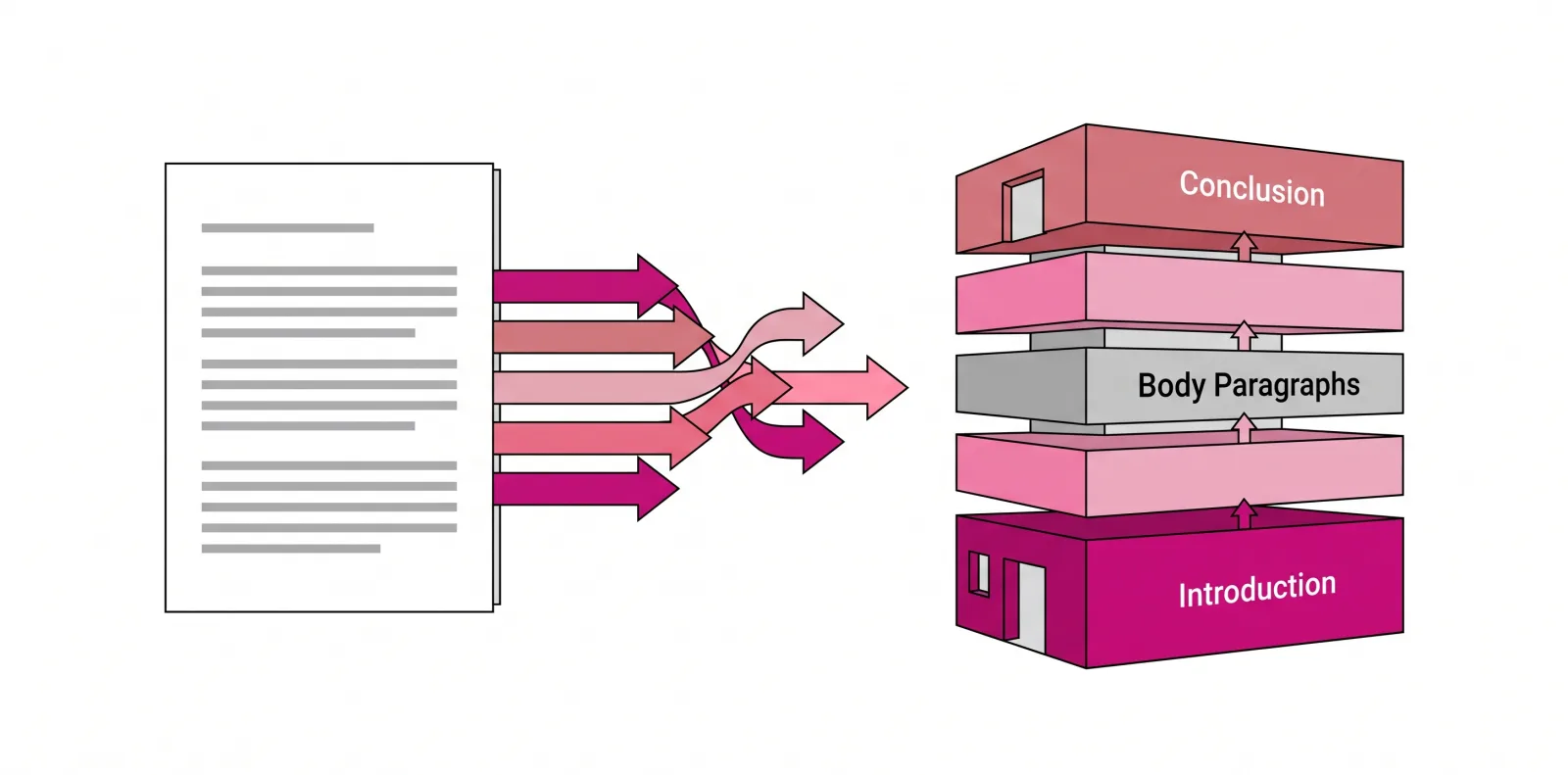
Ask anyone who works in a university writing centre and they will tell you a version of that story. Students assume a first-class essay needs more knowledge, when what separates the bands most reliably is what they do with the knowledge they already have. Structure is not decoration around content. For markers, it often is the content, because structure is where an argument becomes visible.
First, 2:1, 2:2: what the boundaries actually reward#
UK undergraduate degrees are classified into bands: first-class honours (typically 70% and above), upper second, known as a 2:1 (60 to 69%), lower second, or 2:2 (50 to 59%), and third-class (40 to 49%). Each university sets its own detailed marking criteria and exact cut-offs, so treat those figures as a widely used convention rather than a fixed national rule.
More consistent across institutions is the underlying shift in expectation, described in general terms by the sector-recognised Framework for Higher Education Qualifications behind the UK Quality Code. Move up the bands and the expectation shifts from describing and applying existing knowledge towards independently constructing and sustaining an argument. A 2:2 essay often reads as competent but list-like: this happened, then this happened, here is what a source said. A 2:1 usually shows a clear, well-supported argument. A first-class essay does something extra: it holds together across the whole piece, addresses its own weaknesses, and reaches a conclusion that couldn't simply be swapped in from another essay on the same reading list.
None of that is about writing more. It is about wiring the same material into something that argues. A history essay and a lab report aren't marked on identical criteria, and this piece focuses on the standard argumentative essay used across humanities and social sciences.
One rough but useful convention taught by academic skills tutors is how word count divides across an essay of this kind.
The proportions matter less than the discipline behind them. An introduction bloated to 25% of the word count is usually doing the body's job badly. A one-line conclusion usually means the essay stopped rather than finished.
Inside one paragraph: point, evidence, analysis, link#
Most UK writing centres teach some version of the same paragraph model, shortened to PEAL or PEEL: point, evidence, analysis, link. It looks basic as an acronym, which is exactly why students skip the last two steps under time pressure.
Here is a paragraph with each part labelled:
[Point] The 1918 franchise extension did not, on its own, produce a democratic electorate. [Evidence] Women under 30 remained excluded, and the retained property qualification meant working-class women were still disproportionately left out. [Analysis] This suggests the reform was shaped as much by anxiety about post-war stability as by any principled commitment to equal representation; enfranchising older, propertied women reads as a cautious concession, not a full endorsement of universal suffrage. [Link] It is this partial, negotiated character that explains why suffrage campaigning continued largely unbroken for another decade.
A 2:2 paragraph typically stops after evidence, or repeats the point in different words instead of analysing it. The analysis sentence is where marks concentrate, because that's where the student, not the source, is doing the thinking. The link sentence is what a first-class paragraph adds almost automatically: it tells the reader why this paragraph had to come before the next.
Chaining paragraphs into an argument, not a list#
A common examiner complaint, echoed across academic writing guides from Manchester to Reading, is the "list essay": accurate, well-evidenced paragraphs that never add up to a case. Each is fine alone. Together, they read like an inventory rather than an argument.
The fix is to treat every paragraph as advancing a single claim stated in the introduction, not as a mini-essay on a sub-theme. Before drafting, try finishing the sentence "this paragraph exists because it proves X, which the previous one had not yet shown." If that's hard to write, the paragraph is probably a tangent, however interesting, and belongs in a footnote or nowhere at all.
Planning earns its keep here. A one-page outline that gives each paragraph a single job, in order, catches list-essay structure before it is drafted, when fixing it means reordering rather than rewriting.
Topic sentences and signposting: giving the marker a map#
A topic sentence announces what a paragraph will argue, not what it will be about. "This section will discuss the causes of the 1918 reform" describes a topic. "The 1918 reform was driven more by fear of post-war unrest than by principle" makes a claim the paragraph then has to defend. Markers spot the difference in the first line.
Signposting language does the connective work between paragraphs: however, by contrast, this in turn suggests, a further complication is. The University of Manchester's Academic Phrasebank, a widely used free resource built from published academic writing, exists largely to give students this vocabulary instead of the same three transition words on repeat. Good signposting is not throat-clearing. It tells the reader whether the next paragraph supports, complicates, or qualifies the one before it, which is exactly what a marker needs to follow an argument at speed.
Where the counterargument belongs, and why it isn't a weakness#
Students often treat acknowledging an opposing view as admitting their own argument is shaky. UK academic skills guidance tends to say the opposite: engaging seriously with the strongest counterargument, then explaining why it doesn't overturn your position, is one of the clearest markers of first-class thinking. A 2:1 essay might mention that "some historians disagree." A first-class essay explains why, states the counterargument as fairly as its own proponents would recognise, and shows exactly where it falls short.
Placement matters, too. Buried in the introduction as a throwaway concession, a counterargument does little work. Given its own paragraph, usually after the main case is established but before the conclusion, it shows the writer has tested their argument rather than just asserted it.
A conclusion that argues, not repeats#
The most common conclusion in a 2:2 essay is a compressed restatement of the introduction with the tenses adjusted. It costs marks not because repetition is forbidden but because it wastes the one place reserved for synthesis: showing how the paragraphs combine into something none of them said alone.
A first-class conclusion typically does what a repeated introduction cannot. It states the overall argument in its final, most precise form, now the evidence is laid out. It addresses the "so what": why the argument matters beyond the essay question, whether that's a broader debate in the field or an implication for how the topic should be understood. And where relevant, it is honest about the argument's limits, a different move from undermining it. A live question or a stated boundary at the end reads as control, not doubt.
Questions students ask about essay structure#
Does structure really matter more than content?#
Not more than content, but often more than extra content. Two students working from the same reading list can land different classifications because one organised the material into an argument and the other into a list. Structure is how content becomes an argument a marker can evaluate.
What actually makes an essay a "list essay"?#
A list essay presents accurate, well-evidenced paragraphs that summarise sources or events in sequence, without one paragraph's claim depending on or building from the last. Each part could be reordered with no real loss, which is usually the giveaway.
How long should my introduction be?#
Long enough to state the question, your position, and the shape of your argument, and no longer. As a rough convention, around a tenth of total word count is common in UK academic skills guidance, though this varies with essay length and discipline.
Do all UK universities mark essay structure the same way?#
No. Exact criteria, weighting and terminology differ between institutions and departments. The general shift QAA-aligned frameworks describe, from descriptive competence towards independent, sustained argument at higher grades, is broadly consistent, but check your own module handbook and marking rubric.
Can better structure alone turn a 2:1 into a first?#
It can move an essay a significant distance when the content was already solid, because unclear structure often hides analysis a student has actually done. It isn't guaranteed, since some gaps are genuinely about depth of reading, not organisation.
What's the single most common structural mistake?#
Paragraphs that end on evidence rather than analysis. Stopping as soon as a quotation or statistic has been presented, without a sentence on what it proves and why it matters, is the fastest way to leave marks on the table.
Structure as the argument itself#
None of this requires new reading or more hours in the library than the essay already demanded. It requires treating structure as an argument in its own right, one a marker reads before, and alongside, the content it carries. Move paragraphs so each earns its place. Make the topic sentence a claim. Give the counterargument a paragraph of its own. Let the conclusion synthesise rather than repeat. That is most of the distance between a 2:1 and a first, and it costs nothing but a second draft.