

Eleven sign-up sheets, one show-up by week five#
You know the drill. The sports hall at the freshers' fair is a wall of gazebos, glitter, and enthusiastic third-years shouting over each other. You leave with a tote bag of flyers, a free water bottle, and your name on eleven sign-up sheets: rowing, film society, debating, K-pop dance, a cheese appreciation club that seemed funny at the time. Your inbox fills with welcome emails. Your calendar, briefly, looks like you're about to become an entirely different person.
By week five, most of that has evaporated. You've been to one rowing taster session at 6am and never again. The film society WhatsApp group has three hundred unread messages. On paper you're a member of eleven societies, and an active participant in roughly none of them.
This isn't a personal failing. It's close to the default outcome of how freshers' fairs are built, and it happens to most new students every September. The fix isn't joining fewer societies out of guilt. It's being deliberate about which two you keep, and understanding why two, chosen well, serve you better than eleven left to wither.
Why the fair turns everyone into a serial joiner#
Freshers' fairs run on novelty and social pressure, and both are worth naming because neither is a character flaw. Novelty means everything looks appealing in isolation: pole fitting, politics, a niche board game society, a subject society you haven't even started the subject for yet. Stood at each stall for ninety seconds, every option feels low-risk, because you're not yet weighing it against the society you signed up for two stalls back. Social pressure does the rest: everyone around you is signing up, membership is usually a couple of pounds, and saying no to a friendly rep feels oddly harder than it should.
The trouble is that broad, shallow involvement rarely delivers what people actually want from societies: a sense of belonging, and something that looks decent on a CV later. Research on student belonging in UK higher education, including work summarised by the Higher Education Policy Institute, links belonging to extracurricular participation, but only through a functioning, ongoing community, not a list of unattended memberships. A widely cited UK study on extracurricular engagement and wellbeing found the benefit is tied to how meaningfully students engage, not how many activities they're signed up to, and noted that consistent engagement isn't equally easy for everyone, particularly those juggling paid work or long commutes. Turning up regularly to two things builds the repeated contact that produces belonging. Turning up once to eleven does not.
The same logic applies to employability. A single line reading "member of eleven societies" signals very little to anyone reading a CV. A sustained, specific involvement, ideally with a role attached, signals commitment, reliability and a skill you can describe in an interview. Depth reads as substance. Breadth, on its own, reads as a fresher who went to a fair.
The two-list method for narrowing ten societies down to two#
Cutting a long list feels harder than it is, mostly because "which two do I love most" is the wrong question at the start. A better one is logistical: which options survive contact with your actual week?
Write two short lists instead of one long one. List A is things you already know you like: a sport you played at school, an instrument, a subject you'd happily talk about for an hour. List B is one thing that sounds interesting precisely because you've never done it. Most people gravitate toward List A and treat List B as optional; keeping the split explicit stops you defaulting to only the familiar.
Then run every option through three filters. Does it clash with lectures, a job, or a placement, checked against a real timetable rather than a vague "probably fine"? What's the actual weekly time cost, including travel? And, harder to admit, do the people seem like people you'd want to see every week regardless of the activity, since that's usually what decides whether you show up in November. Anything failing two of three gets cut, no debate. You should be left with two or three genuine contenders, and picking is far easier than it was with a list of ten.
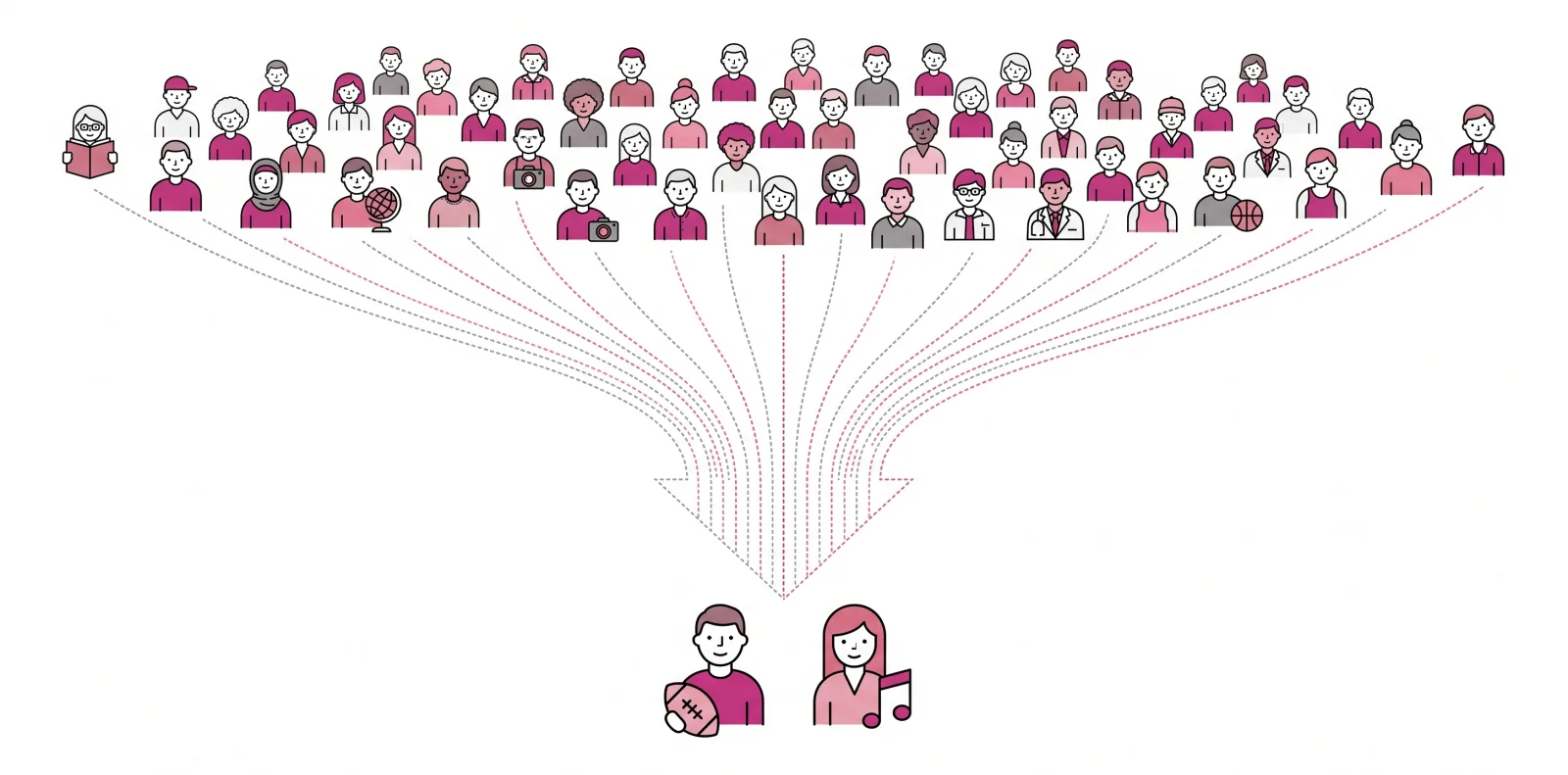
One for joy, one for the CV: balancing your two picks#
A useful, if slightly artificial, way to choose between finalists is to aim for one pick that exists purely for enjoyment and one that connects to something you're working towards. The joy pick might be a casual sport, a choir, or a gaming society, chosen with zero regard for how it looks written down anywhere. Its job is stress relief and friendship, and it does that better because there's no pressure attached.
The second pick can lean goal-aligned: a subject society, a debating group, an enterprise or volunteering group, student journalism, anything that builds a skill or network relevant to where you want to end up. This isn't a demand to be strategic about everything you enjoy, and plenty of students find their most CV-relevant experience in something they only joined for fun. It's a shortcut for the moment you're stuck between four things you like equally: ask which gap in your week or your future each one would fill, and let that break the tie.
What actually gets people back past week three#
The gap between "signed up" and "still going" usually comes down to habit mechanics rather than willpower or how much you enjoyed the first session. Research on habit formation by psychologist Phillippa Lally and colleagues found it took a median of around 66 days for a new activity to feel automatic, varying widely by person. The exact number matters less than the point behind it: early sessions are supposed to feel like a decision you talk yourself into, and that doesn't mean the society is wrong for you.
Three things reliably help. Fix the session into your calendar the way you'd fix a lecture, rather than treating it as optional if something better comes up, since a fixed slot removes the daily re-negotiation. Go with, or make, one person you'd feel mildly guilty about ditching, because social accountability beats self-discipline for almost everyone. And the same research found that missing a single session doesn't meaningfully damage a forming habit, so treat one skipped week as irrelevant rather than a reason to quietly let the whole thing drop, which is what actually kills momentum.
Turning up is the baseline: committee roles and their real pay-off#
Attending consistently is the foundation, but a committee role is where a society starts doing real work for you beyond the term itself. You don't need to be president. Treasurer, social secretary, welfare officer and first-year representative all carry describable responsibility: budgeting real money, organising an event from scratch, managing a rota, or being the person other members go to with a problem.
Students' unions run skills sessions for society committee members because the roles map onto graduate-level competencies: time management, stakeholder communication, decision-making under a deadline, basic financial accountability. Employers consistently say they want evidence of responsibility, not just a list of interests, and a committee role is exactly that, framed as a story about a problem you solved. It's a modest addition on top of ordinary membership, usually a couple of hours a week, and it converts passive belonging into something you can point to.
When it's fine to quit a society and try something else#
None of this is an argument for gritting your teeth through something you dislike. If you've given a society a genuine run, several sessions, not one bad Tuesday, and it still isn't landing, quitting is a reasonable, common decision, not a failure of commitment. Students' unions generally let you join and leave societies at any point in the year, because fit often only becomes clear once you're inside it.
The distinction worth holding onto is between quitting after real information and quitting after mild discomfort. A first session is often awkward for everyone, including people who end up loving the society by December, so treat early unease as data, not a verdict. But if by session four you're dreading it rather than just not itching to go, that's a fair signal to drop it and try the next thing instead. There's no universally correct number of societies to end up with, and plenty of students only find their real fit on the second or third attempt.
Quick answers on choosing and keeping a university society#
How many societies should I join at university?#
There's no fixed right number, but most students get more from two or three societies attended consistently than a long list attended rarely. Sample broadly at the fair if you like, then use a filter like the two-list method to settle on fewer within the first few weeks.
Is it bad to sign up to loads of societies at the fair?#
No, it's a normal way to sample options when tasters and free trials are on offer. The issue isn't signing up, it's letting inertia decide which ones you keep. Narrowing down within the first fortnight avoids paying fees for things you'll never attend.
What if my two chosen societies clash on the timetable?#
Check the actual weekly meeting time and any extra events, not just the headline slot, before committing. An occasional clash is usually fine; a permanent weekly one is a good reason to swap that pick for an alternative.
Do employers actually care about society involvement?#
They care more about what you did within it than the fact of membership. A committee role or a specific project carries far more weight on an application than a list of societies with no detail attached.
Should my two picks be degree-related or something completely different?#
Either works, and a mix tends to serve people best. One pick tied to your subject can build relevant experience and contacts; one unrelated pick protects your wellbeing by giving you an identity outside your coursework, which UK research links to a stronger sense of belonging.
What if I miss a few weeks of a society I actually like?#
Missing sessions occasionally doesn't undo the habit you've built, so don't treat one gap as a reason to quietly stop going altogether. Message someone in the group, find out what you missed, and go to the next one.
Is it ever too late to join a society partway through the year?#
No. Most societies accept new members throughout the year, and second-term joiners are common once people realise their original picks weren't the right fit. Contact the committee directly if sign-up isn't open on the union site.