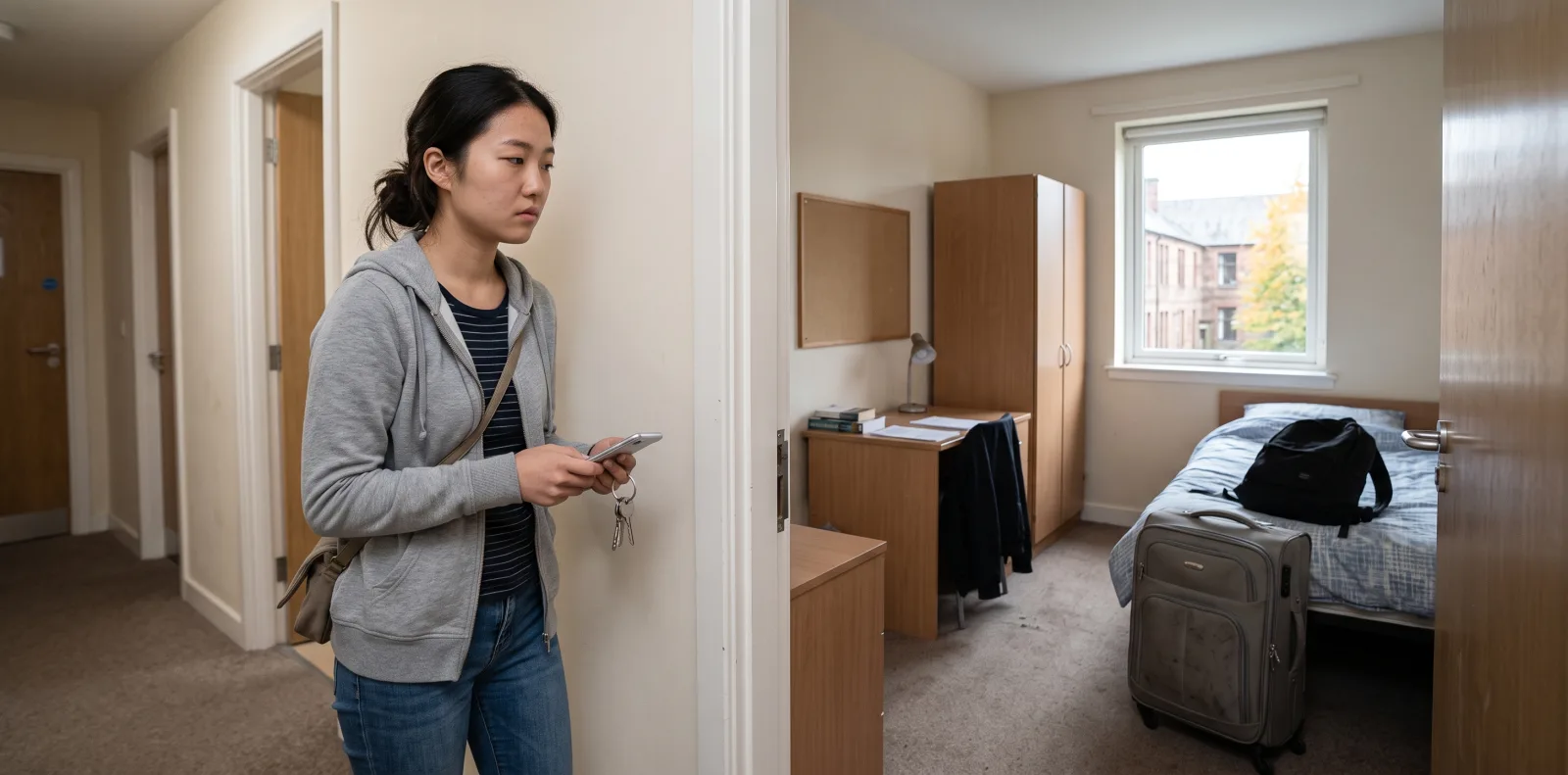

The seminar where everyone else looks like they belong#
You've done the reading. You've got a point about the seminar text. Then the person next to you speaks, fluent and unbothered, and you quietly decide yours wasn't worth saying. Everyone else in the room seems to have arrived with a settled sense that they belong there. You didn't get that memo.
A good number of the people who look settled are running the same script. Some of them are watching you, assuming you're the one who's got it figured out.
This flavour of self-doubt, feeling like a fraud who's talked their way into a room of people who actually deserve to be there, is common enough at university that researchers have studied it since the 1970s. Imposter syndrome at university has a name, a specific origin, and a research base considerably more nuanced than the inspirational-quote version that circulates online.
What Clance and Imes actually found in 1978 (and what they didn't)#
The term comes from a 1978 paper by psychologists Pauline Clance and Suzanne Imes, "The Imposter Phenomenon in High Achieving Women: Dynamics and Therapeutic Intervention." Working at Oberlin College, both had noticed the same pattern in their clients and students: high-achieving women with strong academic records who were nonetheless convinced they weren't actually intelligent, and that success was down to luck or having fooled everyone around them. Praise didn't land as evidence. It raised the stakes, meaning more people to disappoint once the truth came out.
Clance and Imes called this the impostor phenomenon, and the word "phenomenon" matters more than it looks. It has never appeared in the Diagnostic and Statistical Manual of Mental Disorders, and it isn't a diagnosis a GP or counsellor can give you. It's a well-documented psychological pattern instead: a persistent gap between how competent someone actually is and how competent they believe themselves to be, paired with a fear of being publicly unmasked.
In 1985, Clance developed the Clance Impostor Phenomenon Scale, still used to measure the intensity of these feelings. That measurement question matters a great deal. A 2020 systematic review by Dena Bravata and colleagues, drawing on decades of studies, found reported prevalence ranging from as low as 9% to as high as 82% of a sample, depending entirely on which instrument was used and where researchers drew the cut-off. That's not a sign the phenomenon isn't real. It's a sign psychologists still don't fully agree on how to draw its edges, a legitimate ongoing debate rather than grounds to dismiss the concept.
Why freshers' week is prime time for feeling like a fraud#
Imposter feelings don't arrive evenly across a degree. They cluster around transitions, which is exactly what a 2016 paper by Anna Parkman on the impostor phenomenon in higher education describes: the feeling tends to spike whenever someone takes on an unfamiliar role, and resurfaces whenever the challenge changes shape again, from starting a course to beginning a placement to a first graduate job.
Starting university is about as sharp a transition as student life offers. Most first-years arrive having been near the top of their class at school. University quietly removes that reference point and replaces it with a room full of people who were also near the top of theirs. Nothing about your actual ability has changed. The comparison group has.
A word of scepticism is due here too. The claim that "70% of people experience impostor feelings at some point" gets repeated constantly online, usually traced loosely to Clance's own writing, but it's a soft, recycled figure rather than a clean statistic from a controlled study, and researchers have pushed back on treating it as precise. The honest version is less quotable: imposter feelings are common at moments of transition, and university is stacked with them, but nobody has pinned down one number that applies to everyone.
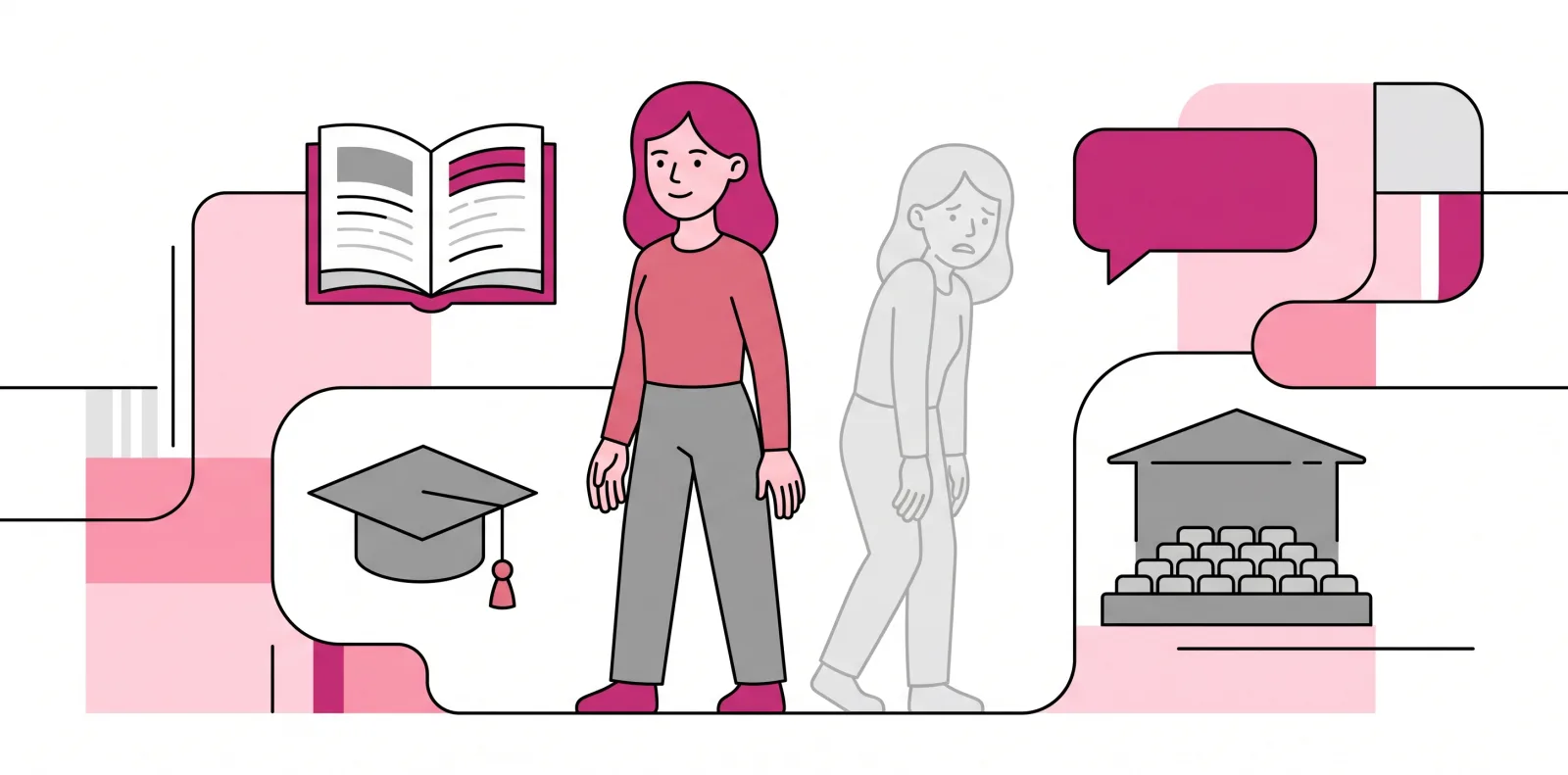
The students carrying the heaviest load#
Imposter feelings aren't handed out evenly. A 2017 study by Kevin Cokley and colleagues in the Journal of Counseling Psychology found impostor feelings among ethnic minority college students helped explain part of the link between experiences of discrimination and worse mental health outcomes. For some students, feeling like a fraud isn't a purely internal glitch, it's tangled up with real experiences of being treated as if they don't belong.
First-generation students, those without a parent who went to university, face a related but distinct pressure. Their families often haven't navigated higher education, so informal knowledge other students absorb at home, how seminars work, what office hours are for, that struggling with a topic doesn't mean you're in the wrong place, simply isn't there to draw on. The evidence is more mixed than the popular narrative suggests, though. A 2024 study in the Journal of College Student Retention found first-generation and continuing-generation students reported broadly similar overall levels of impostor feeling, but the feeling was more strongly tied to stress for first-generation students specifically. The load isn't necessarily heavier in frequency. It bites harder when it lands.
UK-specific research adds another layer. A 2023 study by Órla Meadhbh Murray and colleagues, based on interviews with marginalised STEMM undergraduates at two elite UK universities, made a pointed argument: framing this purely as an individual quirk can let institutions off the hook. If a lecture theatre and curriculum were built with a fairly narrow type of student in mind, feeling out of place isn't only a personal thinking error. It's also a reasonably accurate read of an environment not designed with you in it.
Feeling like a fraud vs actually having a skills gap#
One useful, genuinely tricky test is telling the difference between imposter feelings and a real, addressable gap in your skills.
Psychologists sometimes contrast the impostor phenomenon with the Dunning-Kruger effect, a 1999 finding from Justin Kruger and David Dunning showing that people with low competence often overestimate how well they're doing, because the same lack of skill that produces poor performance also makes it hard to spot. Imposter feelings run the other way. People experiencing them are frequently performing well by any objective measure, decent grades, positive feedback, work that meets the brief, while privately discounting all of it.
The practical distinction is evidence, not vibes. If your marks and feedback consistently say you're doing fine but you feel like a fraud anyway, that's the imposter pattern. If they're consistently pointing to a specific gap, in referencing, in a method, in exam technique, that's a skills gap calling for a skills fix rather than a mindset one: a study skills session, office hours, or a formative assignment redone with feedback applied.
What the evidence says actually helps#
Three things come up repeatedly in the research, and they're more modest than most listicles promise.
The first is simply naming it out loud. Impostor feelings thrive on the private, mistaken belief that you're the only one who feels this way, so disclosure punctures it quickly. Hearing a course mate or a tutor admit to the same internal monologue is often the fastest way to loosen its grip, because it removes the "everyone else has this sorted" assumption the feeling depends on.
The second is keeping a concrete record of evidence, feedback comments, completed work, moments something went well, rather than relying on memory, which is biased towards the question you fumbled and away from the ten you answered fine. Treat the belief "I don't deserve to be here" as a claim to test against evidence, not a fact to accept on arrival.
The third is being honest about how thin the treatment research still is. Bravata and colleagues, in that same 2020 review, found that while group and individual therapy are both used, the evidence for what works best remains underdeveloped. That's not a reason to do nothing. It's a reason to be wary of anyone selling a guaranteed fix, and to treat these as reasonable starting points rather than a cure.
When it's worth talking to student support services#
Imposter feelings on their own don't need clinical intervention. Most people who experience them get through their degree perfectly well while quietly finding the feeling irritating. But there's a point where it's worth involving your university's wellbeing or counselling service rather than just pushing through.
That point tends to arrive when the feeling starts changing your behaviour rather than just your mood: avoiding seminars in case you're asked a question, rewriting work past the point of improvement, or persistent anxiety and disrupted sleep that a difficult week alone doesn't explain. UK universities run wellbeing and counselling services for exactly this, and personal tutors can flag extenuating circumstances where imposter-driven avoidance has already affected coursework. None of it requires a diagnosis. Feeling persistently unable to trust your own results is reason enough to ask for support.
Quick answers to common questions#
Is imposter syndrome an official mental health diagnosis?#
No. It doesn't appear in the Diagnostic and Statistical Manual of Mental Disorders. It's a documented pattern first described by Clance and Imes in 1978, not a clinical diagnosis, though it can intensify anxiety worth discussing with a GP or counsellor if it becomes disruptive.
Does everyone really experience this at some point?#
It's genuinely common, but the often-quoted "70% of people" figure is a loosely sourced estimate rather than a precise finding. What's better supported is that it clusters around transitions like starting university, with reported rates varying enormously, from roughly 9% to over 80%, depending on how a study measures it.
Are women more likely to experience it than men?#
The original 1978 research focused on high-achieving women, but later studies are mixed, some finding higher rates among women and many finding no significant gender difference. It's better understood as widespread across genders than as a specifically female experience.
Is imposter syndrome just low self-esteem?#
They overlap but aren't identical. Low self-esteem is a general, stable sense of low worth. Imposter feelings are more specific: a persistent belief you've been overrated in one domain, usually academic, despite evidence to the contrary in that exact domain.
Can talking about it with friends actually make a difference?#
Yes, and it's one of the better-supported informal strategies. It works by undermining the assumption the feeling depends on, that you're uniquely unqualified while everyone else is secretly fine.
Will it go away once I've been at university longer?#
For many it fades as the transition settles and evidence of competence accumulates, but it often resurfaces at the next one, a placement, a final year project, a first graduate job. That recurrence is part of the pattern, not a sign you're doing something wrong.