The car boot that will not close#
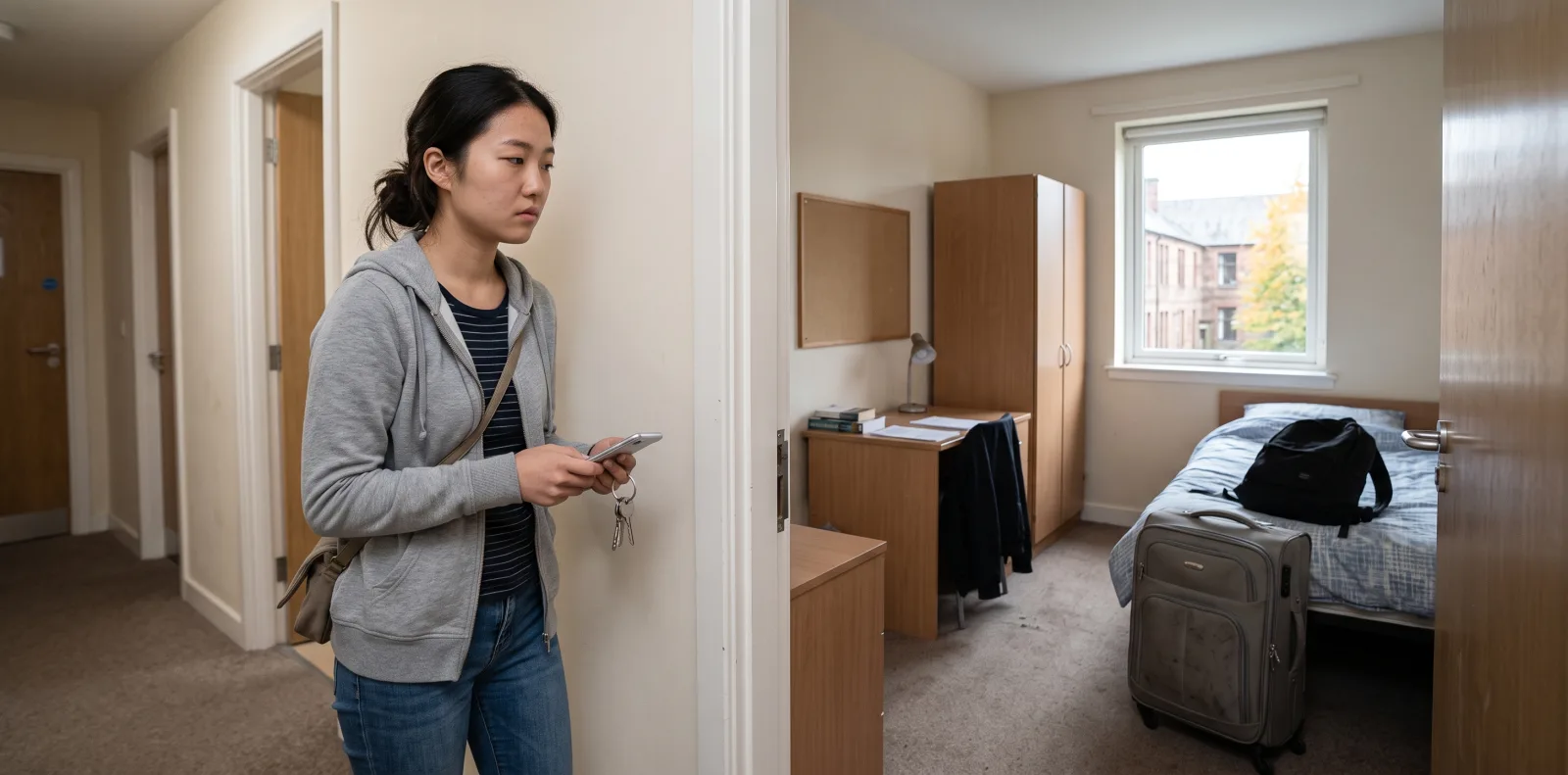
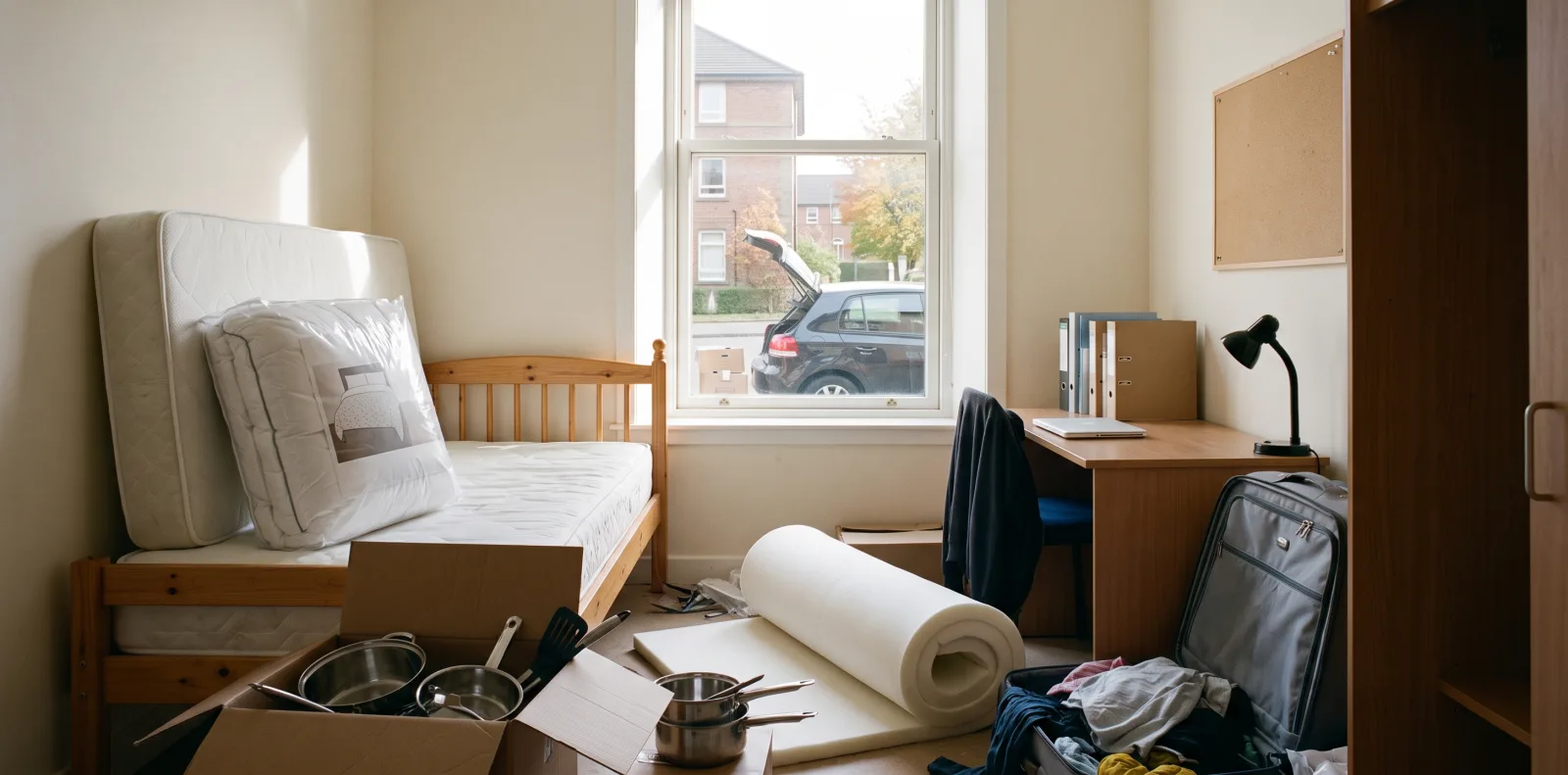
Every September, the same scene plays out on the same access roads. A hatchback creeps along a one-way system built for delivery vans, its boot bungee-corded shut over a rice cooker, three duvets, a printer nobody will plug in, and an ironing board bought specifically for this occasion. Wedged in the back seat between a box of tinned food and a desk lamp shaped like an owl sits the actual student, wondering why nobody checked what the room already has.
This is an information failure more than a packing failure. Universities publish what a standard room contains, and fire safety rules dictate what cannot come through the door, yet the same over-stuffed cars turn up every year because that information sits on page four of a portal nobody reads until the night before.
What follows is a packing list built around what halls actually provide, what they explicitly ban, and what to pack for halls that your parents will lovingly insist on and you will quietly return at Christmas.
What halls give you, and what fire rules take away#
Before buying anything, two documents matter more than any student blog: your accommodation's own "what's provided" inventory, and its fire safety policy.
Most standard halls rooms come with a bed, mattress, desk, chair, and some form of wardrobe or shelving, alongside a wash basin in some rooms and an en-suite bathroom in others. Shared-kitchen halls, still the most common set-up at UK universities, typically supply large appliances such as an oven, hob, fridge-freezer and kettle in the communal kitchen, leaving students to bring their own pans, cutlery and food storage. En-suite halls without a shared kitchen sometimes provide a small kitchenette per flat instead, so what "the kitchen" means varies enormously between one hall and the next. That is the first thing to check, because a list written for a shared-kitchen catered hall is close to useless for a self-catered en-suite one.
Fire safety is stricter than most families expect. UK universities including UCL, Edinburgh, Liverpool and University of the Arts London all publish near-identical rules banning candles, incense and naked flames anywhere in halls, and restricting cooking appliances such as kettles, toasters and rice cookers to designated kitchen areas only, never bedrooms. These are not suggestions. Confiscation on discovery is standard, and a bedroom kettle is a common cause of an unwanted 3am fire alarm evacuating an entire block in the rain. Deep fat fryers and portable heaters are usually banned outright, given the fire load they add to a building full of first-time independent residents.
There is a third, quieter rule: electrical safety testing. Many universities require electrical items brought from home, from hairdryers to games consoles, to pass a Portable Appliance Test (PAT) before use, particularly anything over a year old. An item that fails gets removed until fixed or replaced, a five-minute inconvenience during welcome week that explains why an ancient desk lamp sometimes vanishes from a room within its first week.
Kitchen kit that earns its place in a shared kitchen#
Shared kitchens are ruthless environments. Unlabelled items disappear, delicate items get broken by someone else's washing-up technique, and anything needing counter space competes with six other people's dinner. The kit worth bringing is small, sturdy and clearly yours.
A single decent saucepan and frying pan cover most student cooking, and Tupperware earns its keep daily, for batch-cooked meals and for claiming fridge shelf space with a name written on the lid, less petty than it sounds once food theft becomes a live issue in a flat of eight strangers. A sharp knife, a chopping board, and basic cutlery and crockery for one matter more than any gadget, because most students under-equip for cooking and over-equip for entertaining. A few sealed containers for dry goods, to keep mice and flatmates' fingers out of your pasta, complete the kit without a second trip to the car.
Bedroom items that matter more than people expect#
The bedroom items that get skipped are rarely exciting, which is exactly why they get skipped. A mattress protector is one of the highest-value items on any list: halls mattresses have hosted several years of previous residents, and a protector makes the end-of-tenancy inspection less stressful. Two sets of bedding, not one, means you are never sleeping on a bare mattress while your only duvet cover sits mid-wash in a shared laundry room, which can take most of an afternoon.
An extension lead with surge protection solves the near-universal problem of halls rooms having two sockets and six devices each. A desk lamp helps on nights the overhead light feels too harsh, and an eye mask matters more than expected in halls facing a street lamp or a courtyard where people are still talking at 2am. A small drawer lock sounds paranoid until the first missing charger of term.
Paperwork and admin items people forget#
Nobody packs excitedly for admin, which is precisely why it gets left behind. Photo ID and your university offer or enrolment confirmation are non-negotiable for checking in on day one, and a printed copy of your accommodation contract is worth having even if everything was signed online, in case wifi drops on the day you need to reference a clause.
Contents insurance is the item families most often skip and regret. Student-specific insurers such as Endsleigh routinely note that halls contents cover is not automatic, and a standard home policy rarely extends to a room in a shared building. A laptop and phone are most students' single most expensive possessions, travelling into a building full of strangers with keys to communal areas. A copy of your GP registration details and your accommodation's out-of-hours emergency number complete a folder that takes ten minutes to assemble and saves a bad afternoon later.
The classic over-packed items, and why they never leave the cupboard#
Every halls corridor contains a near-identical graveyard of good intentions. The ironing board is the flagship example: most students buy wrinkle-release spray or hang things in a steamy bathroom instead, and a board too big for a single wardrobe becomes furniture nobody asked for. A full dinner service for one person mostly nests unused, since one bowl, one plate and one mug cover 90% of student meals.
A printer feels essential to parents who remember university before online submission portals; most UK courses now handle coursework digitally, and campus libraries offer cheap printing for the rare physical handout. A stack of set texts "just in case" usually loses to the library and second-hand copies bought once a reading list is confirmed. An entire wardrobe for every occasion runs into halls storage reality: rooms are small, and two weeks of rotating basics plus one smart outfit covers almost everyone.
| Category | Worth packing | Commonly over-packed | Why it gets left unused |
|---|---|---|---|
| Kitchen | One pan, one knife, Tupperware, drying rack | Full dinner service, matching kitchen gadgets | Shared kitchen space and storage is limited; items get lost or broken |
| Bedroom | Mattress protector, two bedding sets, extension lead | Ironing board, spare furniture, second desk lamp | Rooms are small; halls already provide the basics |
| Laundry | Mesh wash bag, travel-size detergent, drying rack | Full-size iron, large drying rack, bulk detergent | Communal laundry rooms are cramped and shared with a flat or floor |
| Paperwork | ID, contract copy, insurance details, GP info | Printed lecture notes, physical dictionaries, printer | Most admin and coursework is now digital and library-supported |
| Comfort | Photos, one soft blanket, a few favourite mugs | Entire book collection, childhood toy box, spare crockery set | Emotional value is real but storage space is not |
Small comfort items worth the suitcase space#
Not everything on a sensible list needs to be strictly functional. Homesickness is common and rarely discussed honestly; students moving into halls consistently report the first weeks bring a mix of excitement and low-grade grief for a bedroom that no longer feels like theirs. A handful of printed photos, one blanket from home, and a couple of favourite mugs cost almost no suitcase space and do real work on a bad Tuesday in November. A small speaker for a room that otherwise sounds like a corridor, and a plant that survives on neglect, help a generic room feel like a chosen one. None of this appears on a university's checklist, yet it is what students say they were glad they brought.
Questions students and parents actually ask#
Do I need to bring my own kettle and toaster?#
Almost never. Most shared kitchens already have a kettle, toaster and microwave, and bedroom versions are banned under fire safety rules at most UK universities anyway.
Are fairy lights and candles allowed in halls?#
Fairy lights are usually fine with a valid safety mark (CE or UKCA), kept clear of exits and smoke detectors. Candles, incense and any naked flame are banned in essentially every UK hall, "for display only" or not.
How much bedding should I actually bring?#
Two full sets. One is always mid-wash on the day you need it, and a busy shared laundry room can eat an entire afternoon per cycle.
Do I need contents insurance for a halls room?#
Worth arranging. Standard family home insurance rarely covers a room in a separate building, and laptops, phones and bikes are common targets for opportunistic theft in busy corridors. Student-specific insurers price for exactly this gap.
What actually needs PAT testing?#
Policies differ, but electrical items from home over a year old, such as hairdryers, straighteners or games consoles, are commonly required to pass a Portable Appliance Test. Failed items are removed until fixed or replaced, so check your hall's process during welcome week.
Is it worth bringing a printer?#
Rarely. Most UK coursework runs through online submission portals, and campus libraries offer cheap printing for the occasional physical document, usually cheaper than owning and eventually disposing of a personal printer in a room with no space for one.
What if my room is smaller than I expected?#
Check the published inventory and room dimensions before buying storage, since under-bed boxes only help if they match the actual space. Most halls let items go back to a car or home in the first week if the fit is wrong, so treat the first few days as a trial, not a fixed layout.
What do halls definitely not provide?#
Kitchen utensils, cookware, bedding and toiletries are almost never included, even where large appliances are supplied. Always check your own accommodation's list, since provision varies between universities, private providers and room types.