
The timer is not the thing that is broken. The interval is#
Pomodoro is elegant. Set a timer for 25 minutes, work on one thing, stop, take a five-minute break, repeat, and take a longer break after four rounds. Francesco Cirillo devised it as a student in the late 1980s, named it after a tomato-shaped kitchen timer, and it has survived four decades largely unchanged.
It survived because it solves a real problem: starting. A 25-minute commitment is small enough to accept when the task feels enormous, and that is genuinely valuable.
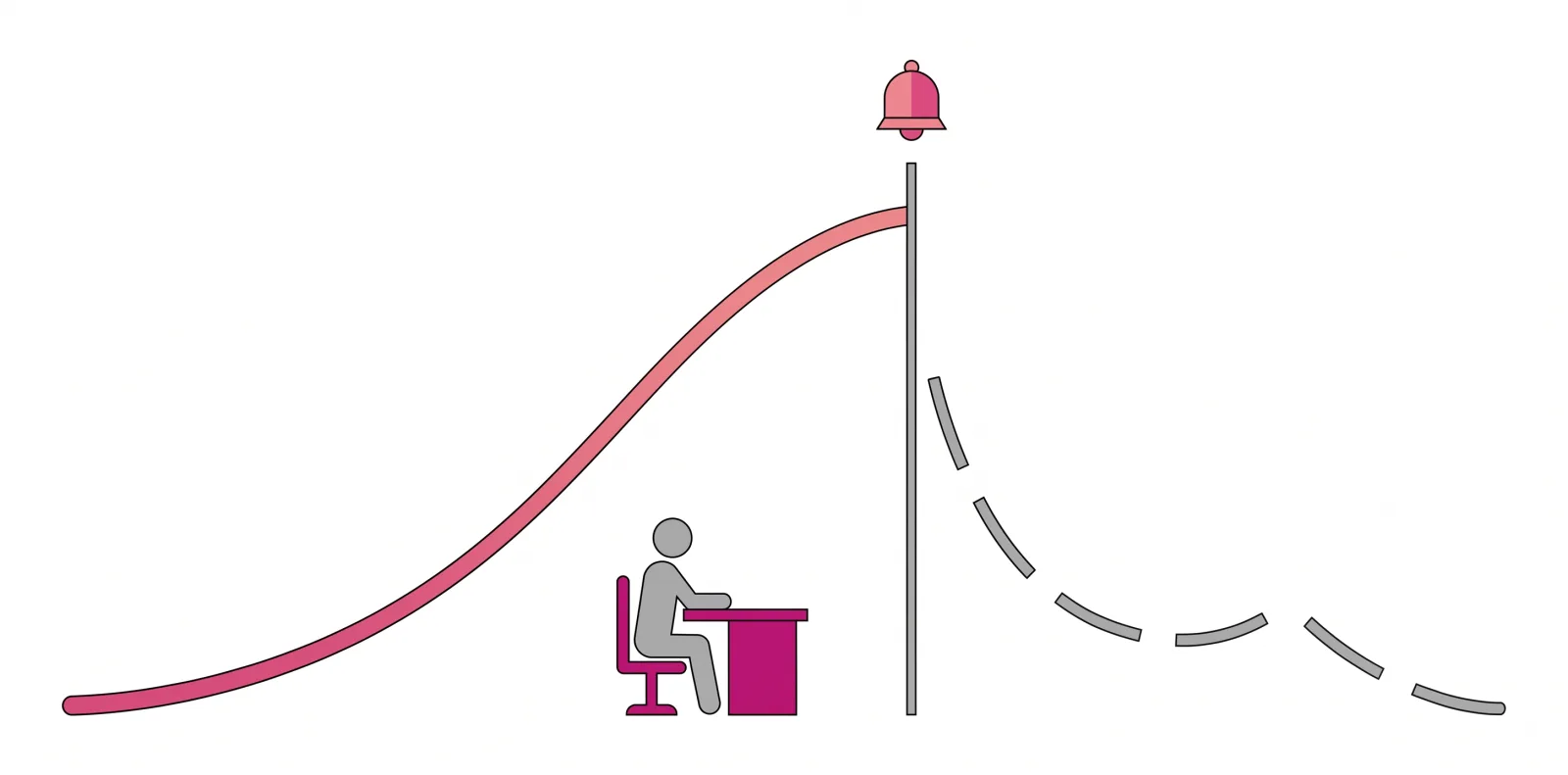
The trouble is that 25 minutes was not derived from anything. It was the timer Cirillo had. And for a large share of academic work, a bell that stops you at 25 minutes arrives precisely when you have finally got the problem loaded into your head.
What the attention research actually shows#
Gloria Mark, a researcher at the University of California, Irvine, has been measuring how long people hold attention on a single screen for about two decades. In the early 2000s the average was around two and a half minutes. By the 2020s it was 47 seconds, and several independent studies between 2014 and 2020 found figures between 44 and 50 seconds.
The same body of work produced the figure people usually quote: after an interruption, it takes roughly 23 minutes to return to the original task. That number does not mean 23 minutes of staring into space. It means the work in between, the detour, and the slow climb back into context.
Sophie Leroy, at the University of Washington, named the underlying mechanism in 2009: attention residue. When you switch away from an unfinished task, part of your attention stays with it. You arrive at the new task carrying a fragment of the old one, which is why the second task feels harder than it should.
Put those together and the problem with a 25-minute block becomes clear. If re-entry into a demanding task costs a meaningful chunk of time, then any system that ends sessions on a schedule is paying that cost repeatedly, by design.
When Pomodoro genuinely works#
It would be unfair to write the technique off, because it does some things very well.
It works for tasks with low re-entry cost. Filing references, formatting a bibliography, answering emails, doing flashcards, tidying data. You can stop and start these almost freely.
It works when the enemy is avoidance rather than distraction. If you have been circling a task for three days, a 25-minute commitment is often the only thing small enough to accept.
It works for people who overwork, because the structure enforces breaks. Students who study until they feel ill do not need permission to focus longer.
And it works as a measurement tool. Counting completed intervals for a week tells you how much real work you actually do, which is usually a sobering number and a useful one.
Where it fails is in sustained cognitive work: proofs, essays, debugging, statistical analysis, close reading. Those tasks have a loading phase, and 25 minutes is often most of it.
Four alternatives, matched to the task#
| Method | How it runs | Best for | The catch |
|---|---|---|---|
| Task-based blocks | Work until a defined unit is finished, not until a time elapses. Break when you hit the boundary | Essays, problem sets, coding, analysis | Needs honest scoping. An undefined task expands to fill the day |
| Long blocks with soft ends | 90 minutes with no alarm, stop when attention genuinely fades | Reading, writing, proofs, dissertation work | Easy to drift. Pair with a written goal for the block |
| Pomodoro, unchanged | 25 on, 5 off, four rounds then a longer break | Admin, flashcards, references, task avoidance | Interrupts deep work at the worst point |
| Two-minute start rule | Commit only to opening the file and doing two minutes. No timer, no session plan | Anything you have been avoiding | Not a work system. It is a starting system |
The framing that helps most is to stop asking how long you should work and start asking how expensive it is to put this task down. Cheap to resume means short blocks are fine. Expensive to resume means protect the block.
Protect the start, not the middle#
Most people try to defend the middle of a work session. The vulnerable part is the beginning.
The first ten to fifteen minutes of demanding work feel worse than the rest, because you are reconstructing context: where you got to, what you were trying to prove, what the variable was called. That reconstruction is unpleasant and produces nothing visible, which is exactly when the phone becomes interesting.
Two things help. The first is leaving yourself a note at the end of every session saying what you were about to do next, in one sentence, in plain language. Reading that sentence collapses the loading phase from fifteen minutes to about two.
The second is deliberately stopping mid-task rather than at a clean finish. Stopping at a natural endpoint feels satisfying and makes restarting harder, because you face a blank next step. Stopping mid-sentence or mid-function leaves an obvious handhold. Writers have used this trick for a century.
Self-interruption is the bigger problem#
The attention research contains one finding that changes where you should spend effort: a large share of interruptions are self-generated. Nobody messaged you. You reached for the phone.
That makes notification settings only half a solution. The other half is removing the option, which usually means physical distance. A phone in another room is not equivalent to a phone face down on the desk, because the second one is a decision you have to make repeatedly and the first is a decision you made once.
The same applies to browser tabs. Twenty open tabs is not a filing system, it is twenty invitations.
If you take one thing from the interruption literature, make it this: the cost of a distraction is not the length of the distraction. Thirty seconds on a phone can cost far more than thirty seconds, which is why the arithmetic of a quick check never works out.
Build the session around the task, not the clock#
A workable default for academic work, assuming a task you cannot cheaply put down.
Write one sentence naming what done looks like for this session. Not the module, not the essay. The specific next thing.
Remove the phone from the room and close everything not needed for that sentence.
Work without a timer until attention genuinely fades, which for most people falls somewhere between 45 and 90 minutes rather than at any fixed point.
Break properly. A break spent scrolling is not a break, because the attention system does not get to reset. Walking, eating something, staring out of a window and doing nothing all work better and feel worse, which is a pattern you will notice throughout this subject.
Before stopping, write the one-sentence note for next time.
That is five steps, none of them requiring an app, and it takes the idea Pomodoro got right, which is that sessions need a defined scope, and drops the part it got arbitrarily, which is the number 25.
Measure sessions, not hours#
One habit worth keeping from Pomodoro is the counting, applied to something more useful than intervals.
At the end of each week, write down how many sessions of genuinely focused work you completed. Not hours at a desk, which includes the forty minutes spent looking for a pen and the afternoon spent reorganising a folder. Sessions in which you produced something.
Most people are startled by the number the first time they do this, and the surprise is the useful part. It converts "I need more discipline" into "I managed four sessions and I need six", which is an arithmetic problem with obvious next steps rather than a verdict on your character.
Frequently asked questions#
Is the Pomodoro technique bad? No. It is a general-purpose tool applied to tasks with very different resumption costs. For admin and for beating avoidance it is genuinely good. For deep cognitive work it interrupts you at the wrong moment.
Where does the 23-minute figure come from? Research led by Gloria Mark at the University of California, Irvine, on how long people take to return to an original task after an interruption. It includes the detour and the recovery, not 23 minutes of doing nothing.
Is it true that attention spans are 47 seconds now? That is the average time people spend on a single screen before switching, measured across about two decades of observational studies. It is not a measure of how long a human being can concentrate. People still read novels for hours.
How long should a study block be? Long enough to get past the loading phase and short enough that quality holds. For most students that lands between 45 and 90 minutes for demanding work, and much shorter for routine tasks. Use the task's resumption cost to decide, not a rule.
What should I do during breaks? Something that is not another screen. Walking, stretching, eating, sitting still. Scrolling during a break gives the attention system more of the same input it was just recovering from.
Does music help me focus? For repetitive work, often yes. For reading and writing, music with lyrics in a language you understand measurably impairs comprehension, and the impairment is larger than people expect because they do not notice it happening.
I can't focus for 25 minutes, let alone 90. Where do I start? With the two-minute start rule and nothing else for a fortnight. Length comes back with practice, but only if the starting habit exists first. Trying to jump straight to 90-minute blocks is how people conclude they are incapable of focus.